
Context:
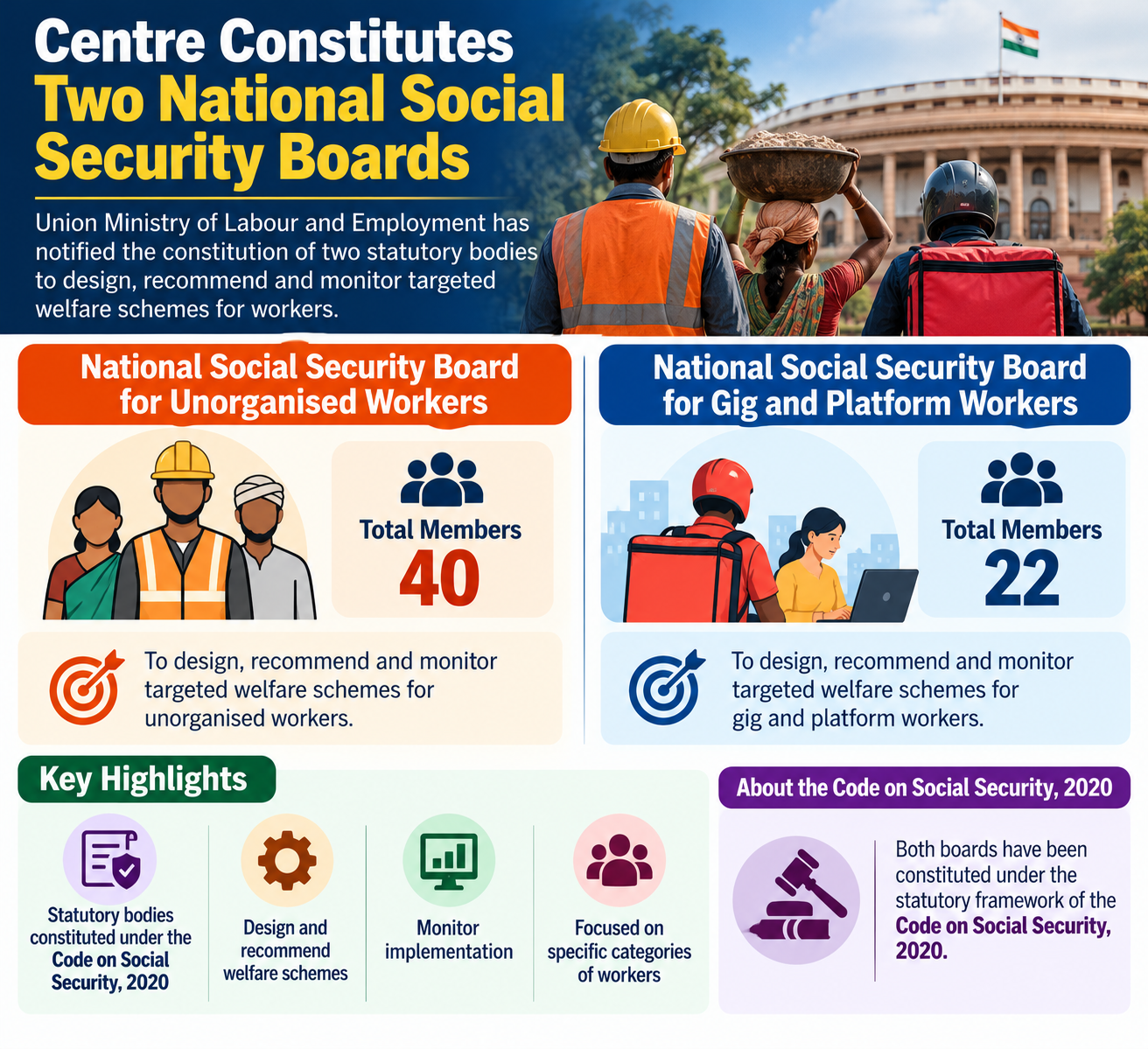
Recently, the Union Ministry of Labour and Employment notified the constitution of two statutory bodies: the National Social Security Board for Unorganised Workers, comprising 40 members, and the National Social Security Board for Gig and Platform Workers, comprising 22 members. These boards aim to design, recommend and monitor targeted welfare schemes for different categories of workers.
About the National Social Security Boards:
The both boards have been constituted under the statutory framework of the Code on Social Security, 2020. Their major functions include:
-
-
- Recommending suitable social security schemes for unorganised, gig and platform workers.
- Advising the Union Government on the administration of the Social Security Code.
- Monitoring the implementation of welfare schemes.
- Reviewing state-level record-keeping mechanisms and expenditure from relevant funds.
- Recommending measures to improve social security coverage.
- Both boards are required to meet at least three times a year. Union Labour and Employment Minister Mansukh Mandaviya will serve as the chairman of both boards, while the Union Labour Secretary will be the vice-chairperson. Their membership includes representatives from Central and State governments, aggregator companies, employers, trade unions and civil society organisations.
- Recommending suitable social security schemes for unorganised, gig and platform workers.
-
About Code on Social Security, 2020:
The Code on Social Security, 2020, consolidates and simplifies existing social security laws and aims to extend social protection to organised and unorganised workers.
Important provisions include:
-
-
- Section 6: Provides for the constitution of the National Social Security Board for unorganised workers and State-level boards.
- Section 109: Empowers the Central Government to formulate social security schemes for unorganised workers.
- Section 113: Provides for registration of unorganised, gig and platform workers to facilitate access to welfare benefits.
- Section 114: Empowers the Central Government to formulate social security schemes for gig and platform workers, covering life and disability insurance, accident insurance, health and maternity benefits, old-age protection and crèche facilities.
- Section 6: Provides for the constitution of the National Social Security Board for unorganised workers and State-level boards.
-
About Gig and Platform Workers:
-
-
- Gig Workers: Individuals undertaking work arrangements outside the traditional employer-employee relationship, such as freelancers and independent service providers.
- Platform Workers: Individuals engaged in work through online platforms, such as food delivery partners and app-based drivers.
- Unorganised Workers: Workers engaged in home-based, self-employed or wage-based activities in the unorganised sector.
- Gig Workers: Individuals undertaking work arrangements outside the traditional employer-employee relationship, such as freelancers and independent service providers.
-
Significance of the Development:
-
-
- Social Security Coverage: Extends institutional support to workers who often lack health insurance, pensions and accident protection.
- Recognition of the Gig Economy: Recognises changing employment patterns and the welfare requirements of digital platform workers.
- Institutional Coordination: Brings governments, employers, aggregators and workers' organisations onto a common platform.
- Shared Responsibility: Encourages aggregator companies to contribute towards workers' social security.
- Improved Welfare Delivery: Monitoring and reviewing welfare schemes can strengthen transparency and accountability.
- Social Security Coverage: Extends institutional support to workers who often lack health insurance, pensions and accident protection.
-
Conclusion:
The constitution of these boards represents an important step towards inclusive social protection in India's changing labour market. However, their success will depend on effective implementation, adequate financial resources and the actual delivery of benefits to workers.