
SIPRI Report: India Second Largest Arms Importer (2021–25)
Context:
A recent report by the Stockholm International Peace Research Institute (SIPRI) revealed that India remained the world’s second-largest importer of major arms between 2021 and 2025.
Key Findings of the SIPRI Report:
The SIPRI analysis provides several important insights into global arms transfers and India’s position in the defence market.
-
-
- India ranked second globally in arms imports during 2021–25.
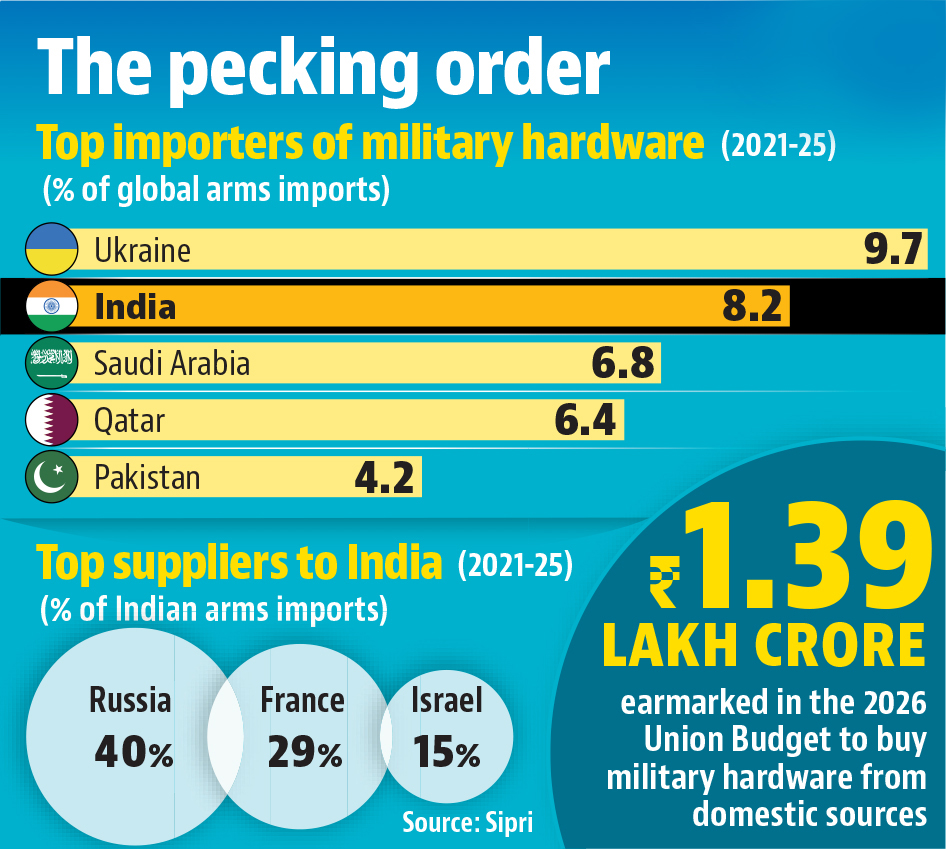
- The country accounted for 8.2% of global arms imports.
- India’s arms imports declined by about 4% compared to the previous five-year period (2016–2020).
- The decline is partly due to growing domestic defence production, though indigenous projects often face delays.
- India ranked second globally in arms imports during 2021–25.
-
Globally, Ukraine was the largest arms importer, followed by India, Saudi Arabia, Qatar and Pakistan.
Reasons for India’s High Arms Imports:
-
-
- Security Challenges in South Asia:
- India’s arms procurement is largely shaped by strategic threats from neighbouring countries. Tensions with China and Pakistan, including occasional military clashes, require constant upgrading of defence capabilities.
- These geopolitical factors drive India to acquire advanced military equipment such as fighter aircraft, submarines, missiles and surveillance systems.
- India’s arms procurement is largely shaped by strategic threats from neighbouring countries. Tensions with China and Pakistan, including occasional military clashes, require constant upgrading of defence capabilities.
- Modernisation of Armed Forces:
- India is undertaking extensive military modernisation programmes to upgrade ageing equipment across the Army, Navy and Air Force.
- Large procurement projects include:
- Combat aircraft purchases
- Advanced missile systems
- Submarines and naval platforms
- Many of these high-technology systems are still sourced from foreign suppliers.
- Combat aircraft purchases
- India is undertaking extensive military modernisation programmes to upgrade ageing equipment across the Army, Navy and Air Force.
- Limitations in Domestic Defence Production:
- technological gaps
- production delays
- limited industrial capacity
- As a result, imports remain necessary for advanced weapon systems.
- technological gaps
- Security Challenges in South Asia:
-
Changing Pattern of Defence Procurement:
-
-
- Declining Dependence on Russia:
- 70% during 2011–15
- 51% during 2016–20
- 40% during 2021–25
- 70% during 2011–15
- India has increasingly diversified its suppliers.
- Rise of Western Defence Partners:
- France
- United States
- Israel
- France
- This diversification reflects India’s strategy to reduce dependence on a single supplier and enhance strategic partnerships.
- Global Arms Trade Trends:
- United States remained the largest arms exporter with 42% of global exports.
- France ranked second, followed by Russia.
- Europe emerged as the largest arms-importing region, driven by security concerns related to the Ukraine conflict.
- United States remained the largest arms exporter with 42% of global exports.
- These trends reflect rising geopolitical tensions and increased defence spending worldwide.
- Declining Dependence on Russia:
-
Implications for India:
The findings highlight the need for India to accelerate defence indigenisation, strengthen domestic research and development, and enhance private sector participation in the defence manufacturing ecosystem.
Conclusion:
The SIPRI report shows that while India is striving to become self-reliant in defence production, it still remains one of the world’s largest arms importers due to its complex security environment and modernisation needs. Strengthening indigenous defence capabilities through technological innovation, industrial development and strategic partnerships will be crucial for India to reduce dependence on foreign military equipment in the long term.



