
Shekha Jheel Declared Ramsar Site
Context:
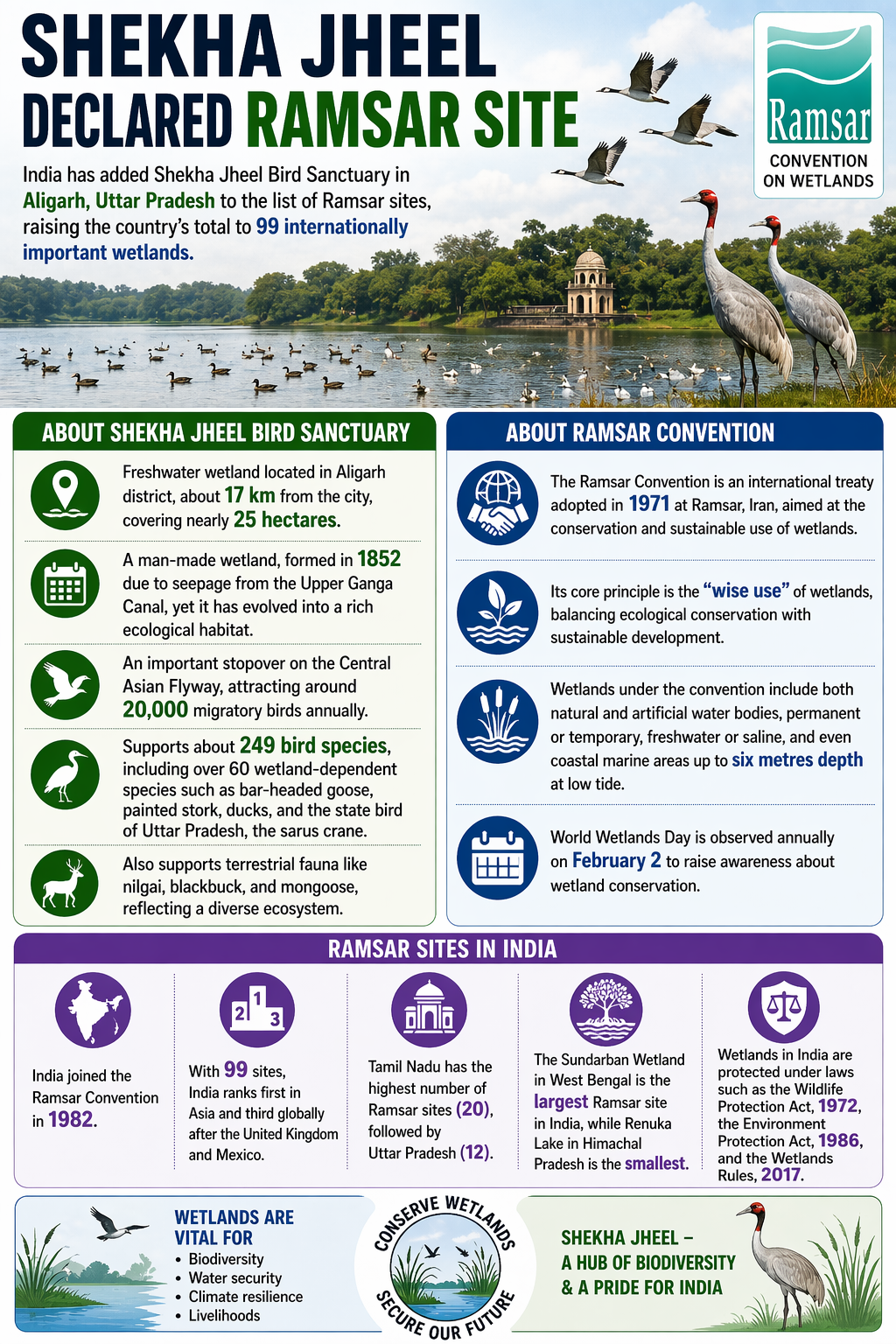
Recently, India has added the Shekha Jheel Bird Sanctuary in Aligarh, Uttar Pradesh to the list of Ramsar sites, raising the country’s total to 99 internationally important wetlands under the Ramsar Convention.
About Shekha Jheel Bird Sanctuary:
-
-
- Shekha Jheel is a freshwater wetland located in Aligarh district, about 17 km from the city, covering nearly 25 hectares. It is a man-made wetland, formed in 1852 due to seepage from the Upper Ganga Canal, yet it has evolved into a rich ecological habitat.
- It is an important stopover on the Central Asian Flyway, attracting around 20,000 migratory birds annually. The wetland supports about 249 bird species, including over 60 wetland-dependent species such as the bar-headed goose, painted stork, ducks, and the state bird of Uttar Pradesh, the sarus crane. It also supports terrestrial fauna like nilgai, blackbuck, and mongoose, reflecting a diverse ecosystem.
- Shekha Jheel is a freshwater wetland located in Aligarh district, about 17 km from the city, covering nearly 25 hectares. It is a man-made wetland, formed in 1852 due to seepage from the Upper Ganga Canal, yet it has evolved into a rich ecological habitat.
-
About Ramsar Convention:
-
-
- The Ramsar Convention is an international treaty adopted in 1971 at Ramsar, Iran, aimed at the conservation and sustainable use of wetlands.
- Its core principle is the “wise use” of wetlands, balancing ecological conservation with sustainable development. Wetlands under the convention include both natural and artificial water bodies, permanent or temporary, freshwater or saline, and even coastal marine areas up to six metres depth at low tide.
- World Wetlands Day is observed annually on February 2 to raise awareness about wetland conservation.
- The Ramsar Convention is an international treaty adopted in 1971 at Ramsar, Iran, aimed at the conservation and sustainable use of wetlands.
-
Ramsar Sites in India:
-
-
- India joined the Ramsar Convention in 1982.
- With 99 sites, India ranks first in Asia and third globally after the United Kingdom and Mexico.
- Tamil Nadu has the highest number of Ramsar sites (20), followed by Uttar Pradesh (12).
- The Sundarban Wetland in West Bengal is the largest Ramsar site in India, while Renuka Lake in Himachal Pradesh is the smallest.
- Wetlands in India are protected under laws such as the Wildlife Protection Act, 1972, the Environment Protection Act, 1986, and the Wetlands Rules, 2017.
- India joined the Ramsar Convention in 1982.
-
Conclusion:
The inclusion of Shekha Jheel as a Ramsar site highlights India’s growing commitment to wetland conservation and biodiversity protection. It strengthens ecological security, supports migratory bird conservation along global flyways, and reflects India’s balanced approach toward development and environmental sustainability.



