
Context:
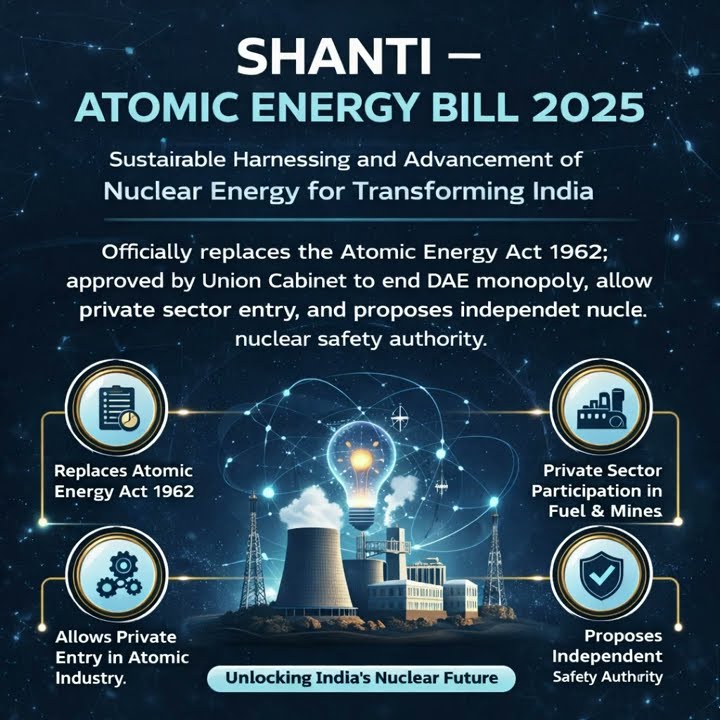
Recently, the Union Cabinet approved the Sustainable Harnessing and Advancement of Nuclear Energy for Transforming India (SHANTI) Bill, 2025, officially titled the Atomic Energy Bill, 2025. The proposed legislation aims to overhaul India’s nuclear sector by enabling private investment and supporting the government’s target of achieving 100 GW of nuclear power capacity by 2047.
Background:
At present, the Atomic Energy Act prohibits private entities and state governments from operating nuclear power plants, leaving the Nuclear Power Corporation of India Limited (NPCIL) as the sole operator of all 24 commercial nuclear reactors in the country.
Key Features of the SHANTI Bill:
-
- Private Sector Entry: The Bill authorises private companies to participate across the nuclear energy value chain—from power generation and reactor construction to equipment manufacturing, fuel fabrication, and other civil nuclear activities that were previously restricted under the Atomic Energy Act.
- Unified Legal Framework: It proposes to consolidate existing atomic energy legislation into a streamlined statute, facilitating licensing, safety compliance, dispute resolution, and regulatory clarity. This seeks to remove regulatory gaps that have historically deterred private investment.
- Foreign Direct Investment (FDI): The SHANTI Bill opens the sector to up to 49% foreign direct investment, enabling collaborations with global technology partners, strategic investors, and sovereign wealth funds.
- Liability and Insurance Reforms: The legislation contemplates revising nuclear liability provisions by capping equipment supplier liability and restructuring operator insurance through the Indian Nuclear Insurance Pool, aligning India’s framework with international norms to improve investor confidence.
- Regulatory Enhancements: The Bill envisages the establishment of a new independent nuclear safety authority and possibly a specialised nuclear tribunal to ensure robust oversight, transparency, and regulatory certainty.
- Private Sector Entry: The Bill authorises private companies to participate across the nuclear energy value chain—from power generation and reactor construction to equipment manufacturing, fuel fabrication, and other civil nuclear activities that were previously restricted under the Atomic Energy Act.
Strategic Significance:
-
- Meeting Energy and Climate Goals: India has set an ambitious target of achieving 100 GW of nuclear power capacity by 2047 to support its energy transition, decarbonisation pathway, and net-zero emissions target by 2070. As a stable baseload source, nuclear energy is critical in complementing renewable energy and reducing dependence on fossil fuels.
- Unlocking Investment and Innovation: The entry of private players is expected to unlock substantial capital inflows, accelerate the deployment of nuclear projects, and promote technological innovation, including in Small Modular Reactors (SMRs) and next-generation nuclear technologies.
- Boost to Domestic R&D: By permitting private participation in nuclear research and technological development, India aims to create a competitive ecosystem that fosters indigenous innovation, skill development, and intellectual property creation.
- Meeting Energy and Climate Goals: India has set an ambitious target of achieving 100 GW of nuclear power capacity by 2047 to support its energy transition, decarbonisation pathway, and net-zero emissions target by 2070. As a stable baseload source, nuclear energy is critical in complementing renewable energy and reducing dependence on fossil fuels.
Challenges Ahead:
-
- Liability and Insurance Framework: Effective reform of nuclear liability regimes remains crucial to reassure global technology providers and domestic investors who are cautious about exposure to nuclear risks.
- Regulation and Oversight: Establishing independent, credible regulators and adopting risk-based safety protocols will be essential to maintaining public trust and ensuring adherence to international safety standards.
- Long Lead Times: Nuclear power projects involve long gestation periods and high capital intensity, necessitating sustained policy stability, reliable financing mechanisms, and institutional capacity.
- Liability and Insurance Framework: Effective reform of nuclear liability regimes remains crucial to reassure global technology providers and domestic investors who are cautious about exposure to nuclear risks.
Conclusion:
The Cabinet’s approval of the SHANTI Bill, 2025 marks a historic shift in India’s nuclear policy—from a state-dominated model to a more inclusive, competitive, and innovation-driven framework. If enacted by Parliament and implemented effectively, the Bill could catalyse significant expansion in nuclear capacity, strengthen India’s energy security, and accelerate the country’s transition towards a low-carbon economy.



