
Context:
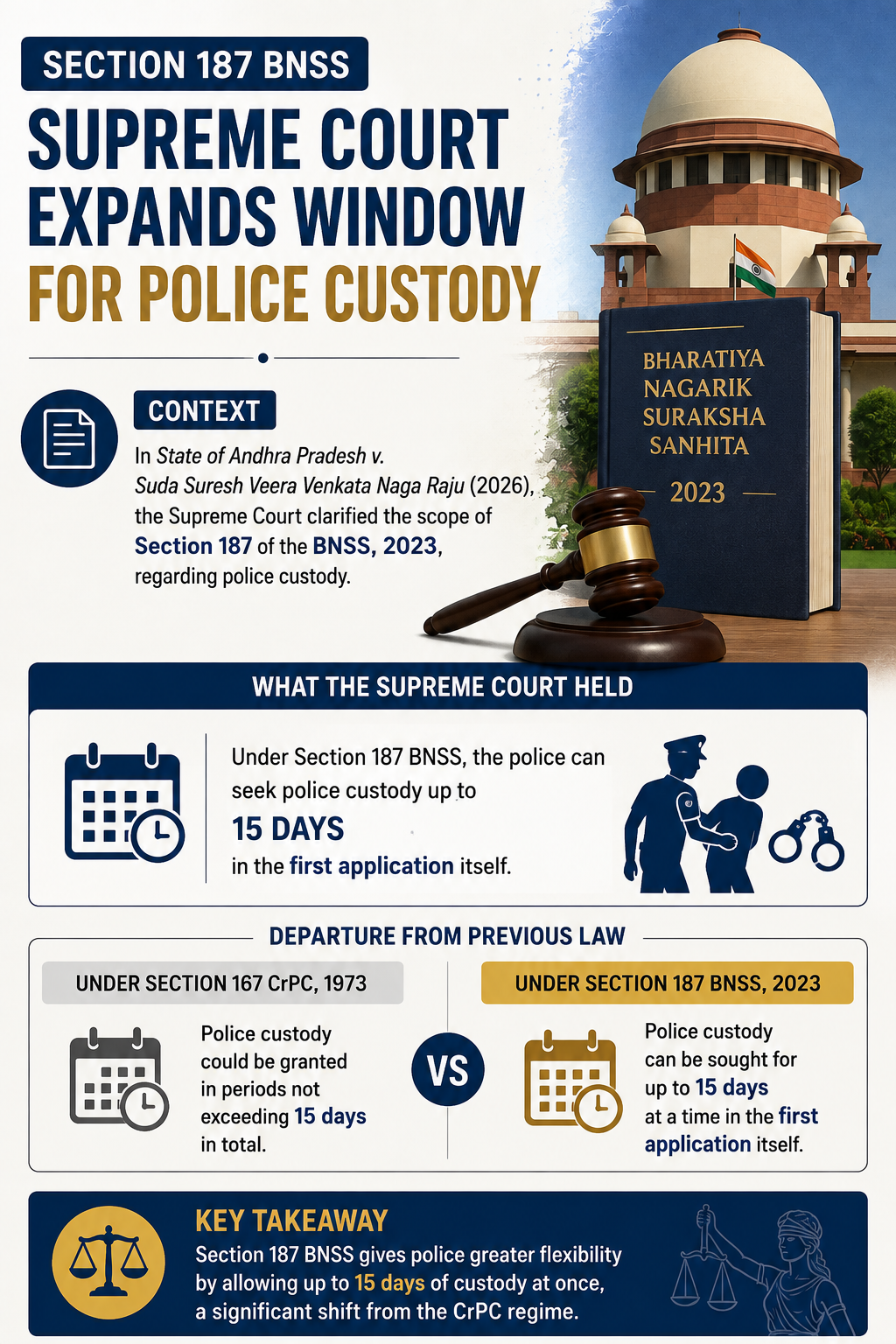
Recently, The Supreme Court, in State of Andhra Pradesh v. Suda Suresh Veera Venkata Naga Raju (2026), has clarified the scope of Section 187 of the Bharatiya Nagarik Suraksha Sanhita (BNSS), 2023, particularly regarding police custody. The judgment marks an important departure from the earlier position under Section 167 of the Code of Criminal Procedure (CrPC), 1973.
What is Section 187 BNSS?
Section 187 deals with remand when an investigation cannot be completed within 24 hours. It regulates police custody, judicial custody and statutory or default bail. While broadly corresponding to Section 167 CrPC, the BNSS introduces greater flexibility in the manner and timing of police custody.
Key observations by Court:
-
-
- Enlarged Window for Police Custody: The Supreme Court clarified that the maximum aggregate period of police custody remains 15 days. However, these 15 days need not necessarily be completed during the first 15 days of remand. Police custody may be sought in parts or phases during the initial 40 or 60 days, depending upon whether the applicable overall detention period is 60 or 90 days. Thus, the judgment changes the window for using police custody, not its maximum duration.
- Departure from the CrPC Position: Under the earlier CrPC framework, the decision in CBI v. Anupam J. Kulkarni generally restricted police custody to the first 15 days. Section 187 BNSS deliberately permits custody to be granted “in whole, or in parts”, thereby allowing investigators to seek custody later when circumstances justify it.
- Investigative Justification: The Court recognised that investigations may produce fresh facts, discoveries or new leads after the initial period of custody. A rigid rule preventing any further police custody after 15 days could, therefore, hamper effective investigation, evidence recovery and crime-scene reconstruction.
- Right to Counsel and Safeguards: The Court also considered Section 38 BNSS, which gives an accused the right to meet an advocate of choice during interrogation. However, this provision does not require the lawyer's continuous physical presence throughout the entire interrogation. At the same time, custodial powers remain subject to Article 21 and the protection of personal liberty. The Court rejected impractical requirements such as uninterrupted videography throughout transit, while recognising videography of interrogation and recoveries as an important safeguard.
- Six-Month Safeguard: Section 187 also protects accused persons in summons-cases triable by a Magistrate. If investigation remains incomplete for six months from arrest, the Magistrate must ordinarily stop further investigation unless continuation is justified by special reasons and the interests of justice.
- Enlarged Window for Police Custody: The Supreme Court clarified that the maximum aggregate period of police custody remains 15 days. However, these 15 days need not necessarily be completed during the first 15 days of remand. Police custody may be sought in parts or phases during the initial 40 or 60 days, depending upon whether the applicable overall detention period is 60 or 90 days. Thus, the judgment changes the window for using police custody, not its maximum duration.
-
Conclusion:
Section 187 BNSS represents a significant shift from the CrPC regime. Fifteen days remains the maximum aggregate police custody, but those 15 days may be divided and utilised within the initial 40 or 60 days. The provision consequently provides greater investigative flexibility while retaining judicial oversight and constitutional safeguards for personal liberty.



