
Context:
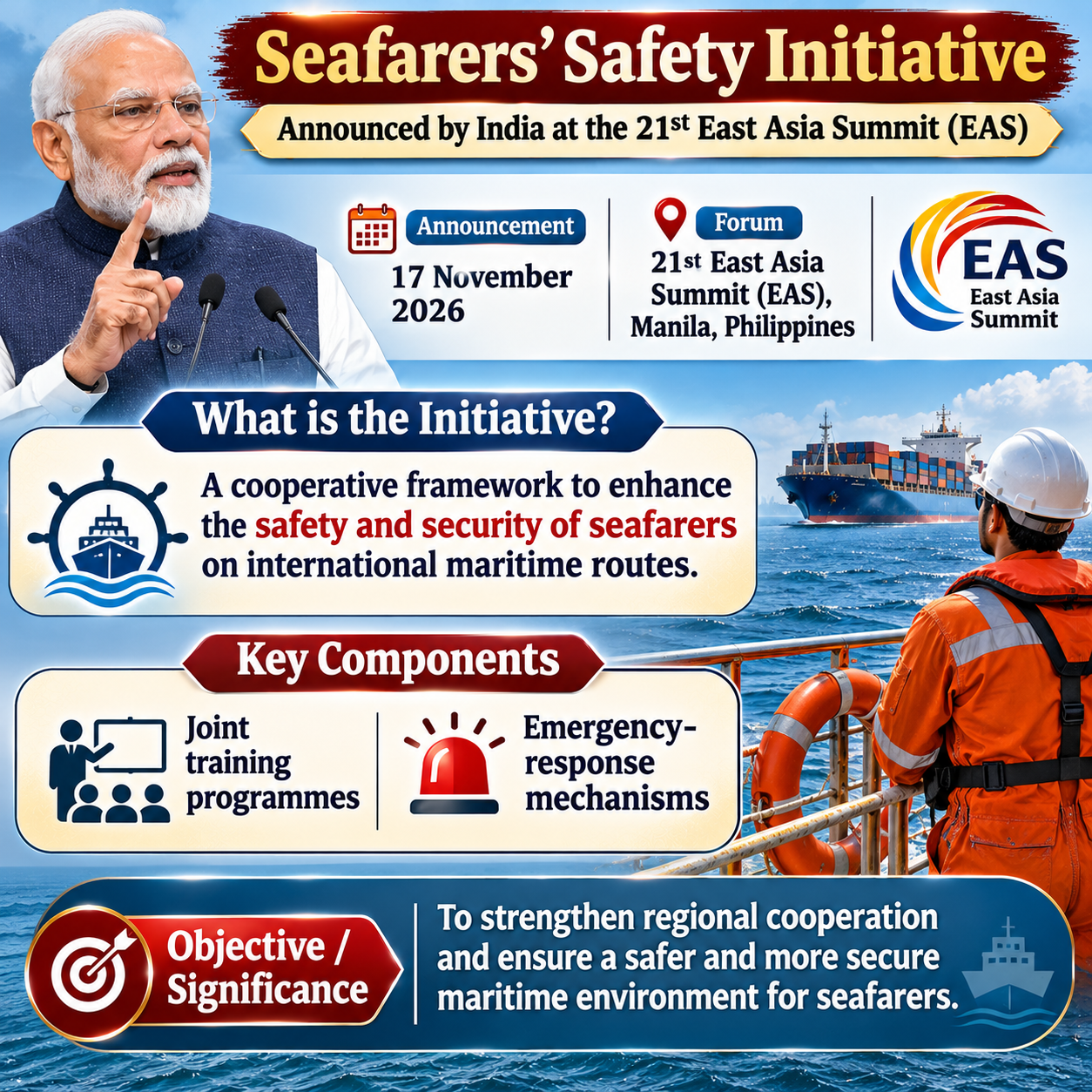
Recently, Prime Minister Narendra Modi announced the Seafarers’ Safety Initiative at the 21st East Asia Summit (EAS), held in Manila, Philippines, on 17 November 2026. The initiative aims to strengthen cooperation among participating countries through joint training programmes and emergency-response mechanisms to ensure the safety and security of seafarers working on international maritime routes.
About East Asia Summit (EAS):
-
-
- The East Asia Summit (EAS) is a leaders-led forum established in 2005 to promote dialogue and cooperation on strategic, political and economic issues in the Indo-Pacific region. The first summit was held in Kuala Lumpur, Malaysia.
- Nature: ASEAN-led regional forum.
- Chair: Rotates with the ASEAN Chair.
- Membership: 19 participating countries, including 11 ASEAN members and eight partners: India, China, Japan, South Korea, Australia, New Zealand, the USA and Russia.
- Key areas: Maritime security, regional stability, economic cooperation, connectivity and strategic dialogue.
- India's role: India is a founding participant and supports ASEAN centrality and a free, open, inclusive and rules-based Indo-Pacific.
- Nature: ASEAN-led regional forum.
- The EAS provides an important platform for India to strengthen its Act East Policy and regional engagement.
- The East Asia Summit (EAS) is a leaders-led forum established in 2005 to promote dialogue and cooperation on strategic, political and economic issues in the Indo-Pacific region. The first summit was held in Kuala Lumpur, Malaysia.
-
What is Seafarers?
Seafarers are professionals working aboard ships, including captains, marine engineers and crew members. They play a crucial role in international trade, as nearly 80% of global trade by volume is transported through maritime routes. However, geopolitical conflicts, piracy and attacks on merchant vessels have increased risks to their lives. India has over 3.2 lakh seafarers, the world's second-largest workforce after the Philippines, with more than 18,000 currently serving aboard vessels in West Asia.
India's Previous Initiatives:
The proposal builds upon India's earlier efforts, including the Seafarers Emergency Support Network, proposed at the BRICS Summit in September 2026 to facilitate distress alerts, medical assistance, family communication and evacuation. Further, India and Liberia established the Group of Friends on Safety and Security of Shipping and Seafarers on 25 September 2026 to strengthen international coordination.
Significance for India:
The initiative is significant for India's economic and strategic interests because maritime routes are essential for energy security, international trade and global supply chains. It strengthens India's maritime diplomacy, enhances cooperation with ASEAN countries and supports its SAGAR (Security and Growth for All in the Region) vision.
Challenges:
The major challenges include geopolitical rivalries, piracy, maritime terrorism, attacks on merchant vessels, inadequate emergency-response infrastructure and differences in maritime regulations among countries.
Way Forward:
India should promote joint maritime exercises, real-time information-sharing, stronger Coast Guard cooperation and common emergency-response protocols. Effective implementation of international maritime conventions and improved welfare, insurance and medical facilities for seafarers are also necessary.
Conclusion:
The Seafarers’ Safety Initiative represents an important step towards human-centric maritime security. Protecting seafarers is essential not only for safeguarding human lives but also for ensuring uninterrupted global trade and maritime stability. It reinforces India's commitment to regional cooperation, ASEAN centrality and a secure Indo-Pacific.