
Context:
Recently, The 25th Meeting of the Council of Heads of Government (CHG) of the Shanghai Cooperation Organisation (SCO) was held in Dushanbe, Tajikistan, on 20 October 2026. The meeting discussed regional economic cooperation, trade, connectivity, digital development and security challenges. India emphasised counter-terrorism, respect for sovereignty and inclusive economic growth.
About the Shanghai Cooperation Organisation (SCO):
-
-
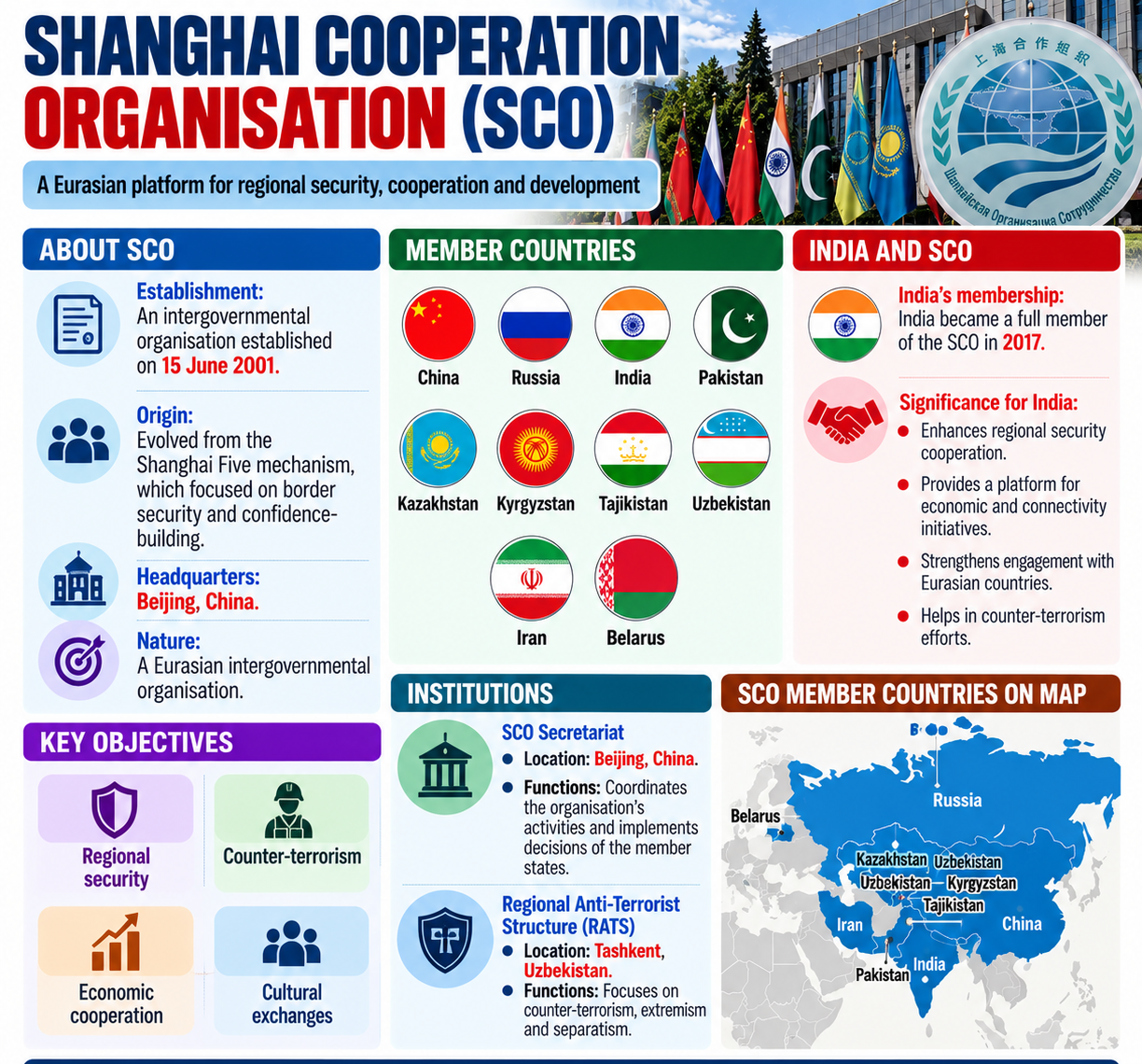
- The SCO is a Eurasian intergovernmental organisation established on 15 June 2001. It evolved from the Shanghai Five mechanism, which focused on border security and confidence-building.
- Headquarters: Beijing, China
- Members: China, Russia, India, Pakistan, Kazakhstan, Kyrgyzstan, Tajikistan, Uzbekistan, Iran and Belarus.
- India's membership: India became a full member in 2017.
- Objectives: Regional security, counter-terrorism, economic cooperation and cultural exchanges.
- Headquarters: Beijing, China
- The SCO Secretariat is located in Beijing, while its Regional Anti-Terrorist Structure (RATS) is based in Tashkent, Uzbekistan.
- The SCO is a Eurasian intergovernmental organisation established on 15 June 2001. It evolved from the Shanghai Five mechanism, which focused on border security and confidence-building.
-
Key Outcomes of the Meeting:
The meeting focused on strengthening cooperation among member states through economic and institutional initiatives.
-
-
- Economic cooperation: Adoption of an action plan for multilateral trade and economic cooperation for 2026–2030.
- Regional security: Emphasis on combating terrorism, extremism, separatism and terrorist financing.
- Connectivity: Discussion of transport corridors and improved regional trade links.
- Digital development: Promotion of digital technologies, innovation and digital trade facilitation.
- Institutional cooperation: Support for strengthening the SCO's institutional mechanisms and cooperation against transnational crime.
- Economic cooperation: Adoption of an action plan for multilateral trade and economic cooperation for 2026–2030.
-
India's Strategic and Economic Interests:
-
-
- Security: The SCO provides India with a platform to coordinate with Eurasian countries on terrorism, extremism and regional stability.
- Energy security: Central Asia's energy resources offer opportunities for diversifying India's energy supplies and accessing critical minerals.
- Connectivity: The International North–South Transport Corridor (INSTC) and Chabahar Port can improve India's access to Central Asian markets.
- Economic cooperation: India can expand trade in pharmaceuticals, information technology, agriculture and engineering services.
- Multilateral diplomacy: The SCO enables India to engage with major regional powers while advancing strategic autonomy and a multipolar international order.
- Security: The SCO provides India with a platform to coordinate with Eurasian countries on terrorism, extremism and regional stability.
-
Major Challenges:
-
-
- Despite its potential, the SCO faces several constraints:
- India–Pakistan tensions: Political and security disagreements restrict cooperation.
- India–China differences: Border disputes and strategic mistrust affect bilateral engagement.
- Connectivity barriers: Geopolitical tensions, sanctions and inadequate infrastructure complicate regional trade.
- Divergent interests: Member states have different strategic priorities.
- Implementation deficit: Collective declarations do not always translate into concrete outcomes.
- India–Pakistan tensions: Political and security disagreements restrict cooperation.
- India also stresses that connectivity initiatives must respect sovereignty and territorial integrity.
- Despite its potential, the SCO faces several constraints:
-
Way Forward:
The SCO should strengthen intelligence sharing and counter-terrorism cooperation, reduce trade barriers, improve customs procedures and promote transparent connectivity. Greater collaboration in digital public infrastructure, education, research and cultural exchanges can enhance regional integration. Clear implementation targets and periodic reviews are essential to improve institutional effectiveness.
Conclusion:
The Dushanbe meeting highlights the SCO's potential to promote regional stability and economic development. For India, constructive engagement with the organisation can advance its security, energy and connectivity interests. However, its long-term effectiveness will depend on mutual trust, respect for sovereignty and the implementation of practical, result-oriented initiatives.



