
Scheme for Promotion of Surface Coal/Lignite Gasification Projects
Context:
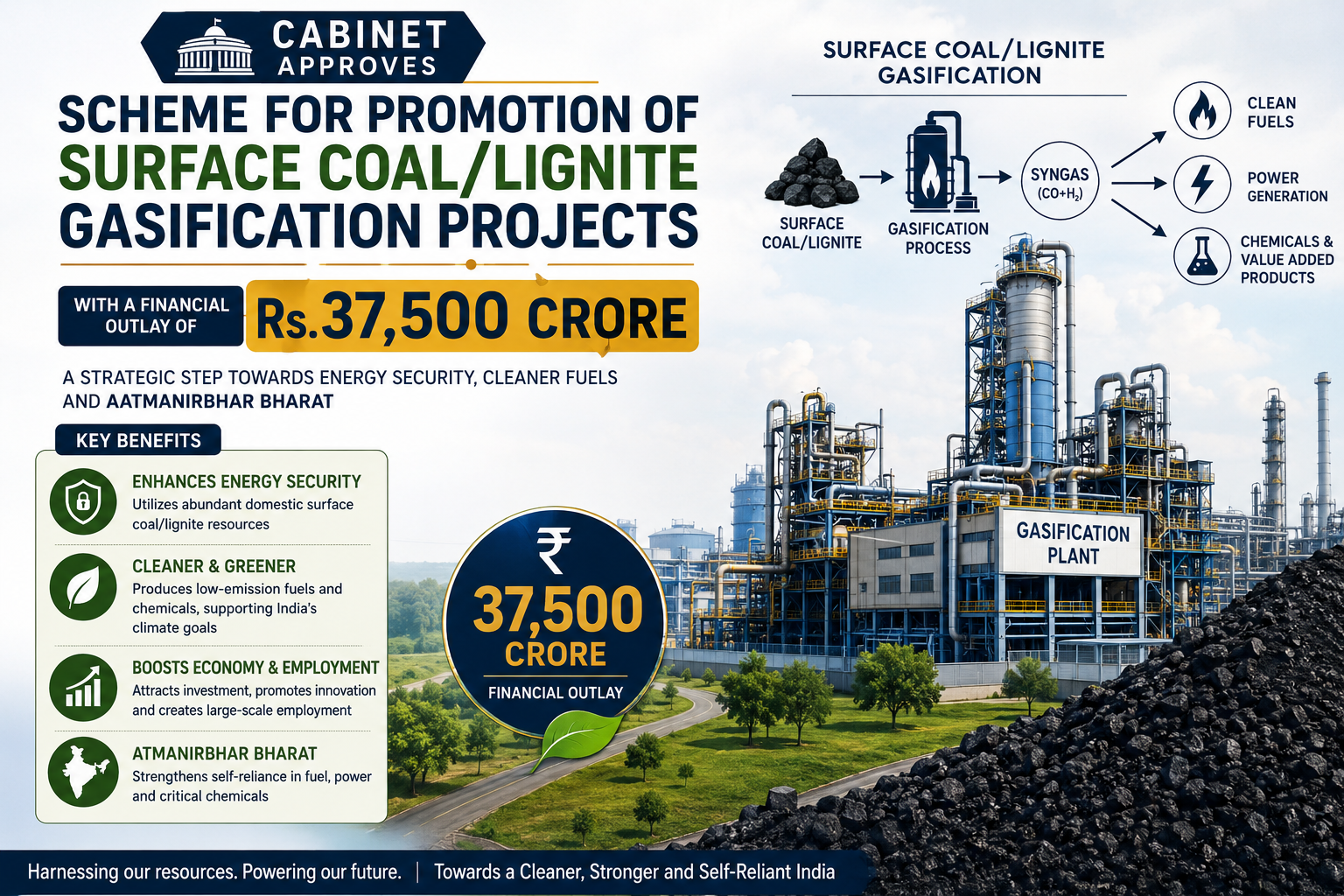
Recently, the Union Cabinet chaired by Prime Minister Narendra Modi approved the Scheme for Promotion of Surface Coal/Lignite Gasification Projects with a total financial outlay of ₹37,500 crore. The scheme is a major step towards accelerating India’s coal gasification programme and achieving the national target of gasifying 100 million tonnes of coal by 2030.
About Coal Gasification:
-
-
- Coal gasification is a process in which coal or lignite is converted into synthesis gas (syngas). Syngas mainly consists of carbon monoxide, hydrogen, and other gases. It can be used for producing fertilizers, methanol, ammonia, synthetic natural gas, fuels, and industrial chemicals. This technology enables diversified and cleaner use of coal resources.
- India currently imports large quantities of LNG, methanol, ammonia, urea, and coking coal. The import bill for these products reached nearly ₹2.77 lakh crore in FY2025, making the country vulnerable to international price fluctuations and geopolitical uncertainties. Coal gasification can help reduce this dependence by utilizing domestic coal resources more efficiently.
- Coal gasification is a process in which coal or lignite is converted into synthesis gas (syngas). Syngas mainly consists of carbon monoxide, hydrogen, and other gases. It can be used for producing fertilizers, methanol, ammonia, synthetic natural gas, fuels, and industrial chemicals. This technology enables diversified and cleaner use of coal resources.
-
Key Features of the Scheme:
The scheme includes several important provisions to encourage investment in coal gasification projects:
-
-
- Total financial support of ₹37,500 crore for new surface coal and lignite gasification projects.
- Incentives of up to 20% of the cost of plant and machinery.
- Target to facilitate gasification of nearly 75 million tonnes of coal and lignite.
- Financial assistance through a transparent competitive bidding process.
- Incentives to be released in four instalments linked to project milestones.
- A maximum incentive limit of ₹5,000 crore per project.
- Technology-neutral approach with encouragement for indigenous technologies.
- Extension of coal linkage tenure up to 30 years under the Non-Regulated Sector framework.
- Total financial support of ₹37,500 crore for new surface coal and lignite gasification projects.
-
Strategic and Economic Benefits:
-
-
- The scheme is expected to attract investments worth ₹2.5–3 lakh crore and generate nearly 50,000 direct and indirect jobs in coal-bearing regions. It will also increase government revenues through greater coal utilization and taxation.
- Coal gasification can strengthen India’s energy security by reducing imports of LNG, ammonia, methanol, and coking coal. It will also enhance domestic industrial capacity and promote indigenous technologies, thereby reducing dependence on foreign engineering firms.
- The scheme is expected to attract investments worth ₹2.5–3 lakh crore and generate nearly 50,000 direct and indirect jobs in coal-bearing regions. It will also increase government revenues through greater coal utilization and taxation.
-
Coal Distribution and Challenges in India:
-
-
- India’s coal reserves are mainly located in the Gondwana coalfields, which account for around 98% of total reserves. Major coal-producing states include Jharkhand, Odisha, Chhattisgarh, West Bengal, and Madhya Pradesh. Coal types include Anthracite, Bituminous, Sub-bituminous, Lignite, and Peat.
- Despite its importance, coal poses environmental and social challenges. Coal combustion contributes heavily to carbon emissions and pollution. Mining activities often cause land degradation, ecological damage, and displacement of tribal communities.
- India’s coal reserves are mainly located in the Gondwana coalfields, which account for around 98% of total reserves. Major coal-producing states include Jharkhand, Odisha, Chhattisgarh, West Bengal, and Madhya Pradesh. Coal types include Anthracite, Bituminous, Sub-bituminous, Lignite, and Peat.
-
Conclusion:
The Scheme for Promotion of Surface Coal/Lignite Gasification Projects represents a significant policy initiative for cleaner and diversified use of coal resources. By promoting syngas production and reducing import dependence, the scheme can strengthen India’s energy security and industrial growth. However, ensuring environmental sustainability and addressing social concerns will be essential for the long-term success of India’s coal sector.



