
SC Verdict on Stray Dogs and Expansion of Article 21
Context:
Recently, the Supreme Court delivered a landmark judgment expanding the scope of Article 21 (Right to Life and Personal Liberty). The Court ruled that citizens have the right to move freely in public spaces without fear of stray dog attacks, especially amid rising cases of dog bites and rabies deaths.
Key observation by Court:
-
-
-
Constitutional Interpretation of Article 21:
- The Court observed that Article 21 is not limited to mere survival but includes the right to live with dignity and safety. It held that children, elderly citizens, and the general public must be able to access roads, parks, schools, hospitals, and transport hubs without constant fear of physical harm.
- The judgment adds a new dimension to Article 21 by recognising “freedom from fear in public spaces” as part of the Right to Life.
- The Court observed that Article 21 is not limited to mere survival but includes the right to live with dignity and safety. It held that children, elderly citizens, and the general public must be able to access roads, parks, schools, hospitals, and transport hubs without constant fear of physical harm.
-
Balancing Human Rights and Animal Welfare:
- The Supreme Court clarified that stray dogs do not have an unrestricted right to occupy public areas if they pose a threat to human life. While Article 51A(g) promotes compassion towards living creatures, the Court stated that animal welfare cannot override citizens’ rights to safety, mobility, and dignity under Articles 19 and 21.
- Thus, the judgment attempts to balance humane treatment of animals with protection of public safety.
- The Supreme Court clarified that stray dogs do not have an unrestricted right to occupy public areas if they pose a threat to human life. While Article 51A(g) promotes compassion towards living creatures, the Court stated that animal welfare cannot override citizens’ rights to safety, mobility, and dignity under Articles 19 and 21.
-
-
-
-
-
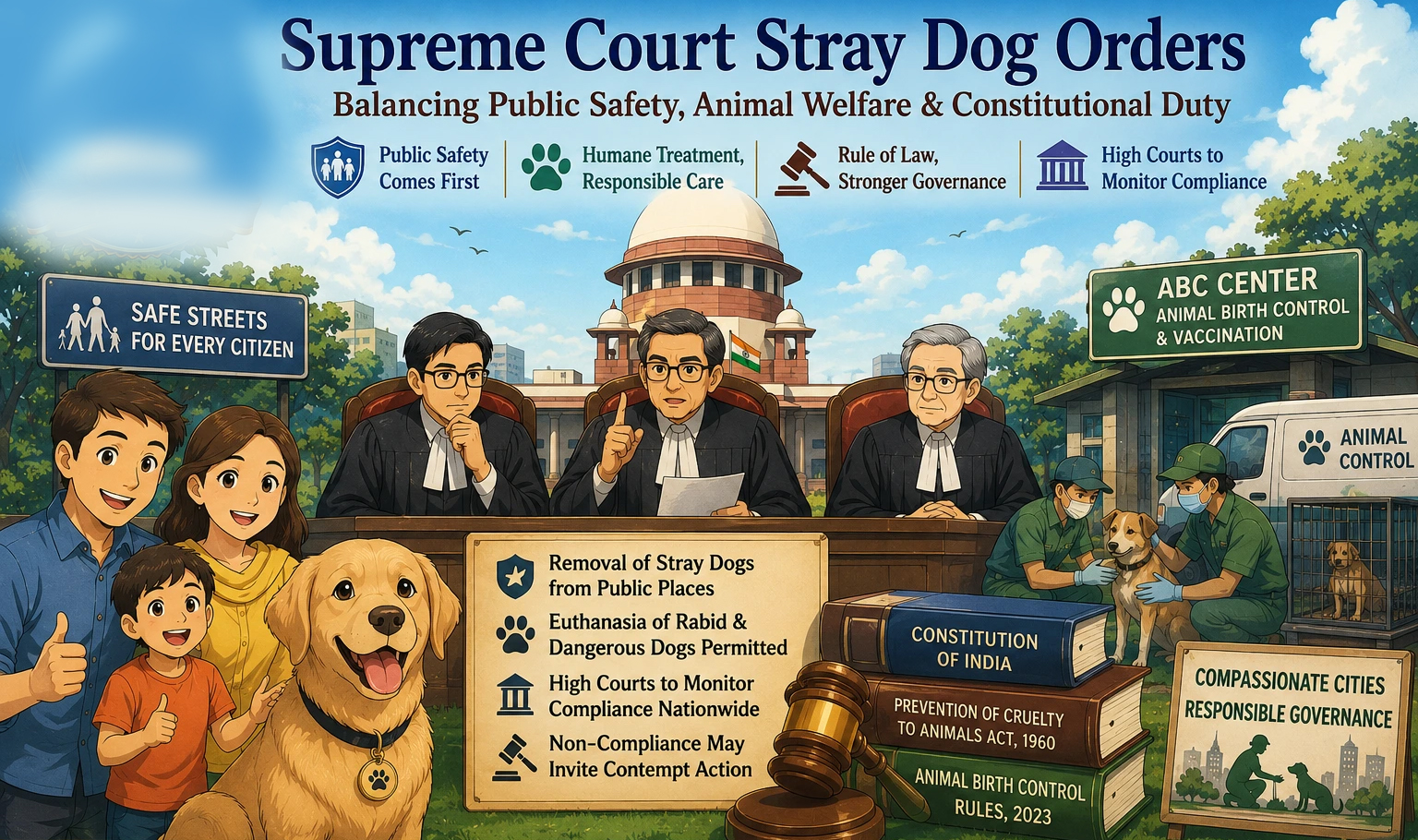
Declaration of “No-Release Zones”:
- The Court directed that stray dogs should not be present in high-footfall public spaces such as:
- Schools and colleges
- Hospitals and clinics
- Railway stations, airports, and bus depots
- Sports complexes and public parks
- Schools and colleges
- Dogs captured from these areas cannot be released back even after sterilisation and vaccination. Instead, they must be relocated to authorised shelters.
- The Court directed that stray dogs should not be present in high-footfall public spaces such as:
-
Euthanasia and Feeding Regulations:
- The judgment permits euthanasia only in legally permissible cases involving rabid, terminally ill, or demonstrably aggressive dogs, under expert veterinary supervision.
- The Court also prohibited indiscriminate feeding of stray dogs in public places and directed municipal authorities to create designated feeding zones.
- The judgment permits euthanasia only in legally permissible cases involving rabid, terminally ill, or demonstrably aggressive dogs, under expert veterinary supervision.
-
Accountability and Administrative Directions:
- The Court ordered every district to establish at least one fully functional Animal Birth Control (ABC) Centre. High Courts will monitor implementation through continuing mandamus proceedings. States and Union Territories must submit compliance reports by August 2026. Officials acting in good faith in stray dog management were also granted legal protection.
- The Court ordered every district to establish at least one fully functional Animal Birth Control (ABC) Centre. High Courts will monitor implementation through continuing mandamus proceedings. States and Union Territories must submit compliance reports by August 2026. Officials acting in good faith in stray dog management were also granted legal protection.
-
-
Way Forward:
India needs a One Health Approach integrating public health, animal welfare, and environmental management. Expansion of sterilisation drives, scientific waste disposal, public awareness, and partnerships with animal welfare organisations are essential.
Conclusion:
The judgment marks an important expansion of Article 21 by linking public safety with the Right to Life. It seeks to create a balanced framework that protects both human dignity and animal welfare through humane and scientific stray dog management.



