
SC Urges Abortion Limit Waiver for Minor Rape Survivors
Context:
Recently, the Supreme Court of India has urged the Union government to amend abortion laws to remove gestational limits for minor rape survivors. The observation came while hearing a curative petition regarding termination of a 30-week pregnancy of a 15-year-old survivor.
Key observations by Court:
-
-
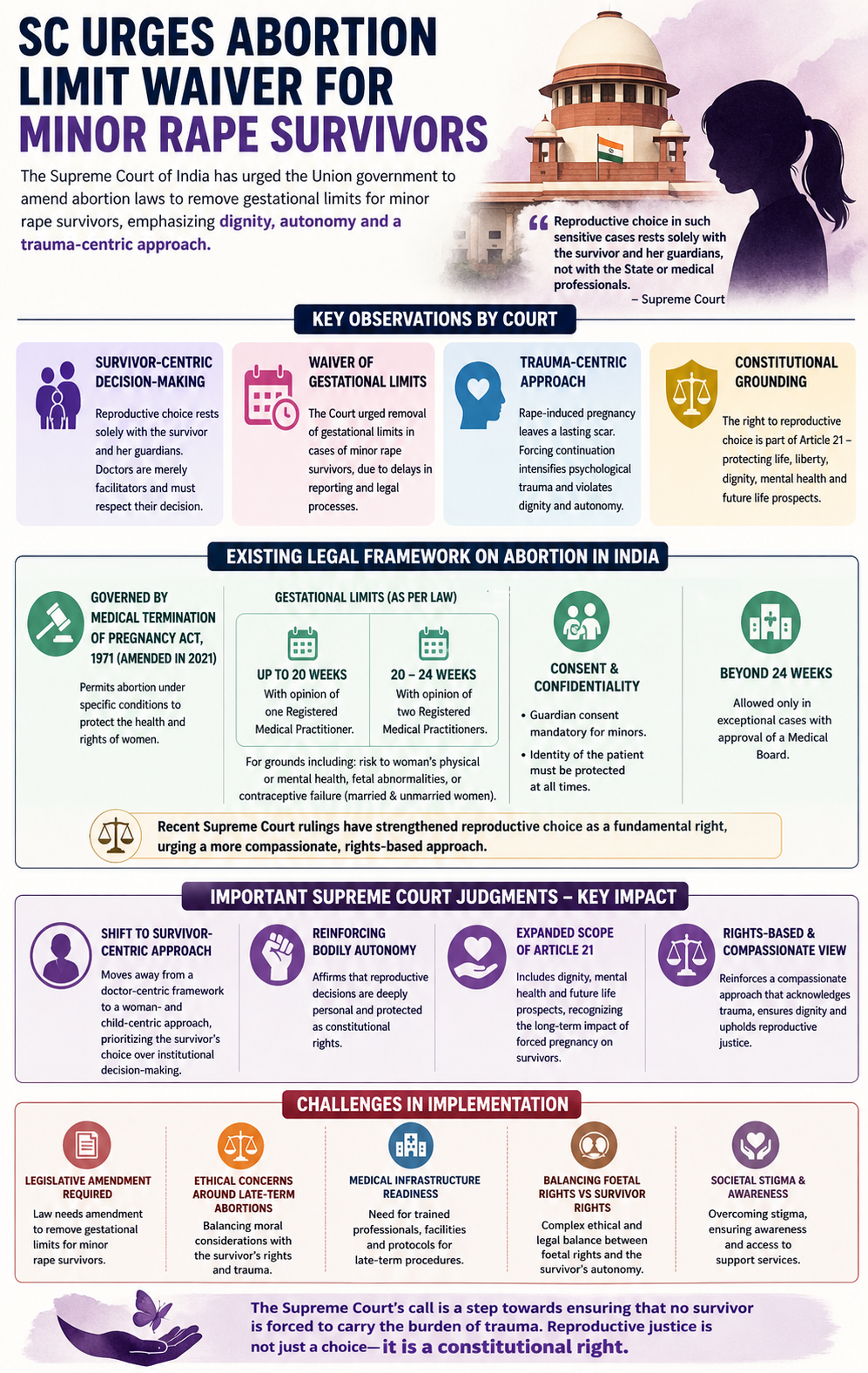
- The Court made it clear that reproductive choice in such sensitive cases rests solely with the survivor and her guardians, not with the State or medical professionals. The Bench led by Justice Surya Kant and Justice Joymalya Bagchi emphasized that doctors are merely facilitators who must respect the decision taken by the minor survivor and her parents.
- It further called for a significant reform in the Medical Termination of Pregnancy Act, 1971, suggesting the removal of gestational limits in cases involving minor rape survivors. The reasoning was grounded in practical realities—delays in reporting and legal procedures often push pregnancies beyond permissible limits, and forcing continuation in such situations can intensify psychological trauma.
- Adopting a trauma-centric approach, the Court acknowledged that rape-induced pregnancy leaves a lasting scar and that compelling a survivor to give birth undermines her dignity and autonomy, principles closely tied to Article 21 of the Constitution.
- The Court made it clear that reproductive choice in such sensitive cases rests solely with the survivor and her guardians, not with the State or medical professionals. The Bench led by Justice Surya Kant and Justice Joymalya Bagchi emphasized that doctors are merely facilitators who must respect the decision taken by the minor survivor and her parents.
-
Existing Legal Framework on Abortion:
-
-
- Abortion in India is governed by the Medical Termination of Pregnancy Act, 1971 (amended in 2021), which permits termination up to 24 weeks for specific categories such as rape survivors and minors, under defined conditions. It allows abortion up to 20 weeks with one doctor’s opinion and 20–24 weeks with two doctors’ approval, based on risks to the woman’s physical or mental health, fetal abnormalities, or contraceptive failure (for both married and unmarried women).
- The framework also ensures consent and confidentiality, requiring guardian approval for minors and protecting patient identity. Abortions beyond 24 weeks are allowed only in exceptional cases with Medical Board approval. Recent rulings by the Supreme Court have further strengthened reproductive choice as a fundamental right, pushing for a more compassionate and rights-based approach.
- Abortion in India is governed by the Medical Termination of Pregnancy Act, 1971 (amended in 2021), which permits termination up to 24 weeks for specific categories such as rape survivors and minors, under defined conditions. It allows abortion up to 20 weeks with one doctor’s opinion and 20–24 weeks with two doctors’ approval, based on risks to the woman’s physical or mental health, fetal abnormalities, or contraceptive failure (for both married and unmarried women).
-
Important Supreme Court Judgments:
-
-
- The judgment marks a clear shift from a doctor-centric framework to a woman- and child-centric approach, prioritizing the survivor’s choice over institutional decision-making.
- It strongly reinforces bodily autonomy by affirming that reproductive decisions are deeply personal and protected as constitutional rights.
- The scope of Article 21 is broadened to include dignity, mental health, and future life prospects, recognizing the long-term impact of forced pregnancy on survivors.
- The judgment marks a clear shift from a doctor-centric framework to a woman- and child-centric approach, prioritizing the survivor’s choice over institutional decision-making.
-
Challenges in Implementation
-
-
- Legislative amendment required
- Ethical concerns around late-term abortions
- Medical infrastructure readiness
- Balancing foetal rights vs survivor rights
- Legislative amendment required
-
Conclusion:
The Supreme Court’s observations mark a progressive shift toward survivor-centric justice, prioritizing dignity, autonomy, and mental well-being over rigid legal timelines.



