
Context:
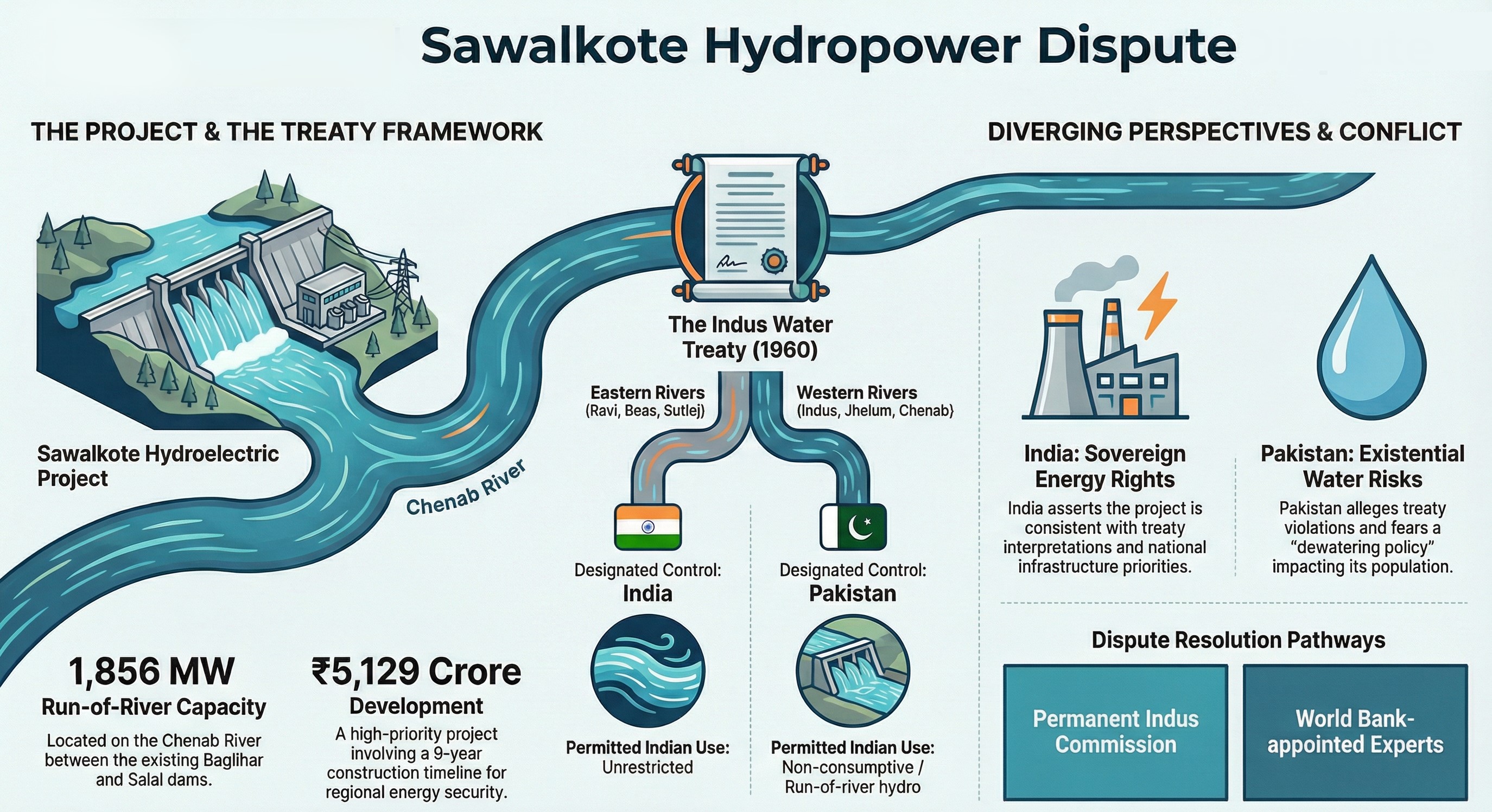
Recently, Pakistan has protested strongly against India’s decision to proceed with the ₹5,129 crore Sawalkote Hydroelectric Project on the Chenab river in Jammu & Kashmir, alleging it violates India’s international commitments and constitutes a “dewatering policy” harming Islamabad’s water rights.
About The Indus Water Treaty (IWT):
The Indus Water Treaty (1960) is a water-sharing agreement between India and Pakistan, brokered by the World Bank, governing the six-river Indus system.
Key features:
-
-
- Signatories & Date: Signed on 19 September 1960 by PM Jawaharlal Nehru and President Ayub Khan in Karachi.
- River Division:
- Eastern Rivers (India): Ravi, Beas, Sutlej – unrestricted use by India.
- Western Rivers (Pakistan): Indus, Jhelum, Chenab – Pakistan has primary control, India retains limited rights.
- Eastern Rivers (India): Ravi, Beas, Sutlej – unrestricted use by India.
- India’s Rights on Western Rivers: Domestic use, non-consumptive, agricultural purposes, and run-of-the-river hydropower projects.
- Permanent Indus Commission (PIC): Bilateral body for cooperation, data sharing, and annual meetings.
- Dispute Resolution:
- PIC for technical questions
- Neutral Expert (appointed by World Bank for differences)
- Court of Arbitration for formal disputes
- PIC for technical questions
- Signatories & Date: Signed on 19 September 1960 by PM Jawaharlal Nehru and President Ayub Khan in Karachi.
-
The Sawalkote project has become the first major Chenab project cleared following India’s suspension of IWT after the Pahalgam terror attack in 2025.
Pakistan’s key Objections:
-
-
- Breach of Treaty Obligations: Pakistan claims India’s unilateral move violates IWT provisions and demanded formal consultations through the Indus Water Commissioners, which it asserts were ignored.
- Water Security Concerns: The project affects the “existential water rights” of Pakistan’s population, as much of its water comes from Chenab, Jhelum, and Indus.
- Breach of Treaty Obligations: Pakistan claims India’s unilateral move violates IWT provisions and demanded formal consultations through the Indus Water Commissioners, which it asserts were ignored.
-
About India’s Position:
-
-
- India maintains that the Sawalkote Hydropower Project is a domestic development initiative pursued under its sovereign rights, fully consistent with its interpretation of the Indus Waters Treaty.
- India emphasises that advancing hydropower projects on western rivers is part of national energy security, regional development, and infrastructure priorities, and it considers objections from Pakistan as non-binding on India’s domestic policy decisions.
- India maintains that the Sawalkote Hydropower Project is a domestic development initiative pursued under its sovereign rights, fully consistent with its interpretation of the Indus Waters Treaty.
-
About Sawalkote Hydropower:
-
-
- Location: Chenab river, Udhampur & Ramban districts, between Baglihar (upstream) and Salal (downstream)
- Capacity: 1,856 MW (Stage I: 1,406 MW; Stage II: 450 MW)
- Type: Run-of-the-river hydroelectric project
- Cost & Timeline: ₹5,129 crore; construction ~9 years, with central push for early commissioning
- Location: Chenab river, Udhampur & Ramban districts, between Baglihar (upstream) and Salal (downstream)
-
Conclusion:
The Sawalkote hydroelectric project illustrates the balance between India’s development needs and Indus Water Treaty obligations. While India pursues domestic energy and infrastructure goals, Pakistan sees potential threats to its water security. The project highlights the role of transboundary water diplomacy, treaty compliance, and conflict resolution in South Asia, showing how infrastructure, geopolitics and international law intersect in policymaking.



