
Context:
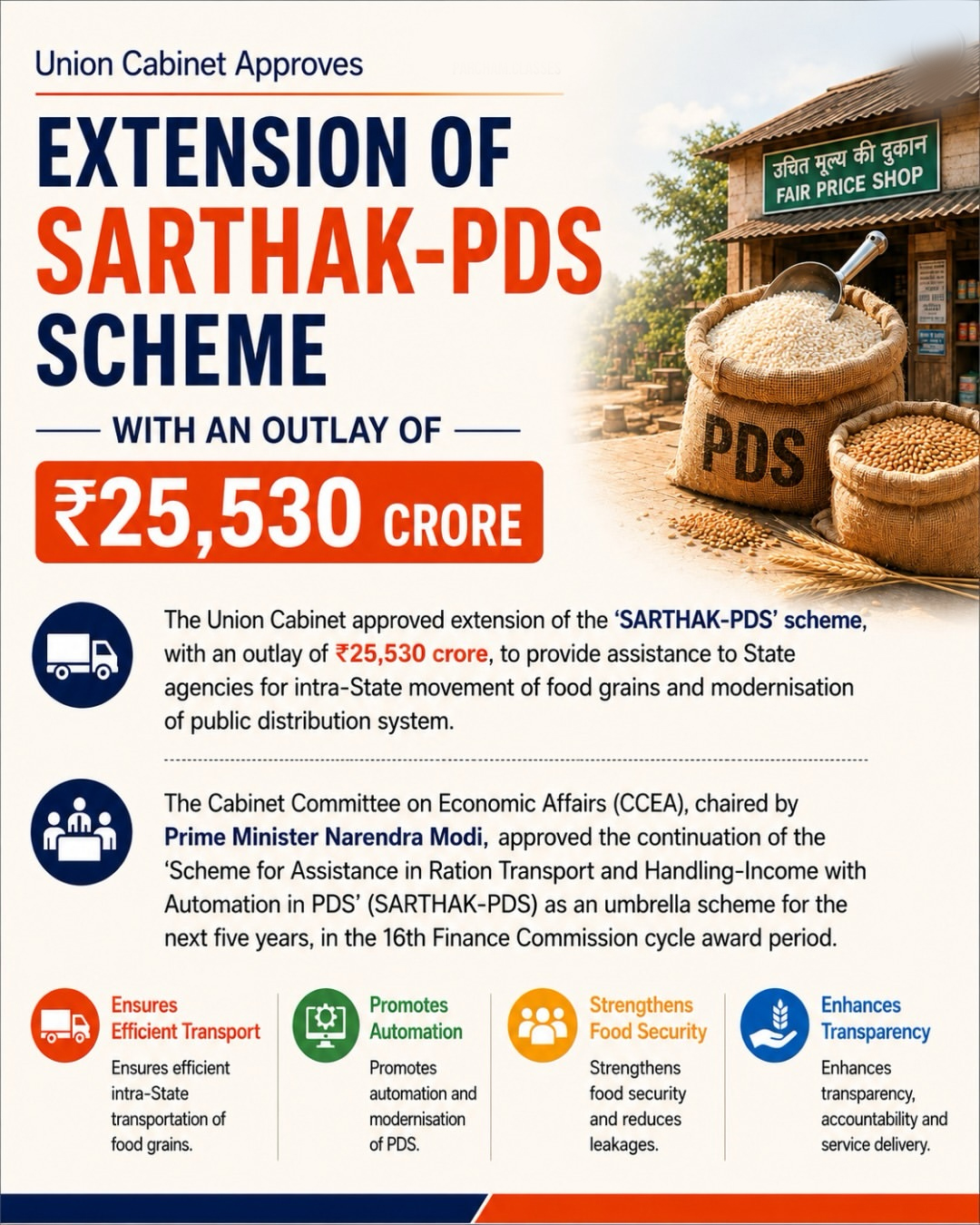
Recently, The Union Cabinet, chaired by the Prime Minister, approved the continuation and expansion of the SARTHAK-PDS scheme with an outlay of ₹25,530 crore till March 2031. The decision aims to modernise India’s Public Distribution System (PDS) through technology-driven reforms and improved logistics.
About SARTHAK-PDS scheme:
SARTHAK-PDS is an umbrella reform programme for strengthening India’s Public Distribution System by integrating:
-
- Earlier logistics and transport support schemes
- SMART-PDS digital reform initiative
- Earlier logistics and transport support schemes
It aims to create a unified, technology-enabled, and efficient food distribution system under the National Food Security Act (NFSA).
Key Features of SARTHAK-PDS Scheme:
The scheme covers the entire PDS value chain:
-
-
- Beneficiary identification
- Procurement and storage logistics
- Transportation of foodgrains
- Fair Price Shop operations
- Grievance redressal and citizen feedback
- Beneficiary identification
-
It also provides:
-
-
- Central assistance for intra-state transport of foodgrains
- Revised margins for FPS dealers
- Continued funding framework for states/UTs
- Central assistance for intra-state transport of foodgrains
-
Technology Integration in SARTHAK-PDS:
The scheme promotes advanced digital reforms using:
-
-
- Artificial Intelligence (AI)
- Machine Learning (ML)
- Natural Language Processing (NLP)
- Blockchain technology
- Artificial Intelligence (AI)
-
Key digital components:
-
-
- Real-time monitoring systems
- Unified beneficiary databases
- State Command Control Centres
- AI-based grievance redressal systems
- ISO-certified process frameworks
- Real-time monitoring systems
-
About PDS in India:
The Public Distribution System (PDS) is India’s largest food security mechanism that procures food grains from farmers at guaranteed prices and distributes them at subsidised rates to vulnerable populations through Fair Price Shops (FPS), commonly called ration shops.
-
- Covers over 81 crore NFSA beneficiaries
- Operates through 5.3 lakh+ Fair Price Shops (FPS)
- Provides subsidised foodgrains (rice, wheat, etc.)
- Managed jointly by Centre and States
- Covers over 81 crore NFSA beneficiaries
Working of the Public Distribution System (PDS):
Procurement
The Central Government, mainly through the Food Corporation of India (FCI), procures food grains such as wheat and rice at the Minimum Support Price (MSP).
Storage and Logistics
-
- Food grains are stored in FCI warehouses and silos
- The Centre transports grains to state depots for further distribution
- Food grains are stored in FCI warehouses and silos
Allocation and Lifting
-
- The Centre allocates grains to States/UTs based on population and poverty ratios
- State governments lift and transport grains to state godowns
- The Centre allocates grains to States/UTs based on population and poverty ratios
Intra-State Distribution
States identify eligible beneficiaries and issue ration cards under the National Food Security Act (NFSA), 2013.
Categories under NFSA:
-
-
- Antyodaya Anna Yojana (AAY): 35 kg food grains per family/month
- Priority Households (PHH): 5 kg food grains per person/month
- Antyodaya Anna Yojana (AAY): 35 kg food grains per family/month
-
States ensure transportation from state godowns to FPS shops.
Final Distribution and Verification
Beneficiaries collect food grains from FPS through:
-
-
- Aadhaar authentication
- e-POS biometric verification
- Aadhaar authentication
-
Food grains are distributed at highly subsidised prices.
Significance of the Scheme:
-
-
- Strengthening Food Security: Ensures timely and efficient delivery of subsidised foodgrains to vulnerable populations under NFSA.
- Reducing Leakages and Corruption: Digital tracking and blockchain systems aim to minimise diversion of foodgrains and improve transparency.
- Improving Last-Mile Delivery: Better logistics and transport support help ensure food reaches remote and rural areas efficiently.
- Supporting Cooperative Federalism: Enhances coordination between Centre and States in procurement, storage, and distribution.
- Welfare of FPS Dealers: Revised margins improve viability and efficiency of Fair Price Shops.
- Strengthening Food Security: Ensures timely and efficient delivery of subsidised foodgrains to vulnerable populations under NFSA.
-
Conclusion:
The extension of SARTHAK-PDS till 2031 marks a major step in modernising India’s food security architecture. By integrating advanced technologies with welfare delivery systems, the scheme aims to build a transparent, efficient, and citizen-centric Public Distribution System aligned with the goal of “food security for all.”



