
Context:
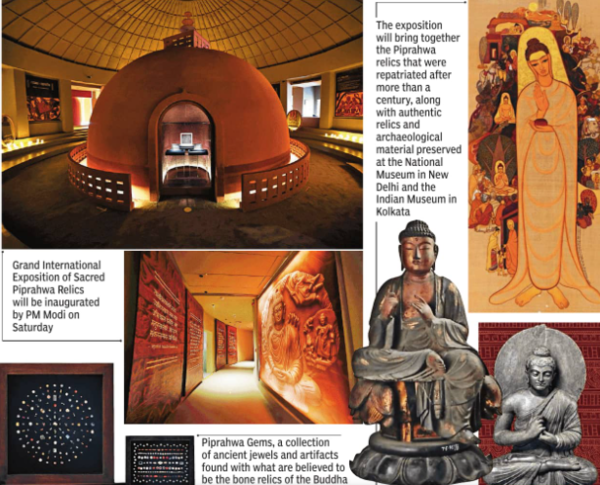
On 3 January 2026, Prime Minister Narendra Modi inaugurated the Grand International Exposition of Sacred Piprahwa Relics, titled “The Light & The Lotus: Relics of the Awakened One”, at the Rai Pithora Cultural Complex in New Delhi.
About the Piprahwa Relics:
-
-
-
- The Piprahwa relics are a collection of ancient artefacts, including bone fragments and gem relics, widely believed to be associated with Bhagwan Buddha. They were first discovered in 1898 at Piprahwa, near the India–Nepal border, at a stupa site archaeologically linked with ancient Kapilavastu, where the Buddha spent his early life before renunciation.
- These relics include sacred relic deposits, reliquaries, and a collection of gemstones. During the colonial period, a portion of these artefacts was taken abroad, with some pieces later resurfacing in private collections overseas.
- The Piprahwa relics are a collection of ancient artefacts, including bone fragments and gem relics, widely believed to be associated with Bhagwan Buddha. They were first discovered in 1898 at Piprahwa, near the India–Nepal border, at a stupa site archaeologically linked with ancient Kapilavastu, where the Buddha spent his early life before renunciation.
-
-
Significance of the Exposition:
1. Historic Reunification and Repatriation
-
-
-
- The exposition brings together repatriated relics along with authentic archaeological materials preserved in Indian institutions such as the National Museum and the Indian Museum.
- This marks the first time in over a century that these dispersed relics have been assembled at a single venue.
- The exposition brings together repatriated relics along with authentic archaeological materials preserved in Indian institutions such as the National Museum and the Indian Museum.
-
-
2. Cultural and Spiritual Heritage
-
-
-
- The event underscores India’s deep civilisational association with Buddhism and its role as the birthplace of the religion.
- It reflects a renewed effort to preserve and promote India’s spiritual and cultural traditions.
- The Prime Minister emphasised that the wisdom and teachings of Buddha are timeless and universal, and that the relics are not merely historical artefacts but an integral part of India’s living heritage.
- The event underscores India’s deep civilisational association with Buddhism and its role as the birthplace of the religion.
-
-
3. Public Engagement
-
-
-
- The exhibition seeks to strengthen the connection between India’s youth and their cultural roots.
- Through curated displays and immersive multimedia experiences, visitors are encouraged to engage with the life, teachings, and legacy of the Buddha.
- The exhibition seeks to strengthen the connection between India’s youth and their cultural roots.
-
-
Strategic and Diplomatic Dimensions:
-
-
- The repatriation and exhibition of the Piprahwa relics form part of India’s broader cultural diplomacy efforts, reinforcing its leadership role in global Buddhist heritage and soft power outreach.
- The return of these artefacts involved coordinated government action, institutional collaboration, and innovative public–private partnership models, reflecting evolving approaches to heritage repatriation.
- The repatriation and exhibition of the Piprahwa relics form part of India’s broader cultural diplomacy efforts, reinforcing its leadership role in global Buddhist heritage and soft power outreach.
-
Conclusion:
The inauguration of the Grand International Exposition of Sacred Piprahwa Relics by Prime Minister Narendra Modi represents a landmark cultural moment. It symbolises India’s commitment to preserving and celebrating its ancient civilisational heritage, reunites invaluable Buddhist relics after more than a century, and promotes cross-cultural understanding while deepening public engagement with India’s spiritual traditions.



