
Rusty-Spotted Cat Sighting in Aravallis
Context:
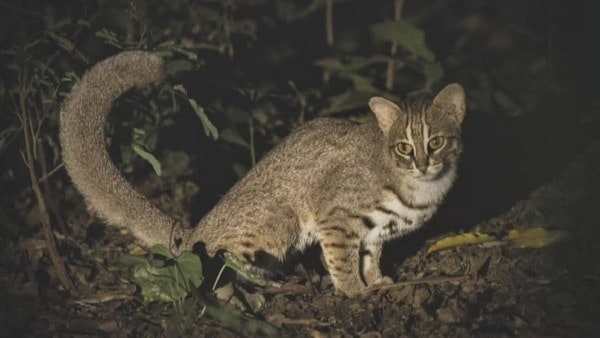
Recently, a “Rusty-spotted Cat” was sighted in the wildlife corridor of the Aravalli region near Faridabad district of Haryana (Delhi-NCR). In particular, photographic evidence of a female cat and her kitten was recorded near Kot village. This is the first time that concrete evidence of breeding of this rare cat has been found in this area, which is a positive sign for the ecological health of the Aravalli ecosystem.
About the Rusty-Spotted Cat:
-
-
- The rusty-spotted cat is one of the smallest wild cats globally, measuring about 35–48 cm in body length, with nearly half contributed by its tail. It has short greyish-red fur with rusty spots that provide camouflage in dry forests and scrublands. It is a highly secretive and nocturnal species, making sightings extremely rare.
- It is native to India, Sri Lanka, and Nepal, but has a scattered and low-density population. Around 75% of its habitat is under pressure due to agriculture, urban expansion, and land-use change. The species is listed as Near Threatened on the IUCN Red List and is protected under Schedule I of the Wildlife (Protection) Act, 1972, ensuring the highest legal protection in India.
- The rusty-spotted cat is one of the smallest wild cats globally, measuring about 35–48 cm in body length, with nearly half contributed by its tail. It has short greyish-red fur with rusty spots that provide camouflage in dry forests and scrublands. It is a highly secretive and nocturnal species, making sightings extremely rare.
-
Why the Sighting in Aravallis is Important:
-
-
- The Aravalli sighting is ecologically significant as it confirms that fragmented scrubland ecosystems near major cities can still support rare wildlife. The Aravalli Range acts as a vital ecological corridor and a natural barrier against the expansion of the Thar Desert in northwestern India.
- Importantly, the observation suggests the possibility of a breeding population, not just a stray individual. This indicates habitat stability, prey availability, and relatively low disturbance in certain pockets. It highlights the ecological value of scrublands, which are often overlooked compared to forests but are crucial for biodiversity conservation.
- The Aravalli sighting is ecologically significant as it confirms that fragmented scrubland ecosystems near major cities can still support rare wildlife. The Aravalli Range acts as a vital ecological corridor and a natural barrier against the expansion of the Thar Desert in northwestern India.
-
Other Small Wild Cats of India:
India hosts several lesser-known small wild cats that play key roles in maintaining ecological balance by controlling rodent populations and supporting food chains.
-
-
-
- Fishing Cat: The fishing cat (Prionailurus viverrinus) is a strong swimmer adapted to wetlands. It is found in the Sundarbans, Ganga-Brahmaputra basins, and parts of the Western Ghats. It is classified as Endangered due to wetland loss, pollution, and urbanisation, and is protected under Schedule I.
- Caracal: The caracal is a medium-sized nocturnal cat identified by its black ear tufts. It is now rare in India, mainly surviving in Rajasthan and Gujarat. It is listed as Least Concern globally but critically threatened in India and protected under Schedule I.
- Asiatic Wildcat: The Asiatic wildcat (Felis lybica ornata) inhabits arid regions, especially the Thar Desert. Its sandy coat provides camouflage in dry habitats. Though globally Least Concern, local populations face habitat pressure and are protected under Schedule I.
- Fishing Cat: The fishing cat (Prionailurus viverrinus) is a strong swimmer adapted to wetlands. It is found in the Sundarbans, Ganga-Brahmaputra basins, and parts of the Western Ghats. It is classified as Endangered due to wetland loss, pollution, and urbanisation, and is protected under Schedule I.
-
-
Ecological Importance of the Aravalli Range:
-
-
-
- The Aravalli Range is one of the oldest mountain systems in the world, stretching across Gujarat, Rajasthan, Haryana, and Delhi. Despite degradation from mining, deforestation, and urbanisation, it remains ecologically crucial.
- It prevents desertification, regulates climate, and supports biodiversity corridors for wildlife movement. The presence of the rusty-spotted cat highlights its ecological resilience and the need for urgent conservation of scrub and dry forest ecosystems.
- The Aravalli Range is one of the oldest mountain systems in the world, stretching across Gujarat, Rajasthan, Haryana, and Delhi. Despite degradation from mining, deforestation, and urbanisation, it remains ecologically crucial.
-
-
International Conservation Context:
India’s conservation efforts are aligned with global initiatives such as the International Big Cat Alliance (IBCA), launched in 2023. While focused on large cats like tigers and leopards, it reflects India’s broader commitment to wildlife protection. India is home to five of the seven big cat species, making it a global biodiversity hotspot.
Conclusion:
The rediscovery of the rusty-spotted cat in the Aravallis demonstrates that even fragile and urban-adjacent ecosystems can support rare wildlife. Along with species like the fishing cat, caracal, and Asiatic wildcat, it underscores India’s rich but vulnerable biodiversity. Strengthening habitat conservation in regions like the Aravallis is essential for protecting these elusive species and maintaining ecological balance.



