
Russia–China Relations and Putin’s 2026 Beijing Visit
Context:
Recently, Russian President Vladimir Putin visited Beijing on 19–20 May 2026, which took place immediately after the visit of US President Donald Trump to China. Putin–Xi summit was also held between the two countries. This visit highlighted China’s growing central role in global diplomacy.
Background of Russia–China Ties:
-
-
- Russia and China share a long history marked by cooperation and rivalry. During the Cold War, both signed the 1950 Treaty of Friendship after the Communist Revolution in China. However, ideological disputes led to the Sino-Soviet split in the 1960s and border clashes in 1969.
- Relations improved after the collapse of the Soviet Union, and under Vladimir Putin and Xi Jinping, ties deepened significantly. In 2022, both countries declared a “no-limits partnership”.
- Russia and China share a long history marked by cooperation and rivalry. During the Cold War, both signed the 1950 Treaty of Friendship after the Communist Revolution in China. However, ideological disputes led to the Sino-Soviet split in the 1960s and border clashes in 1969.
-
About the Meeting:
The Putin–Xi summit focused on strengthening strategic, economic and technological cooperation. Both leaders discussed energy security, trade expansion, digital technology, artificial intelligence, transport connectivity and global governance reforms. More than 40 agreements were signed during the visit.
Key Outcomes:
-
-
- Expansion of bilateral trade and investment.
- Greater cooperation in energy, technology and space sectors.
- Continued work on the Power of Siberia gas pipeline projects.
- Increased use of local currencies (Yuan and Ruble) in trade, promoting de-dollarisation.
- Joint support for a “multipolar world order” and criticism of Western dominance.
- Expansion of bilateral trade and investment.
-
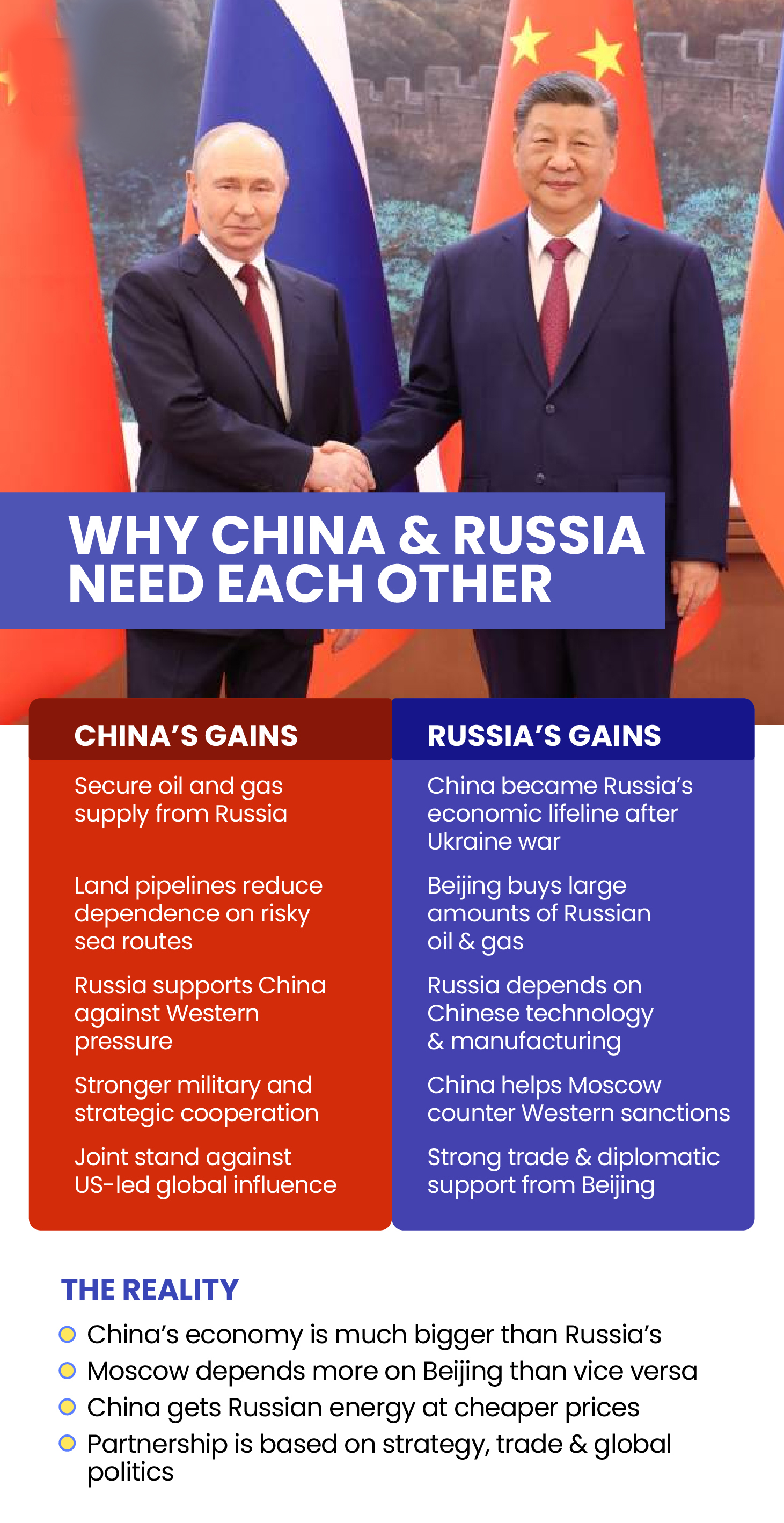
Benefits of the Russia–China Partnership:
-
-
- Russia gains a major economic lifeline from China after Western sanctions due to the Ukraine war.
- China buys large volumes of Russian oil, gas, and raw materials, supporting Russia’s export revenues.
- China supplies Russia with machinery, electronics, vehicles, and technology that were earlier imported from the West.
- In 2025, about 32% of Russia’s total trade was with China, showing rising dependence on Beijing.
- Russia provides China with diplomatic and strategic backing in global forums, especially against US pressure.
- The partnership helps both countries counterbalance Western influence in global affairs.
- Russia gains a major economic lifeline from China after Western sanctions due to the Ukraine war.
-
Global Impacts of partnership:
-
-
- The partnership challenges the US-led global order.
- It supports the idea of a multipolar world with multiple power centres.
- It promotes trade in local currencies, reducing reliance on the US dollar.
- It contributes to gradual de-dollarisation in global trade.
- It increases geopolitical competition among major powers.
- It forces countries like India, Japan, and European states to adjust their foreign policies.
- The partnership challenges the US-led global order.
-
Implications for India:
The growing closeness between Russia and China poses a serious challenge for India’s foreign policy:
-
-
- Strategic dilemma: India has traditionally been a strong defence and strategic partner of Russia. If Russia moves completely into China’s camp, it could affect India’s position along the Line of Actual Control (LAC).
- Impact on defence supplies: India still depends on Russia for military equipment. Closer Russia–China ties could affect these supplies during times of crisis.
- Multipolarity vs unipolarity: India also supports a multipolar world, but it does not favour an Asia dominated by China.
- Strategic dilemma: India has traditionally been a strong defence and strategic partner of Russia. If Russia moves completely into China’s camp, it could affect India’s position along the Line of Actual Control (LAC).
-
Conclusion:
Putin’s latest visit to Beijing underlines Russia’s growing dependence on China following Western sanctions. With Trump also trying to improve ties with Xi Jinping, India must adopt alternative diplomatic and strategic approaches to protect its long-term interests.



