
Rural Land Inequality in India
Context:
Recently, a research paper released by the World Inequality Lab (WIL), titled “Land Inequality in India: Nature, History and Market”, has exposed disturbing data of land ownership in rural India. This report not only reflects economic inequality but also raises serious questions on India’s socio-political structure.
Main Findings of the Report:
According to the report, the distribution of rural land in India is highly unequal:
-
-
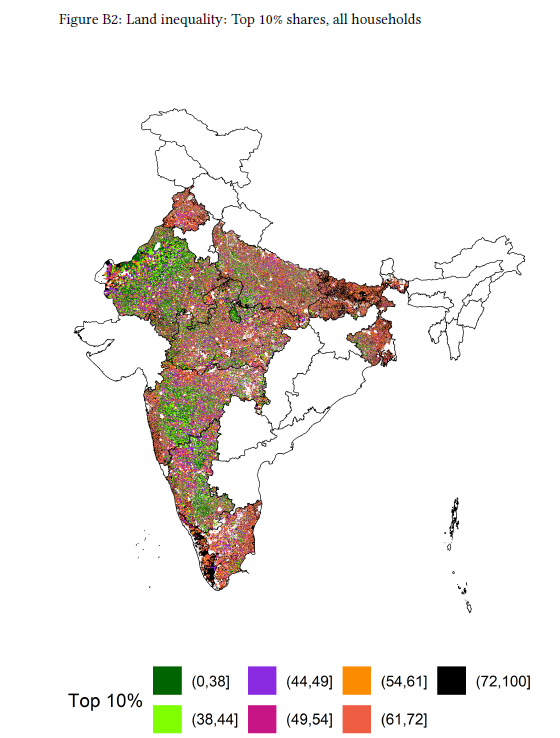
- Concentration: The top 10% of rural households own 44% of the total land. Meanwhile, the top 1% owns 18% and the top 5% hold 32% of the land.
- Condition of Landlessness: About 46% of families in rural areas of India are landless. In an agriculturally prosperous state like Punjab, the rate of landlessness is the highest (73%).
- Village-level Analysis: On average, the largest landowner in a village owns 12.4% of the total village land. In some cases (3.8% of villages), a single person owns more than half of the land.
- Concentration: The top 10% of rural households own 44% of the total land. Meanwhile, the top 1% owns 18% and the top 5% hold 32% of the land.
-
Historical and Structural Factors of Inequality:
The report highlights three main reasons behind this inequality:
-
-
- Colonial Legacy: The study shows that in areas where the ‘Zamindari system’ (where landlords collected taxes and owned land) was implemented during British rule, inequality is still higher compared to areas where ‘Ryotwari’ or princely systems existed. The impact of historical institutional arrangements still dominates land distribution.
- Caste and Social Hierarchy: There is a deep connection between land ownership and social status. In villages where the population of Scheduled Castes (SC) and Scheduled Tribes (ST) is higher, the problems of landlessness and small landholdings are more severe. The historical dominance of upper castes over land still continues.
- Agro-ecology: In fertile and resource-rich regions, higher land concentration is observed because historically powerful groups strengthened their control over profitable assets.
- Colonial Legacy: The study shows that in areas where the ‘Zamindari system’ (where landlords collected taxes and owned land) was implemented during British rule, inequality is still higher compared to areas where ‘Ryotwari’ or princely systems existed. The impact of historical institutional arrangements still dominates land distribution.
-
State-wise Performance:
There is wide variation among Indian states in terms of land inequality:
-
-
- High Inequality States: Kerala (Gini coefficient 90), Bihar, Punjab, Tamil Nadu and West Bengal have the most unequal land distribution.
- Low Inequality States: Karnataka and Rajasthan have relatively more balanced land distribution (Gini coefficient below 65).
- High Inequality States: Kerala (Gini coefficient 90), Bihar, Punjab, Tamil Nadu and West Bengal have the most unequal land distribution.
-
Review of Land Reforms:
After independence, India implemented land reforms such as abolition of intermediaries, land ceiling, and consolidation of holdings. However, this report highlights their limitations:
-
-
- Lack of Implementation: The ‘Ceiling Act’ could not be effectively implemented due to benami property transfers and legal loopholes.
- Role of Market: Development of modern infrastructure and irrigation facilities has increased land value, leading to further growth in the wealth of large landowners, while marginal farmers have lagged behind in market competition.
- Challenge of Digitization: Despite modernization of land records, the gap between actual ownership and possession still remains a major obstacle.
- Lack of Implementation: The ‘Ceiling Act’ could not be effectively implemented due to benami property transfers and legal loopholes.
-
Way Forward:
Land is not only an economic resource but also a means of social security and dignity. To reduce this inequality, the following steps are necessary:
-
-
- Effective Land Ceiling Laws: State governments should review land ceiling laws and actually distribute surplus land among the landless.
- Cooperative Farming: Small and marginal farmers should be encouraged for collective farming so that they can better benefit from resources and markets.
- Social Inclusion: Marginalized communities (SC/ST) should be given priority in land allocation policies.
- Transparent Data: The ‘Digital India Land Records Modernization Programme’ (DILRMP) needs to be made more transparent and inclusive.
- Effective Land Ceiling Laws: State governments should review land ceiling laws and actually distribute surplus land among the landless.
-
Conclusion:
Land inequality in India is not only an economic issue but also a challenge to the principles of democracy and social justice. If India has to achieve the goal of “inclusive development,” it will have to redefine land reforms anew.



