
Context:
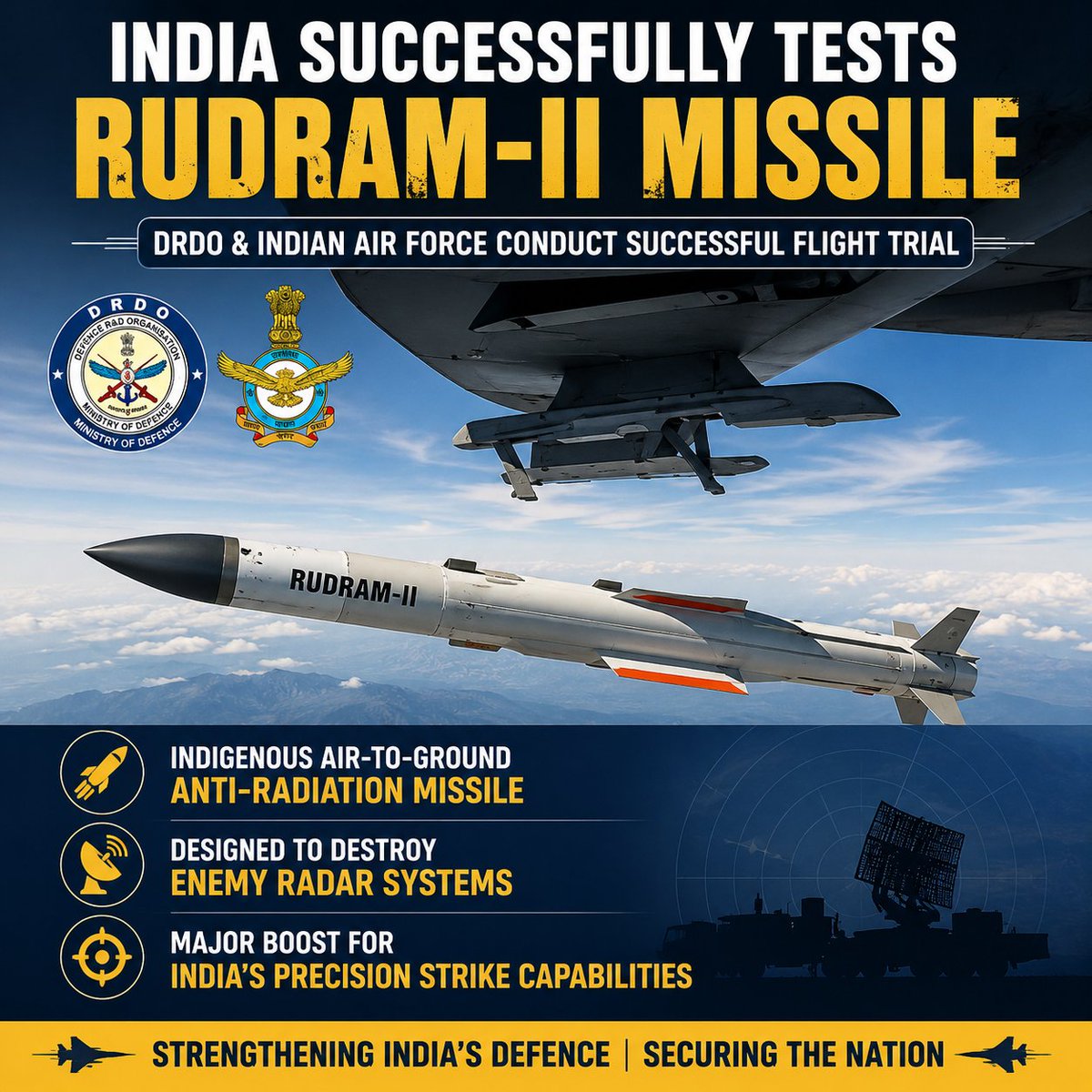
The Defence Research and Development Organisation (DRDO), in collaboration with the Indian Air Force (IAF), successfully conducted the flight test of the indigenous RudraM-II air-to-surface anti-radiation missile on June 2, 2026.
About RudraM-II Missile:
-
-
- RudraM-II is an indigenously developed, solid-propelled, air-to-surface anti-radiation missile designed to detect and destroy enemy radar systems, surveillance networks, and communication infrastructure that form the backbone of integrated air defence systems.
- It has been developed by the Research Centre Imarat (RCI), Hyderabad, in collaboration with DRDO laboratories such as DRDL, HEMRL, and ARDE, along with production partners like Hindustan Aeronautics Limited (HAL).
- RudraM-II is an indigenously developed, solid-propelled, air-to-surface anti-radiation missile designed to detect and destroy enemy radar systems, surveillance networks, and communication infrastructure that form the backbone of integrated air defence systems.
-
Key Technical Specifications:
-
-
- The RudraM-II has an operational range of approximately 300–350 km, enabling stand-off engagement of enemy air defence systems without entering high-threat zones. It can achieve speeds of up to Mach 5.5, significantly reducing enemy reaction time.
- The missile carries a conventional warhead of up to 200 kg and can be launched from altitudes between 3 km and 15 km, offering flexibility across different combat scenarios. Powered by a solid-propellant rocket motor developed by DRDO, it ensures high reliability and sustained thrust throughout its flight profile.
-
Advanced Features and Guidance Systems:
-
-
- RudraM-II features a multi-layered guidance system designed for high precision and survivability. It uses a Passive Radar Homing (PRH) system to detect enemy radar emissions and lock onto targets. This is complemented by an Imaging Infrared (IIR) seeker, allowing the missile to maintain target tracking even if enemy radars are switched off mid-flight.
- Its hybrid navigation system integrates Inertial Navigation System (INS) with satellite guidance such as GPS/NavIC for accurate mid-course correction. The missile supports both Lock-On Before Launch (LOBL) and Lock-On After Launch (LOAL) modes, enabling flexible engagement in dynamic battlefield conditions.
- RudraM-II features a multi-layered guidance system designed for high precision and survivability. It uses a Passive Radar Homing (PRH) system to detect enemy radar emissions and lock onto targets. This is complemented by an Imaging Infrared (IIR) seeker, allowing the missile to maintain target tracking even if enemy radars are switched off mid-flight.
-
Strategic Significance:
-
-
- RudraM-II plays a key role in modern electronic warfare by neutralising enemy air defence networks. By destroying radar stations, surveillance systems, and surface-to-air missile (SAM) sites, it effectively “blinds” enemy defences and creates safe corridors for follow-on air strikes and deep penetration missions.
- The system strengthens India’s defence self-reliance under the Aatmanirbhar Bharat initiative. It is also expected to replace ageing imported systems such as the Russian-origin Kh-31 anti-radiation missiles, reducing dependence on foreign technology.
- RudraM-II plays a key role in modern electronic warfare by neutralising enemy air defence networks. By destroying radar stations, surveillance systems, and surface-to-air missile (SAM) sites, it effectively “blinds” enemy defences and creates safe corridors for follow-on air strikes and deep penetration missions.
-
What is an Anti-Radiation Missile?
-
-
- An Anti-Radiation Missile (ARM) is a specialised weapon that detects and homes in on electromagnetic radiation emitted by enemy radar and communication systems. Instead of emitting signals, it passively tracks radio-frequency emissions and destroys their source.
- Such missiles are crucial in modern warfare as they degrade enemy air defence capabilities and enhance the safety and effectiveness of friendly air operations.
- An Anti-Radiation Missile (ARM) is a specialised weapon that detects and homes in on electromagnetic radiation emitted by enemy radar and communication systems. Instead of emitting signals, it passively tracks radio-frequency emissions and destroys their source.
-
Conclusion:
The successful test of RudraM-II marks a major advancement in India’s indigenous missile technology. With hypersonic speed, long-range strike capability, and advanced guidance systems, it significantly enhances the Indian Air Force’s operational effectiveness. The missile also reflects India’s growing defence self-reliance and preparedness for modern electronic and air warfare scenarios.



