
River Basin Management Scheme Extended Till 2031
Context:
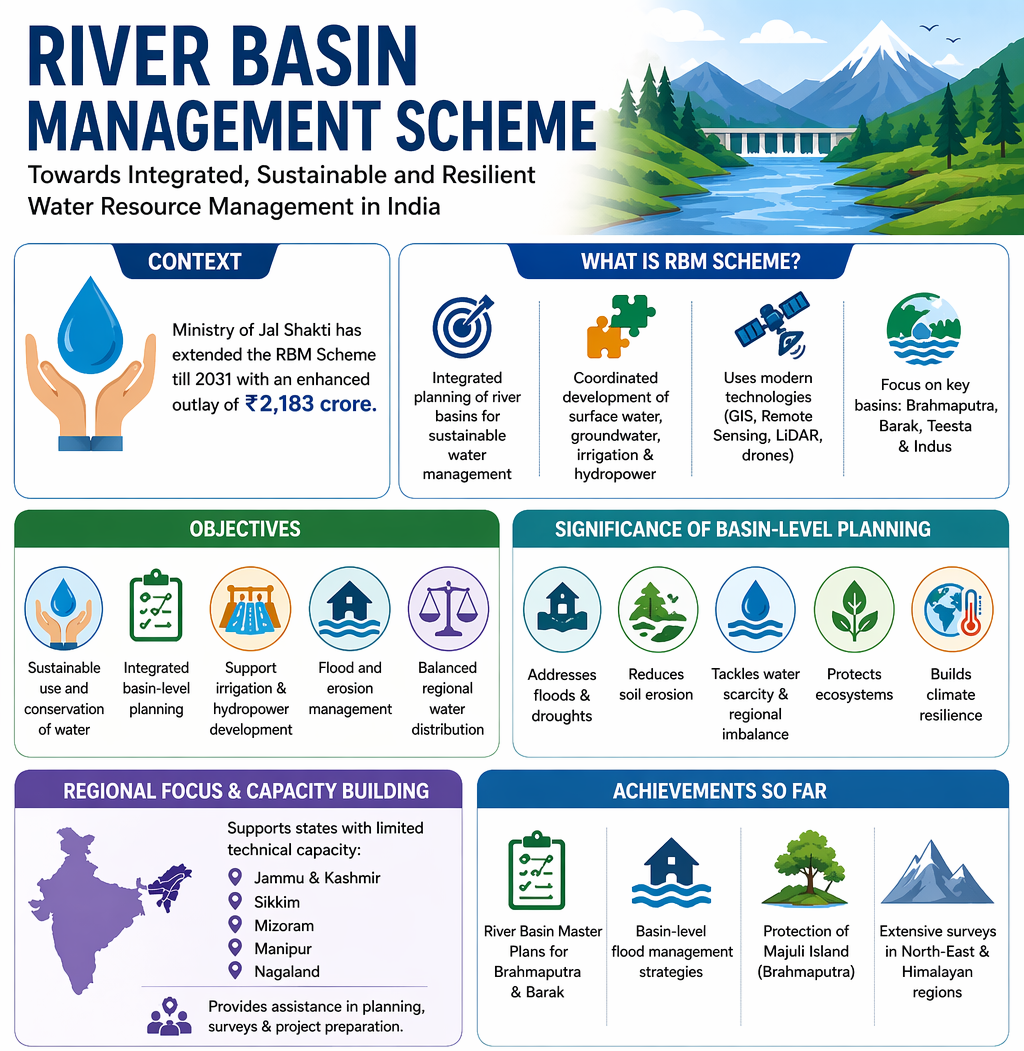
Recently, The Ministry of Jal Shakti has extended the River Basin Management (RBM) Scheme till 2031 with an enhanced outlay of ₹2,183 crore. The scheme aims to strengthen basin-level planning for sustainable use, protection, and development of surface and groundwater resources in India.
About River Basin Management (RBM) Scheme:
-
-
- The River Basin Management (RBM) Scheme is a Central Sector Scheme under the Ministry of Jal Shakti that focuses on integrated planning of river basins to ensure scientific and sustainable management of water resources.
- It promotes coordinated development of surface water, groundwater, irrigation systems, hydropower potential, and flood management systems in an integrated manner to ensure holistic water resource governance.
- The extended RBM Scheme (2026–2031) has a total financial outlay of ₹2,183 crore, which is an increase from ₹1,276 crore in the previous phase (2021–26). The scheme has been extended till 2031 with a basin-level integrated approach to water resource management. It makes extensive use of modern technologies such as Geographic Information System (GIS), remote sensing, LiDAR (Light Detection and Ranging), and drone-based surveys to enhance data accuracy and improve planning and implementation of water-related projects.
- The scheme gives special emphasis to strategically and environmentally significant river basins, including the Brahmaputra, Barak, Teesta, and Indus basins. These basins are of critical importance due to their ecological sensitivity, vulnerability to floods, and geopolitical significance, making their sustainable management essential for long-term water security and regional stability.
- The River Basin Management (RBM) Scheme is a Central Sector Scheme under the Ministry of Jal Shakti that focuses on integrated planning of river basins to ensure scientific and sustainable management of water resources.
-
Objectives of the Scheme:
-
-
- Sustainable use and conservation of water resources
- Integrated basin-level planning
- Support for irrigation and hydropower development
- Flood and erosion management
- Ensuring balanced regional water distribution
- Sustainable use and conservation of water resources
-
Significance of Basin-Level Planning:
-
-
- India’s river systems are highly interconnected and unevenly distributed. Basin-level planning helps address:
- Floods and droughts
- Soil erosion
- Water scarcity and regional imbalance
- Ecological degradation
- Climate change-induced water stress
- Floods and droughts
- Thus, RBM promotes a shift from fragmented to integrated water governance.
- India’s river systems are highly interconnected and unevenly distributed. Basin-level planning helps address:
-
Regional Focus and Capacity Building:
-
-
- The scheme also supports states with limited technical capacity such as:
- Jammu & Kashmir
- Sikkim
- Mizoram
- Manipur
- Nagaland
- Jammu & Kashmir
- It provides assistance in planning, surveys, and project preparation.
- The scheme also supports states with limited technical capacity such as:
-
Achievements So Far:
-
-
- Preparation of River Basin Master Plans for Brahmaputra and Barak
- Basin-level flood management strategies
- Protection of ecologically sensitive areas like Majuli Island (Brahmaputra)
- Extensive hydrological, geological, and topographical surveys in North-East and Himalayan regions
- Preparation of River Basin Master Plans for Brahmaputra and Barak
-
Challenges:
-
-
- Climate change increasing frequency of floods and droughts
- Uneven water distribution across regions
- Need for better coordination among states
- Ecological degradation in river basins
- Technical and capacity gaps in some states
- Climate change increasing frequency of floods and droughts
-
Way Forward:
A multi-dimensional approach is essential to make water management and disaster mitigation more effective. Strengthening inter-state coordination mechanisms is crucial for better management of shared water resources. Additionally, expanding AI, GIS, and satellite-based monitoring can enhance forecasting and rapid response capabilities. Increasing community participation at the local level ensures the effectiveness and sustainability of initiatives. Furthermore, promoting nature-based solutions for flood control will help maintain ecological balance. Finally, improving data-sharing systems among institutions will enable more coordinated and informed decision-making.
Conclusion:
The extension of the River Basin Management Scheme till 2031 marks a significant step towards scientific and sustainable water governance in India. By adopting a basin-level integrated approach and advanced technologies, the scheme aims to ensure long-term water security, ecological balance, and climate resilience in the country.



