
Context:
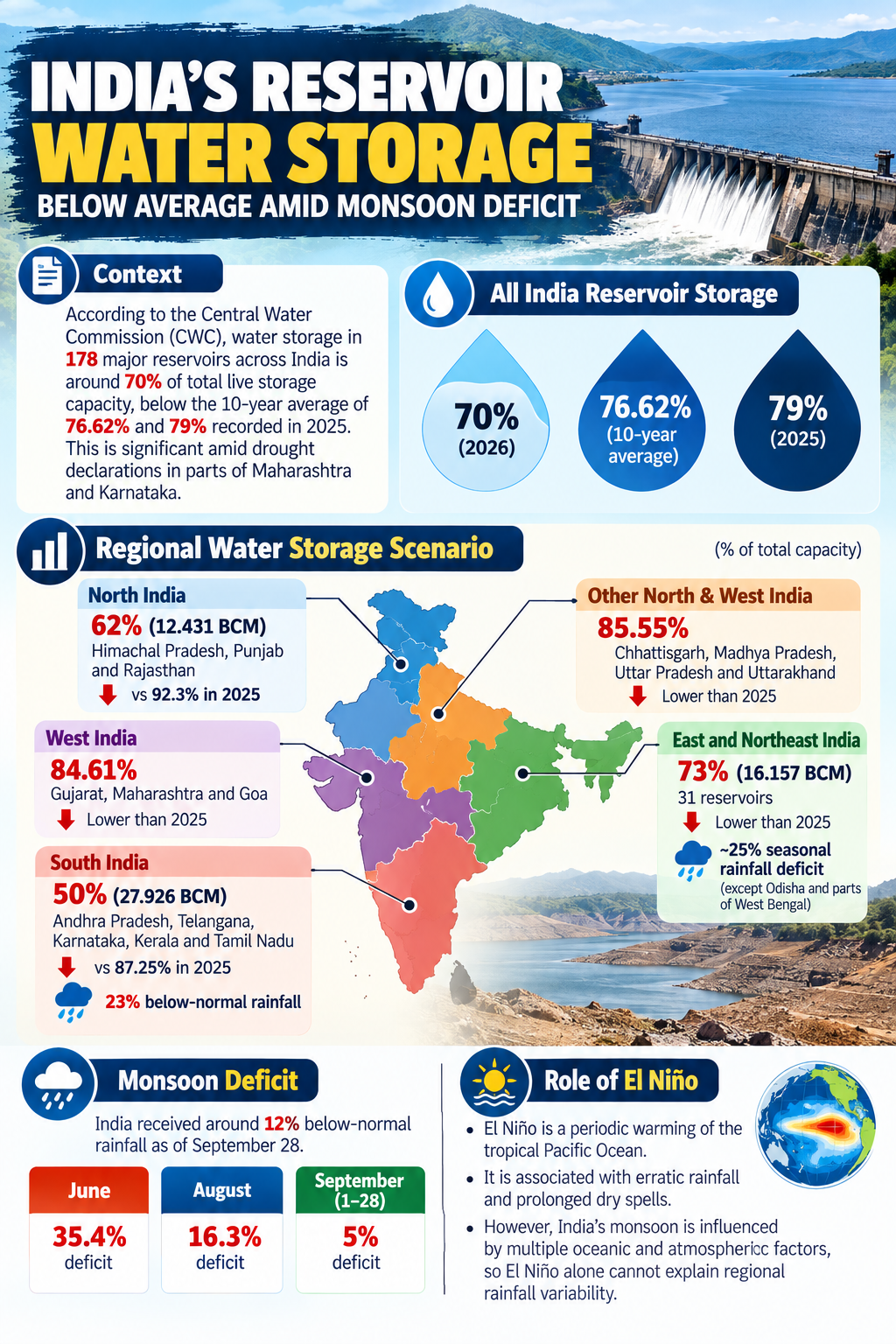
Recently, Central Water Commission (CWC) report stated that water storage in 178 major reservoirs across India stands at around 70% of their total live storage capacity. This is below the 10-year average of 76.62% and the 79% recorded during the same period in 2025. The situation assumes greater significance amid drought declarations in parts of Maharashtra and Karnataka.
Regional Water Storage Scenario:
-
-
- South India faces the most serious water-storage stress. Reservoirs in Andhra Pradesh, Telangana, Karnataka, Kerala and Tamil Nadu contain only 50% (27.926 BCM) of their capacity, compared with 87.25% last year. The region has also recorded 23% below-normal rainfall as of September 28.
- In North India, reservoirs in Himachal Pradesh, Punjab and Rajasthan are at 62% (12.431 BCM), sharply lower than 92.3% last year.
- The East and Northeast have around 73% (16.157 BCM) storage across 31 reservoirs, while the region has experienced a seasonal rainfall deficit of around 25%, except for relatively better conditions in Odisha and parts of West Bengal.
- Reservoirs in Gujarat, Maharashtra and Goa hold around 84.61%, while those in Chhattisgarh, Madhya Pradesh, Uttar Pradesh and Uttarakhand hold 85.55%, both lower than their corresponding 2025 levels.
- South India faces the most serious water-storage stress. Reservoirs in Andhra Pradesh, Telangana, Karnataka, Kerala and Tamil Nadu contain only 50% (27.926 BCM) of their capacity, compared with 87.25% last year. The region has also recorded 23% below-normal rainfall as of September 28.
-
Monsoon Deficit and El Niño:
-
-
- India received around 12% below-normal rainfall as of September 28. June recorded a major deficit of 35.4%, August had a 16.3% deficit, while September 1–28 recorded a 5% deficit.
- The strengthening of El Niño, a periodic warming of the tropical Pacific Ocean, has been associated with erratic rainfall and prolonged dry spells. However, India's monsoon is influenced by multiple oceanic and atmospheric factors, so El Niño alone cannot explain regional rainfall variability.
- India received around 12% below-normal rainfall as of September 28. June recorded a major deficit of 35.4%, August had a 16.3% deficit, while September 1–28 recorded a 5% deficit.
-
Why Reservoir Storage Matters?
The Southwest Monsoon contributes over 70% of India's annual rainfall and replenishes reservoirs that support:
-
-
- Drinking-water supply
- Irrigation and agriculture
- Hydropower generation
- Industrial requirements
- Groundwater recharge
- Low reservoir levels at the end of the monsoon can therefore increase pressure on agriculture, drinking water and energy resources during the dry season.
- Drinking-water supply
-
Key Concerns:
The situation highlights India's vulnerability to hydrological drought, uneven rainfall distribution, groundwater depletion, inefficient irrigation and water-intensive cropping patterns. Reduced surface-water availability may also increase groundwater extraction and aggravate inter-State water disputes.
Way Forward:
India needs integrated water-resource management based on river-basin planning, rainwater harvesting, watershed development and groundwater recharge. Expansion of micro-irrigation, crop diversification, drought-resistant crops and climate-resilient agriculture can reduce water demand. Real-time reservoir monitoring and improved Centre-State coordination are also essential.
Conclusion:
The 2026 reservoir situation demonstrates that India's water challenge is not merely about the quantity of rainfall, but also its timing, distribution and efficient management. Building climate-resilient and integrated water systems is essential for long-term water, food and energy security.



