
Context:
Recently, the Reserve Bank of India (RBI) introduced a new prudential framework for Specified Non-Financial Assets (SNFAs) under the Commercial Banks – Resolution of Stressed Assets Directions, 2025 (Third Amendment Directions, 2026). The framework prescribes uniform rules for banks to acquire, manage, and dispose of immovable assets obtained from defaulting borrowers.
What are Specified Non-Financial Assets (SNFAs)?
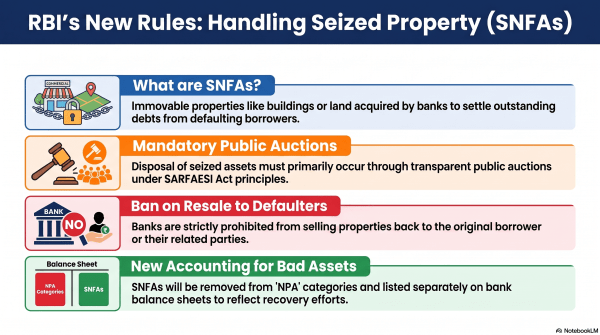
Specified Non-Financial Assets (SNFAs) are immovable properties acquired by banks in full or partial settlement of loans that have become Non-Performing Assets (NPAs). These assets are not part of a bank's regular business but are acquired as a recovery mechanism when borrowers default on loan repayment.
Examples of SNFAs
-
-
- Residential buildings
- Commercial properties
- Industrial land
- Warehouses
- Other immovable assets transferred to banks against outstanding loans
- Residential buildings
-
Key Features of the New Framework:
-
- Banks can acquire SNFAs only after a loan is classified as an NPA.
- Every bank must frame an internal policy for acquisition, valuation, management, and disposal of SNFAs.
- Disposal should primarily be through public auctions, following the principles of the SARFAESI Act.
- Banks are prohibited from selling repossessed properties back to the original borrower or related parties.
- SNFAs will be reported separately in bank balance sheets as "Non-Banking Assets Acquired in Satisfaction of Claims" and will not form part of Gross or Net NPAs.
- Banks can acquire SNFAs only after a loan is classified as an NPA.
What is a Non-Performing Asset (NPA)?
A loan becomes an NPA when the interest or principal remains overdue for more than 90 days.
Special Mention Accounts (SMA)
Before becoming an NPA, stressed loan accounts are classified as:
-
-
- SMA-0: Early signs of stress (overdue up to 30 days).
- SMA-1: Overdue between 31–60 days.
- SMA-2: Overdue between 61–90 days.
- SMA-0: Early signs of stress (overdue up to 30 days).
-
Types of NPAs:
-
-
- Sub-standard Asset: NPA for up to 12 months.
- Doubtful Asset: NPA for more than 12 months.
- Loss Asset: Considered uncollectible by the bank.
- Sub-standard Asset: NPA for up to 12 months.
-
What is the SARFAESI Act?
The Securitisation and Reconstruction of Financial Assets and Enforcement of Security Interest (SARFAESI) Act, 2002 empowers banks and financial institutions to recover bad loans without court intervention.
Key Provisions
-
-
- Banks can take possession of secured assets after issuing a 60-day notice to the borrower.
- They can sell, transfer, or manage the assets to recover dues.
- Borrowers can appeal before the Debt Recovery Tribunal (DRT).
- Banks can take possession of secured assets after issuing a 60-day notice to the borrower.
-
Significance:
-
-
- Brings transparency and uniformity in handling repossessed assets.
- Strengthens recovery of stressed loans.
- Improves governance and accountability in banks.
- Enhances financial stability by ensuring efficient disposal of acquired assets.
- Brings transparency and uniformity in handling repossessed assets.
-
Conclusion:
The RBI's new SNFA framework provides a standardized mechanism for managing immovable assets acquired from loan defaulters. It is expected to improve loan recovery, strengthen bank balance sheets, and enhance the overall efficiency of India's banking system.



