
Context:
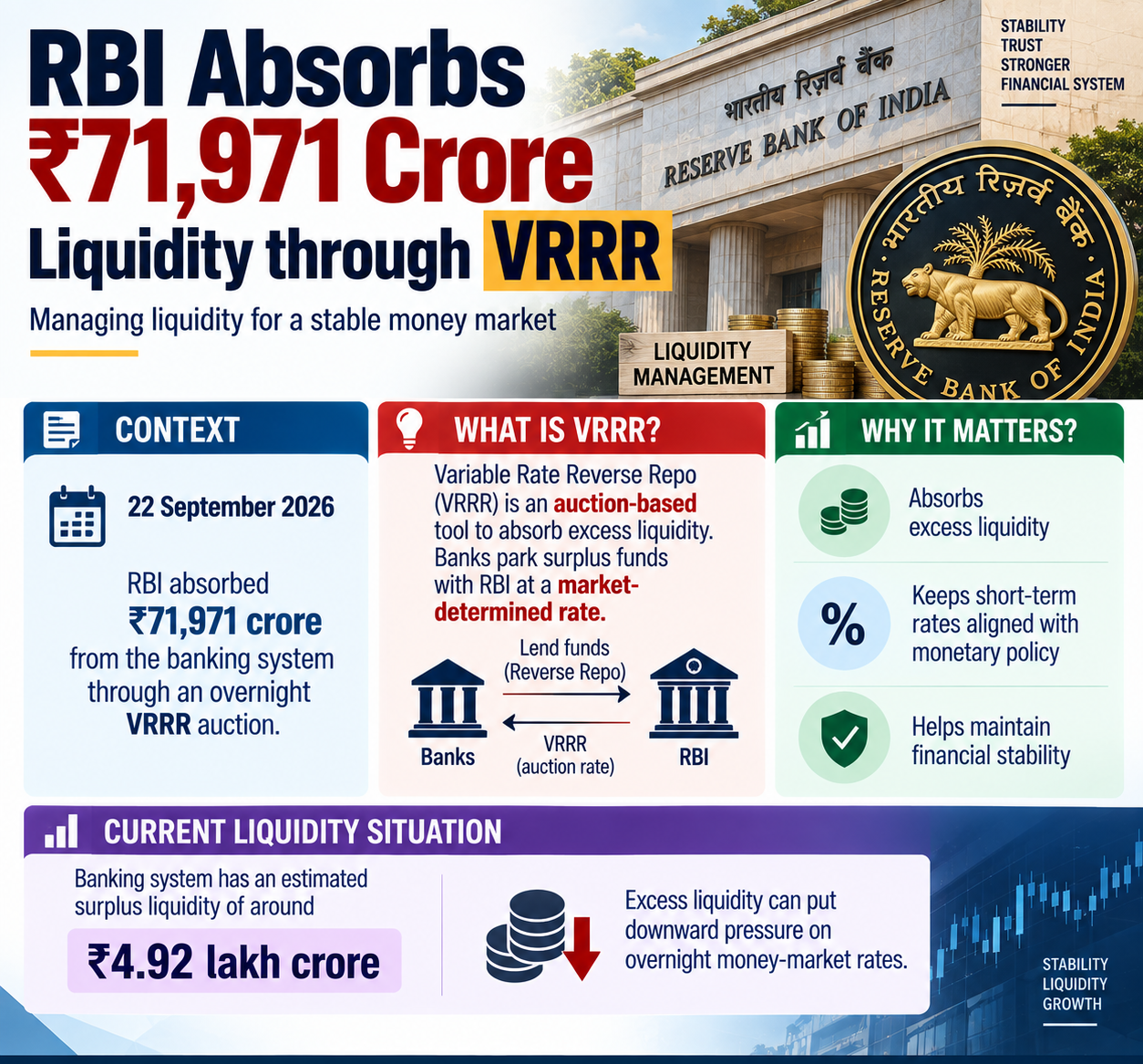
Recently, The Reserve Bank of India (RBI) absorbed ₹71,971 crore from the banking system through an overnight Variable Rate Reverse Repo (VRRR) auction on 22 September 2026. The move aims to manage surplus liquidity and keep short-term money-market rates aligned with the monetary-policy framework.
What is VRRR?
-
-
- Variable Rate Reverse Repo (VRRR) is an auction-based liquidity-absorption tool through which banks temporarily park surplus funds with the RBI at a market-determined rate.
- Reverse Repo: Banks lend funds to RBI.
- VRRR: Interest rate is determined through auction.
- Purpose: Absorb excess/transient liquidity.
- Reverse Repo: Banks lend funds to RBI.
- It helps keep the Weighted Average Call Rate (WACR) aligned with the policy repo rate. RBI has used VRRR auctions as part of its liquidity-management framework.
- Variable Rate Reverse Repo (VRRR) is an auction-based liquidity-absorption tool through which banks temporarily park surplus funds with the RBI at a market-determined rate.
-
Current Liquidity Situation:
-
-
- The banking system currently has an estimated surplus liquidity of around ₹4.92 lakh crore. Such excess liquidity can put downward pressure on overnight money-market rates and cause them to move below the RBI's desired operating level.
- The RBI therefore uses liquidity-management instruments to maintain orderly and balanced financial conditions.
- The banking system currently has an estimated surplus liquidity of around ₹4.92 lakh crore. Such excess liquidity can put downward pressure on overnight money-market rates and cause them to move below the RBI's desired operating level.
-
Reasons for Surplus Liquidity:
The present liquidity surplus has been attributed mainly to:
-
-
- Heavy mobilisation of FCNR(B) deposits: Foreign Currency Non-Resident deposits brought additional foreign-currency inflows into the banking system.
- Currency swaps with RBI: Such operations can alter rupee liquidity available to banks.
- Government expenditure: Month-end spending on salaries, pensions and other government payments injects liquidity into the banking system.
- Heavy mobilisation of FCNR(B) deposits: Foreign Currency Non-Resident deposits brought additional foreign-currency inflows into the banking system.
-
Why is RBI Absorbing Liquidity?
-
-
- Inflation Control: Excess liquidity can increase credit and aggregate demand, creating inflationary pressures.
- Monetary Policy Transmission: Liquidity management helps short-term market rates move in line with the policy rate.
- Financial Stability: It prevents excessive surplus funds from encouraging speculative or riskier lending.
- Managing Capital Inflows: Large capital/forex inflows can create additional rupee liquidity, requiring sterilisation.
- Inflation Control: Excess liquidity can increase credit and aggregate demand, creating inflationary pressures.
-
Legal and Institutional Framework:
-
-
- Reserve Bank of India Act, 1934
- Section 17: Provides the statutory framework for RBI’s banking and monetary operations, including liquidity-management operations.
- Section 42(1): Empowers RBI to prescribe Cash Reserve Ratio (CRR) for scheduled banks.
- The Standing Deposit Facility (SDF) was enabled through an amendment to Section 17. Unlike collateralised reverse-repo operations, SDF allows RBI to absorb liquidity without providing collateral.
- Section 17: Provides the statutory framework for RBI’s banking and monetary operations, including liquidity-management operations.
- Banking Regulation Act, 1949
- Section 24: Provides the statutory framework for the Statutory Liquidity Ratio (SLR), requiring banks to maintain prescribed liquid assets.
- Section 24: Provides the statutory framework for the Statutory Liquidity Ratio (SLR), requiring banks to maintain prescribed liquid assets.
- Reserve Bank of India Act, 1934
-
Major Liquidity Absorption Instruments:
|
Instrument |
Nature |
Mechanism |
|
SDF |
Overnight |
Banks deposit surplus funds with RBI without collateral |
|
VRRR |
Short-term |
Auction-based liquidity absorption |
|
OMO Sales |
Durable |
RBI sells Government Securities |
|
CRR |
Structural |
Banks maintain cash reserves with RBI |
|
MSS |
Structural |
Special securities absorb excess liquidity |
About LAF Corridor:
-
-
- SDF: Floor of the corridor
- Repo Rate: Central policy rate
- MSF: Ceiling of the corridor
- RBI uses this framework to influence short-term interest rates and liquidity conditions.
- SDF: Floor of the corridor
-
Significance for India:
-
-
- Supports price stability.
- Improves monetary-policy transmission.
- Maintains orderly money markets.
- Prevents excessive surplus liquidity.
- Balances liquidity management with credit availability.
- Supports price stability.
-
Conclusion:
The RBI’s VRRR operation demonstrates fine-tuning of systemic liquidity without necessarily changing the policy repo rate. Such instruments are essential for maintaining monetary stability, effective policy transmission and orderly functioning of financial markets.



