
RBI’s Proposed "Universal Kill Switch"
Context:
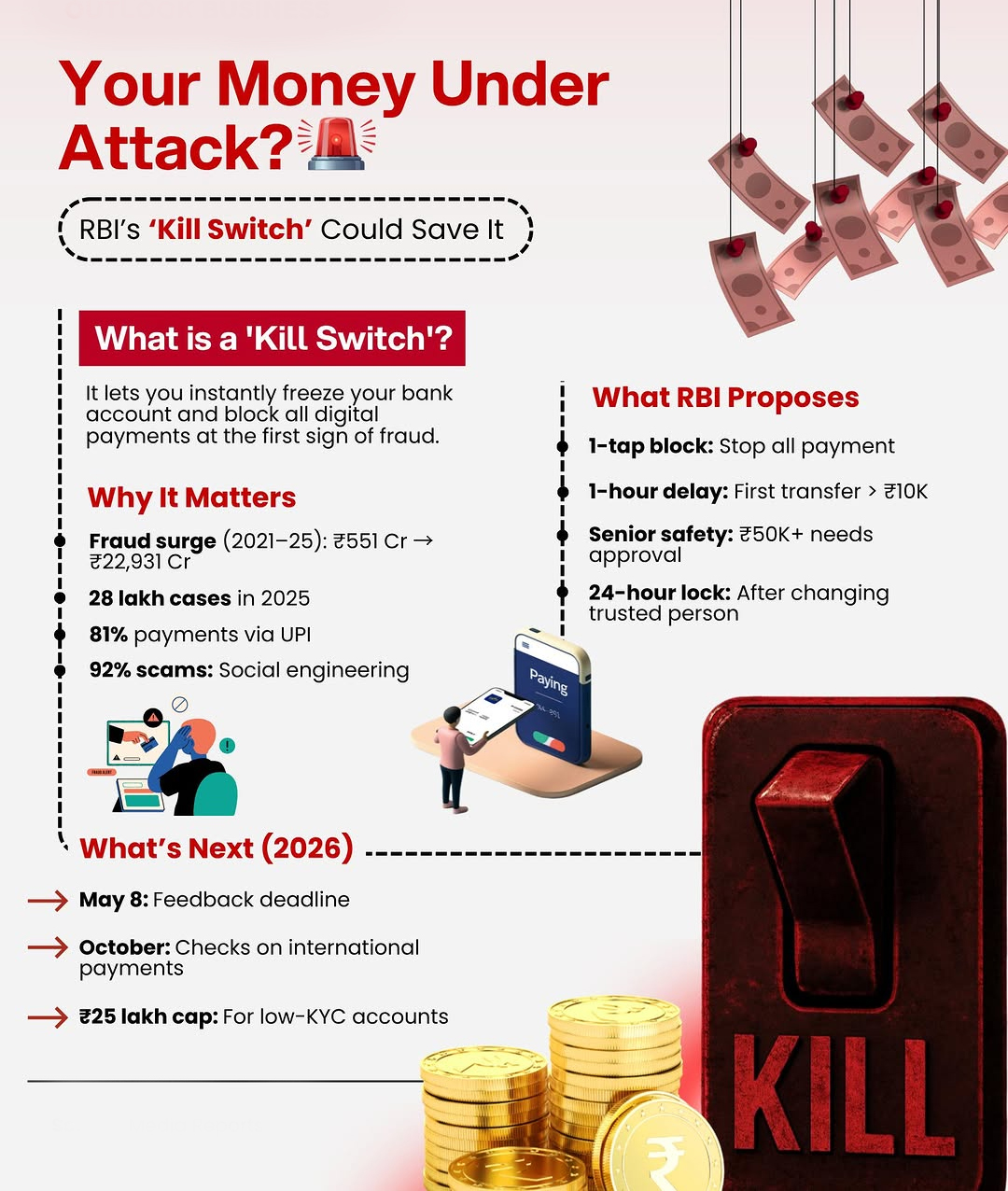
Recently, The Reserve Bank of India (RBI), in its April 2026 discussion paper, proposed a series of radical measures to curb the rising tide of digital payment frauds. The centerpiece of these proposals is a "Universal Kill Switch" designed to empower customers against increasingly sophisticated cybercrimes.
About Universal Kill Switch:
It is a unified, emergency mechanism that allows a bank customer to instantly disable all digital channels—including UPI, NEFT/IMPS, Mobile Banking, and Debit/Credit Cards—through a single action.
-
-
- Objective: To provide an "emergency brake" when a user suspects their account has been compromised or they have fallen victim to an Authorized Push Payment (APP) fraud (where the victim is manipulated into sending money).
- One-Stop Solution: Currently, users often have to block different services individually (e.g., blocking a card via an app but calling a helpline for UPI). The Kill Switch centralizes this process.
- Reactivation Protocol: To ensure security, restoring digital access would involve high-level authentication, such as a physical visit to a bank branch or advanced biometric verification, to prevent fraudsters from undoing the block.
- Objective: To provide an "emergency brake" when a user suspects their account has been compromised or they have fallen victim to an Authorized Push Payment (APP) fraud (where the victim is manipulated into sending money).
-
Need for Such Measures:
-
-
- Digital Explosion: India’s digital payment ecosystem is one of the world's largest, making it a prime target for cyber-attacks.
- Complexity of Scams: The rise of deepfakes, AI-generated voice cloning, and sophisticated phishing has made traditional security less effective against social engineering.
- Protection for Vulnerable Groups: Senior citizens and digitally illiterate populations are often the primary targets of "mule account" operators and impersonation scams.
- Digital Explosion: India’s digital payment ecosystem is one of the world's largest, making it a prime target for cyber-attacks.
-
Other Key Proposals in the Discussion Paper:
-
-
- Lagged Credits: A mandatory 1-hour delay for first-time transfers to a new beneficiary or for transactions exceeding ₹10,000.
- The "Trusted Person" Model: For high-value transactions (above ₹50,000) by senior citizens, a secondary approval from a pre-designated "trusted person" may be required.
- Mule Account Limits: Capping annual credits (e.g., at ₹25 lakh) for accounts flagged as potential "mule" accounts (used to launder stolen money).
- Lagged Credits: A mandatory 1-hour delay for first-time transfers to a new beneficiary or for transactions exceeding ₹10,000.
-
Challenges and Concerns:
-
-
- User Friction: Instant payments are the backbone of the Indian digital economy. Introducing "lags" or complex kill switches could impact the ease of doing business and consumer convenience.
- Exclusions: RBI suggests that regular standing instructions (EMIs, utility bills) should not be affected by the kill switch, which requires a highly sophisticated technical backend to implement.
- User Friction: Instant payments are the backbone of the Indian digital economy. Introducing "lags" or complex kill switches could impact the ease of doing business and consumer convenience.
-
Conclusion:
The proposal marks a shift from "reactive" to "proactive" banking security. While it may introduce slight friction in digital journeys, it addresses the critical need for a safety net in an era where cyber-fraud is becoming a major threat to financial stability and public trust in digital systems.



