
Context:
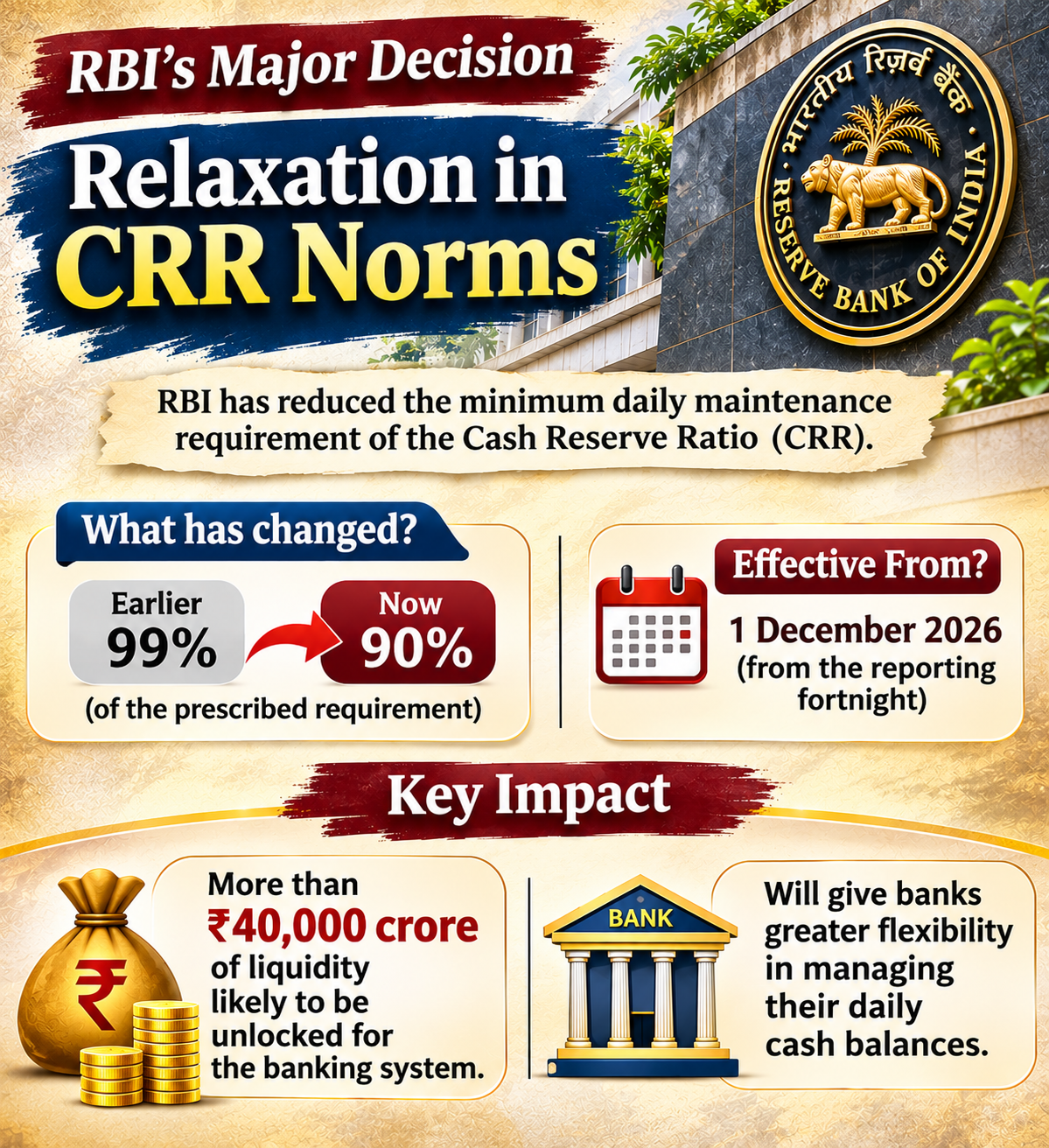
Recently, the Reserve Bank of India (RBI) reduced the minimum daily maintenance requirement of the Cash Reserve Ratio (CRR) from 99% to 90% of the prescribed requirement, effective from the reporting fortnight beginning 1 December 2026. The decision is expected to unlock more than ₹40,000 crore of liquidity for the banking system. It aims to provide banks with greater flexibility in managing their daily cash balances amid tightening liquidity conditions.
What is Cash Reserve Ratio (CRR)?
-
-
- Cash Reserve Ratio refers to the minimum percentage of a bank's Net Demand and Time Liabilities (NDTL) that it must maintain as a cash balance with the RBI. Currently, the prescribed CRR rate is 3% of NDTL. Banks do not earn interest on the CRR balance maintained with the RBI.
- An increase in CRR reduces the funds available for lending, whereas a reduction increases the liquidity available with banks. Thus, CRR is an important quantitative monetary policy instrument used to regulate credit creation and liquidity in the economy.
- Cash Reserve Ratio refers to the minimum percentage of a bank's Net Demand and Time Liabilities (NDTL) that it must maintain as a cash balance with the RBI. Currently, the prescribed CRR rate is 3% of NDTL. Banks do not earn interest on the CRR balance maintained with the RBI.
-
What Has Changed?
-
-
- The RBI has reduced the minimum daily CRR maintenance requirement from 99% to 90%, without changing the prescribed CRR rate of 3%.
- For example, if a bank is required to maintain an average CRR balance of ₹100 crore during a reporting fortnight, it must maintain at least ₹90 crore daily instead of ₹99 crore. However, the average balance maintained throughout the fortnight must still meet the full prescribed requirement of ₹100 crore.
- The earlier 99% requirement was introduced on 16 October 2026 when banking system liquidity was in surplus.
- The RBI has reduced the minimum daily CRR maintenance requirement from 99% to 90%, without changing the prescribed CRR rate of 3%.
-
Legal and Regulatory Framework:
The CRR mechanism is primarily governed by the following provisions:
-
-
- Section 42 of the RBI Act, 1934: Empowers the RBI to prescribe the average daily cash reserve balance that scheduled banks must maintain as a percentage of their NDTL. Section 42(3) also provides for penal interest in case of non-compliance.
- Section 18 of the Banking Regulation Act, 1949: Provides for cash reserve requirements applicable to banking companies that are not scheduled banks.
- Section 35A of the Banking Regulation Act, 1949: Empowers the RBI to issue directions to banking companies in the public interest and in the interest of banking policy.
- Section 42 of the RBI Act, 1934: Empowers the RBI to prescribe the average daily cash reserve balance that scheduled banks must maintain as a percentage of their NDTL. Section 42(3) also provides for penal interest in case of non-compliance.
-
Significance:
The decision will improve banks' short-term liquidity management, support credit availability to businesses and MSMEs, reduce pressure on overnight money market rates and improve monetary policy transmission. It also provides flexibility without changing the overall reserve requirement.
Conclusion:
The RBI's decision reflects a flexible approach to liquidity management. By reducing the daily CRR maintenance requirement without changing the prescribed CRR rate, the central bank seeks to improve banking liquidity while maintaining monetary discipline. It highlights the importance of balancing credit growth, financial stability and macroeconomic management.