
Context:
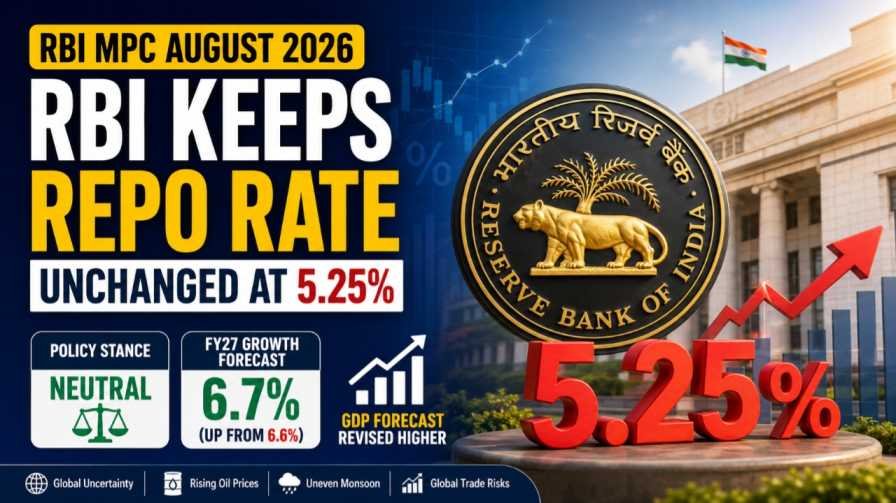
Recently, the Monetary Policy Committee (MPC) of the Reserve Bank of India (RBI) unanimously decided to keep the policy repo rate unchanged at 5.25% under the Liquidity Adjustment Facility (LAF), while retaining its neutral policy stance. Consequently, the Standing Deposit Facility (SDF) remains at 5%, and the Marginal Standing Facility (MSF) along with the Bank Rate continues at 5.5%.
About Liquidity Adjustment Facility (LAF):
The Liquidity Adjustment Facility (LAF) is a key quantitative monetary policy tool used by the Reserve Bank of India (RBI) to inject or absorb short-term liquidity into or from the banking system using government securities as collateral. It was introduced in June 2000 based on the recommendations of the Narasimham Committee II.
Core Components of LAF:
-
-
- Repo Rate (Repurchase Rate): The rate at which the RBI lends short-term funds to commercial banks against government securities. It injects liquidity into the banking system.
- Reverse Repo Rate: The rate at which the RBI borrows funds from commercial banks, thereby absorbing excess liquidity from the banking system.
- Standing Deposit Facility (SDF): A collateral-free liquidity absorption tool introduced by the RBI. It now serves as the lower bound (floor) of the LAF corridor, replacing the fixed-rate reverse repo as the principal instrument for absorbing surplus liquidity.
- Repo Rate (Repurchase Rate): The rate at which the RBI lends short-term funds to commercial banks against government securities. It injects liquidity into the banking system.
-
Reasons behind the Decision:
The RBI decided to maintain the repo rate due to the following reasons:
-
-
- Resilient Domestic Growth: High-frequency indicators show robust private consumption, steady investment, and healthy domestic demand.
- Global Economic Uncertainty: Ongoing geopolitical tensions, supply chain disruptions, and uncertain global growth continue to pose risks to the Indian economy.
- Monsoon Risks: An uneven southwest monsoon under El Niño conditions could adversely affect agricultural production, rural demand, and food inflation.
- Policy Flexibility: Retaining a neutral stance allows the RBI to respond appropriately to future changes in inflation and growth conditions without committing to either tightening or easing monetary policy.
- Resilient Domestic Growth: High-frequency indicators show robust private consumption, steady investment, and healthy domestic demand.
-
What is Monetary Policy?
Monetary policy refers to the measures adopted by the RBI to regulate money supply, interest rates, and credit conditions in the economy. Its objectives include:
-
-
- Maintaining price stability.
- Controlling inflation.
- Supporting sustainable economic growth.
- Ensuring financial stability.
- Facilitating adequate credit flow.
- Maintaining price stability.
-
About Monetary Policy Committee (MPC):
The MPC is a six-member statutory body constituted under Section 45ZB of the RBI Act, 1934, based on the recommendations of the Urjit Patel Committee.
Composition:
-
-
- RBI Governor (Chairperson)
- RBI Deputy Governor in charge of Monetary Policy
- One RBI official
- Three external members nominated by the Government of India
- RBI Governor (Chairperson)
-
Key Features:
-
-
- Meets at least four times a year.
- Decisions are taken by majority vote.
- RBI Governor has a casting vote in case of a tie.
- Determines the repo rate to achieve the inflation target.
- Meets at least four times a year.
-
Conclusion:
The RBI's decision to keep the repo rate unchanged at 5.25% reflects a balanced and forward-looking monetary policy aimed at sustaining economic growth while keeping inflation within the target range. By maintaining a neutral stance amid global uncertainties and domestic risks, the MPC seeks to preserve macroeconomic stability and retain flexibility to respond to evolving economic conditions.



