
RBI Monetary Policy Review 2026: Repo Rate, GDP Growth and Key Reforms
Context:
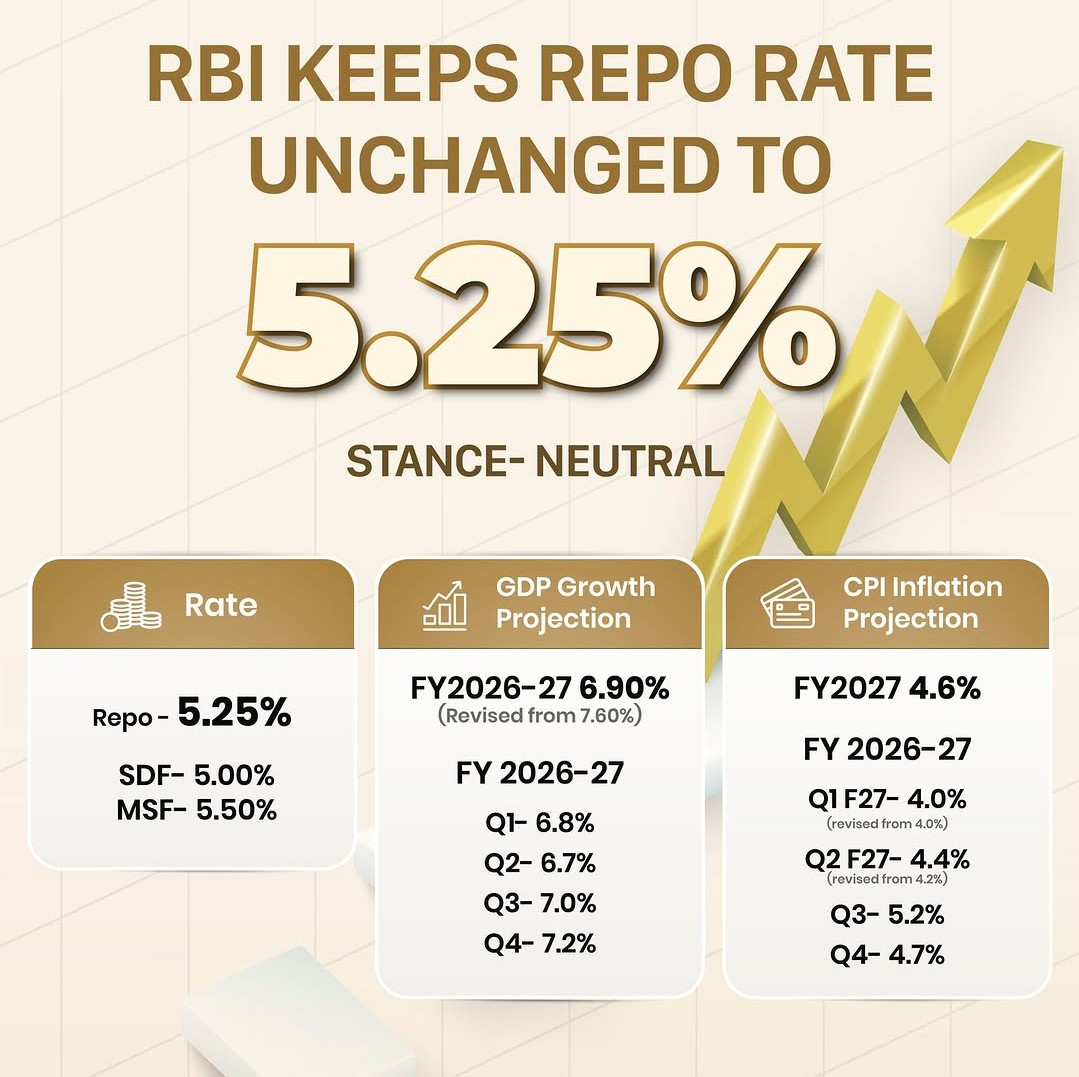
Recently, the Monetary Policy Committee (MPC) of the Reserve Bank of India (RBI) announced the decisions of its first bi-monthly meeting for the financial year 2026-27. Considering global geopolitical tensions and domestic inflationary pressures, the committee, chaired by Governor Sanjay Malhotra, adopted a ‘Neutral’ policy stance and decided to keep the repo rate unchanged at 5.25%.
Key Policy Rates:
|
Rate |
Current Status |
|
Repo Rate |
5.25% (unchanged) |
|
Reverse Repo Rate (SDF) |
5.00% |
|
Bank Rate |
5.50% |
|
Cash Reserve Ratio (CRR) |
3.00% |
|
Statutory Liquidity Ratio (SLR) |
18.00% |
Major Economic Estimates:
-
-
- GDP Growth Forecast: RBI has projected real GDP growth at 6.9% for FY 2026-27. Although lower than last year’s 7.6%, India remains the fastest-growing major economy despite signs of a global slowdown. The moderation in growth is primarily due to disruptions in global supply chains caused by ongoing conflicts in West Asia (US-Iran tensions).
- Inflation (CPI): Consumer Price Index (CPI)-based inflation is projected at 4.6% for FY 2026-27.
- Challenges: Volatility in crude oil prices and climate-induced impacts on food prices.
- Strategy: RBI aims to bring inflation closer to the medium-term target of 4%, while supporting economic growth.
- Challenges: Volatility in crude oil prices and climate-induced impacts on food prices.
- GDP Growth Forecast: RBI has projected real GDP growth at 6.9% for FY 2026-27. Although lower than last year’s 7.6%, India remains the fastest-growing major economy despite signs of a global slowdown. The moderation in growth is primarily due to disruptions in global supply chains caused by ongoing conflicts in West Asia (US-Iran tensions).
-
Key Policy Reforms:
-
-
- Ease of Doing Business: RBI has proposed removing the due diligence requirement under TReDS (Trade Receivables Discounting System) for micro, small, and medium enterprises (MSMEs), improving access to working capital and alleviating liquidity stress for small businesses.
- Financial Market Inclusion: Non-banking financial companies (NBFCs) and housing finance companies (HFCs) are now permitted to participate in the term money market, enhancing liquidity and strengthening credit distribution.
- Banking Reforms: Bank boards are advised to focus more on policy matters rather than daily operations. The requirement to maintain an Investment Fluctuation Reserve (IFR) has been proposed for removal, freeing additional capital for operational purposes.
- Ease of Doing Business: RBI has proposed removing the due diligence requirement under TReDS (Trade Receivables Discounting System) for micro, small, and medium enterprises (MSMEs), improving access to working capital and alleviating liquidity stress for small businesses.
-
About the Monetary Policy Committee (MPC):
The MPC is a 6-member statutory body of the RBI, responsible for determining key policy rates such as the repo rate to control inflation and balance economic growth. Constituted in 2016, it meets at least four times a year.
-
-
- Composition: 3 members from RBI (including the Governor) and 3 appointed by the Government of India.
- Chairperson: RBI Governor.
- Primary Function: To achieve 4% inflation (±2% tolerance band).
- Decision Process: Each member has one vote; in case of a tie, the Governor has the casting vote.
Significance: MPC ensures transparency, accountability, and stability in India’s monetary policy.
- Composition: 3 members from RBI (including the Governor) and 3 appointed by the Government of India.
-
Conclusion:
The RBI’s ‘Neutral’ stance signals that the central bank is not only focused on controlling inflation but also aims to maintain the momentum of economic growth. Future monetary policy will largely depend on incoming data and the global geopolitical situation.



