
Context:
Recently, Israel reopened the Rafah border crossing between the Gaza Strip and Egypt on a limited basis for pedestrian movement under a U.S.-brokered ceasefire framework that began in October 2025. This marks the first significant access through Rafah since Israel took control of the area in May 2024 during its conflict with Hamas. While the reopening is highly restricted, it represents a critical though constrained, humanitarian step, particularly for medical patients and returning civilians.
Geographical and Political Background:
-
-
-
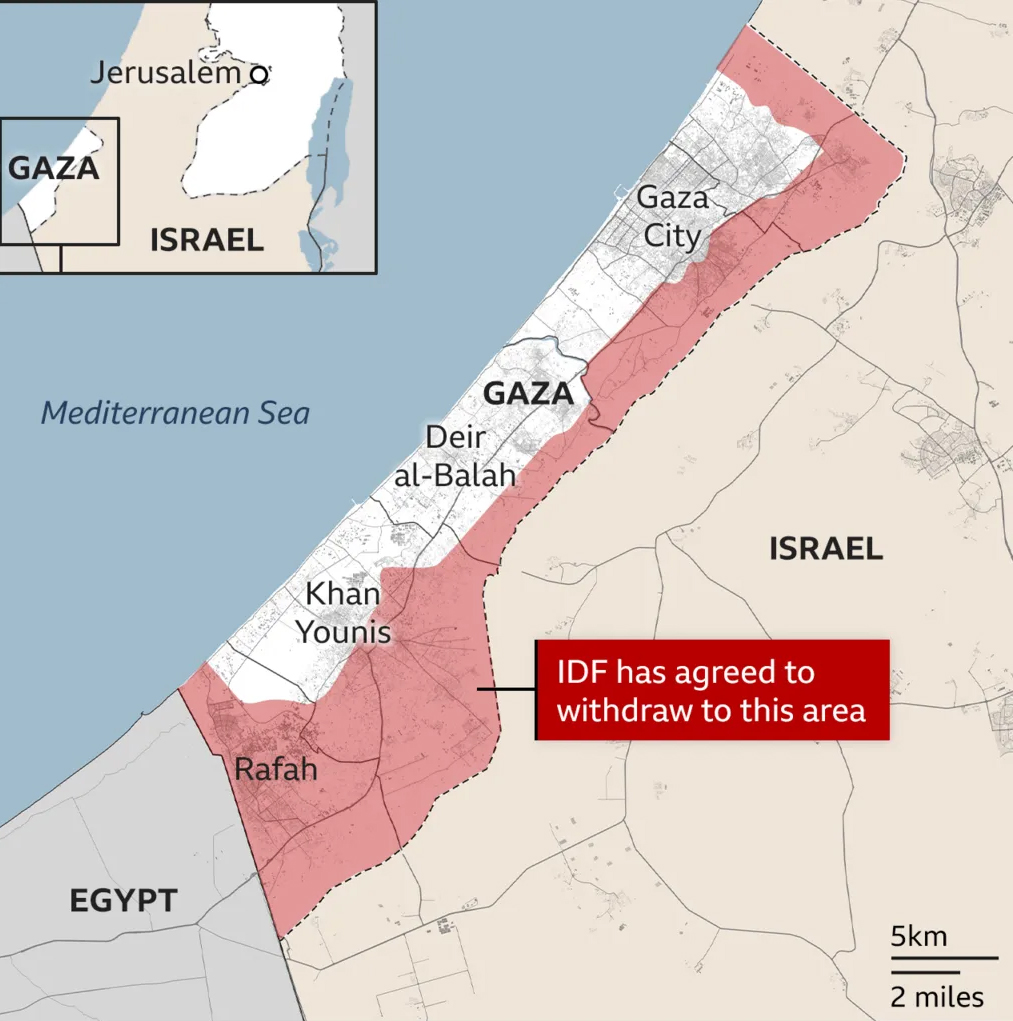
- The Gaza Strip is a narrow Palestinian territory along the eastern Mediterranean coast, bordering Israel to the north and east and Egypt to the southwest. It has long been a flashpoint in the Israeli–Palestinian conflict, shaped by contested claims over land, identity, and governance.
- Since 1967, Gaza has experienced periods of Israeli military control and blockade, and since 2007, it has been governed by Hamas, which is designated as a terrorist organisation by Israel, the United States, and the European Union. The conflict escalated sharply on 7 October 2023, when Hamas launched a major attack on southern Israel, triggering a prolonged Israeli military campaign in Gaza.
- The Gaza Strip is a narrow Palestinian territory along the eastern Mediterranean coast, bordering Israel to the north and east and Egypt to the southwest. It has long been a flashpoint in the Israeli–Palestinian conflict, shaped by contested claims over land, identity, and governance.
-
-
Strategic Importance of Rafah:
-
-
-
- The Rafah crossing is Gaza’s primary access point to the outside world that bypasses Israel. Its reopening, although limited and tightly controlled, enables rare movement of people and provides symbolic relief to a territory that has remained largely isolated due to prolonged conflict and border closures.
- The Rafah crossing is Gaza’s primary access point to the outside world that bypasses Israel. Its reopening, although limited and tightly controlled, enables rare movement of people and provides symbolic relief to a territory that has remained largely isolated due to prolonged conflict and border closures.
-
-
About Trump’s Gaza Peace Plan:
-
-
-
- In September 2025, U.S. President Donald Trump unveiled a 20-point Gaza peace proposal aimed at ending the Israel–Hamas conflict and establishing a framework for humanitarian relief and long-term stability. The plan calls for an immediate ceasefire, the return of all hostages within 72 hours, and a phased withdrawal of Israeli forces contingent on de-escalation.
- The proposal envisions a demilitarised and redeveloped Gaza, free from terror threats, with governance initially managed by a transitional technocratic committee under an international “Board of Peace” chaired by Trump and comprising global figures such as former UK Prime Minister Tony Blair. Israel would refrain from annexation, while a multinational International Stabilization Force would ensure security and train local police. Humanitarian assistance and large-scale infrastructure reconstruction constitute core pillars of the plan.
- In September 2025, U.S. President Donald Trump unveiled a 20-point Gaza peace proposal aimed at ending the Israel–Hamas conflict and establishing a framework for humanitarian relief and long-term stability. The plan calls for an immediate ceasefire, the return of all hostages within 72 hours, and a phased withdrawal of Israeli forces contingent on de-escalation.
-
-
Conclusion:
The limited reopening of the Rafah crossing underscores ongoing efforts to ease humanitarian access amid the Gaza crisis. Trump’s peace initiative represents a comprehensive yet complex proposal linking ceasefire arrangements, security guarantees, governance restructuring, and post-conflict reconstruction. Its success will depend on fragile political dynamics among Israel, Hamas, and international stakeholders, which will ultimately shape prospects for peace and stability in the region.



