
Context:
Recently, The Cabinet Committee on Economic Affairs (CCEA) has approved an increase in the Minimum Support Prices (MSPs) for all six mandated Rabi crops for the 2027-28 Marketing Season. The decision aims to provide remunerative prices to farmers and encourage crop diversification towards pulses and oilseeds.
What is MSP?
-
-
- Minimum Support Price (MSP) is the price at which the government offers to procure certain agricultural commodities from farmers, providing a degree of price assurance when market prices are low.
- MSPs are announced for 22 mandated crops, while the government also announces a fair and remunerative price for sugarcane. The MSP recommendations are made by the Commission for Agricultural Costs and Prices (CACP) and approved by the government.
-
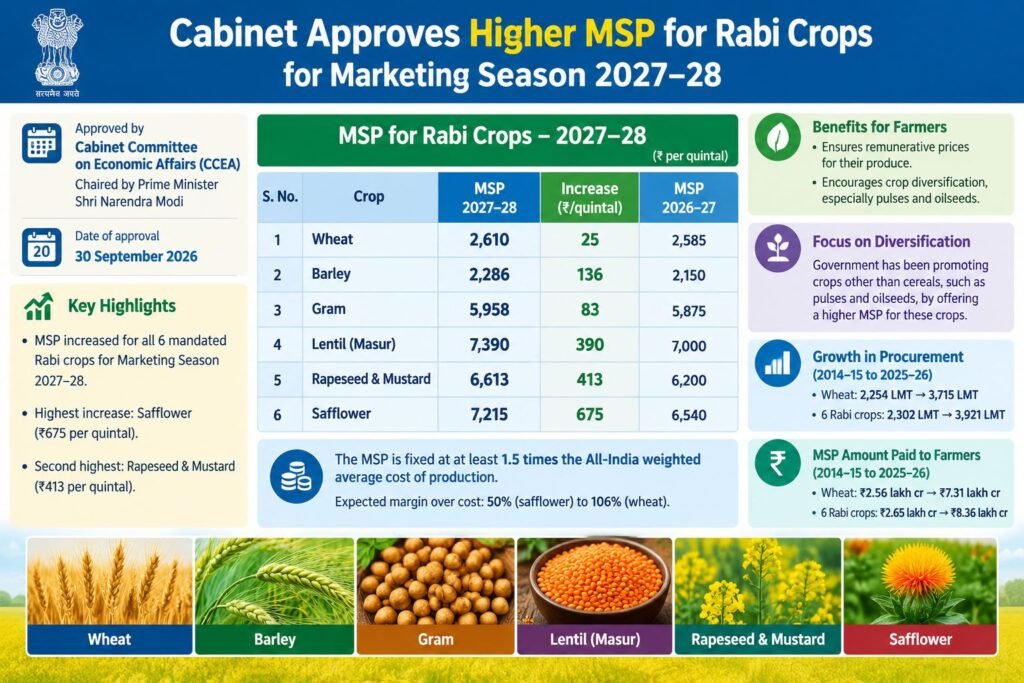
About 2027-28 Rabi Marketing Season MSP:
-
-
- For the 2027-28 Rabi Marketing Season, MSP for wheat has been increased by ₹25 to ₹2,610 per quintal, while barley has been raised by ₹136 to ₹2,286. MSP for gram has increased by ₹83 to ₹5,958, and lentil (masur) by ₹390 to ₹7,390 per quintal. The MSP for rapeseed and mustard has been increased by ₹413 to ₹6,613, while safflower has received the highest absolute increase of ₹675, taking its MSP to ₹7,215 per quintal.
- The government has stated that the revised MSPs are consistent with the policy announced in Union Budget 2018-19, under which MSP is to be fixed at least 1.5 times the all-India weighted average cost of production.
- For the 2027-28 Rabi Marketing Season, MSP for wheat has been increased by ₹25 to ₹2,610 per quintal, while barley has been raised by ₹136 to ₹2,286. MSP for gram has increased by ₹83 to ₹5,958, and lentil (masur) by ₹390 to ₹7,390 per quintal. The MSP for rapeseed and mustard has been increased by ₹413 to ₹6,613, while safflower has received the highest absolute increase of ₹675, taking its MSP to ₹7,215 per quintal.
-
Significance:
-
-
- The MSP hike is significant for farm income security and agricultural diversification. Higher increases for pulses and oilseeds can provide incentives to farmers to move beyond cereal-dominated cropping patterns. This is particularly relevant for India’s efforts to improve domestic production of pulses and edible oils and reduce import dependence.
- The policy can also strengthen food security by providing farmers with greater price assurance and encouraging continued agricultural production.
- The MSP hike is significant for farm income security and agricultural diversification. Higher increases for pulses and oilseeds can provide incentives to farmers to move beyond cereal-dominated cropping patterns. This is particularly relevant for India’s efforts to improve domestic production of pulses and edible oils and reduce import dependence.
-
Challenges:
MSP alone cannot guarantee higher farm incomes because actual procurement at MSP is not uniform across all crops and regions. Farmers may continue to sell in open markets when procurement facilities are inadequate or market prices fall below MSP. Storage constraints, inadequate market infrastructure, regional disparities in procurement and rising input costs also remain important concerns.
Way Forward:
The effectiveness of MSP policy should be complemented by expanded procurement infrastructure, better storage facilities, efficient agricultural markets, crop insurance, irrigation and investment in agricultural technology. Greater procurement of pulses and oilseeds can also support crop diversification and nutritional security.
Conclusion:
The approval of higher Rabi MSPs for 2027-28 reflects the government’s attempt to provide price support to farmers while promoting crop diversification. However, achieving sustainable farm incomes requires MSP to be supported by effective procurement, market access, infrastructure and productivity-enhancing measures.



