
Context:
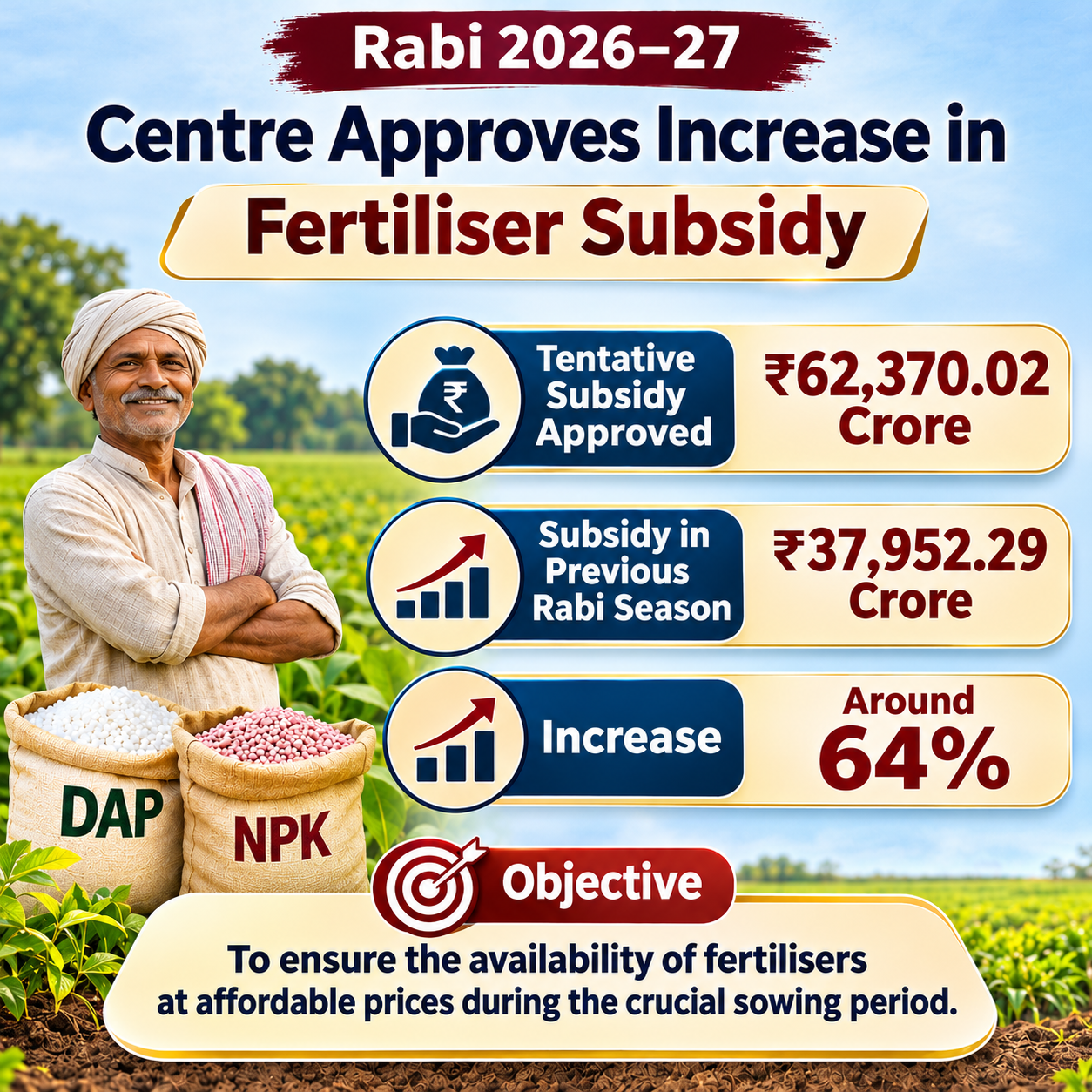
Recently, The Union Cabinet has approved the Nutrient Based Subsidy (NBS) rates for Phosphatic and Potassic (P&K) fertilisers for the Rabi 2026–27 season. The government has earmarked a tentative subsidy of ₹62,370.02 crore, around 64% higher than the ₹37,952.29 crore allocated for the previous Rabi season. The decision aims to ensure the availability of fertilisers at affordable prices during the crucial sowing period.
About Nutrient Based Subsidy Scheme:
-
-
- Launched on 1 April 2010, the NBS scheme provides subsidies on 28 grades of P&K fertilisers, including Di-Ammonium Phosphate (DAP). Under the scheme, the government fixes nutrient-wise subsidy rates, which are paid to fertiliser companies.
- This enables farmers to purchase fertilisers at subsidised prices. The scheme seeks to promote balanced nutrient application and reduce excessive dependence on any single fertiliser.
- Launched on 1 April 2010, the NBS scheme provides subsidies on 28 grades of P&K fertilisers, including Di-Ammonium Phosphate (DAP). Under the scheme, the government fixes nutrient-wise subsidy rates, which are paid to fertiliser companies.
-
Key Features of the Decision:
-
-
- The approved subsidy rates for Rabi 2026–27 are ₹94.21 per kg for nitrogen, ₹66.11 per kg for phosphorus, ₹2.38 per kg for potash and ₹10.42 per kg for sulphur. The government has also continued special support to maintain the DAP price at ₹1,350 per 50-kg bag.
- Similar provisions have been extended to imported and domestic Triple Super Phosphate and imported Mono Ammonium Phosphate.
- Additional support for Single Super Phosphate and ammonium sulphate has also been continued. The government has provided special assistance to domestic sulphur and sulphuric acid manufacturers to address rising input costs.
- The approved subsidy rates for Rabi 2026–27 are ₹94.21 per kg for nitrogen, ₹66.11 per kg for phosphorus, ₹2.38 per kg for potash and ₹10.42 per kg for sulphur. The government has also continued special support to maintain the DAP price at ₹1,350 per 50-kg bag.
-
Significance:
The higher subsidy will protect farmers from fluctuations in international fertiliser prices, transportation costs and raw-material expenses. It will help maintain the affordability and timely availability of essential agricultural inputs, particularly for wheat, mustard, gram and barley cultivation. It also supports agricultural productivity and national food security.
Challenges:
-
-
- India remains dependent on imports for several fertiliser raw materials, making domestic prices vulnerable to global supply disruptions and geopolitical tensions.
- Excessive use of nitrogenous fertilisers, particularly urea, has also contributed to nutrient imbalance, declining soil health and environmental degradation. Rising subsidy expenditure places additional pressure on government finances.
- India remains dependent on imports for several fertiliser raw materials, making domestic prices vulnerable to global supply disruptions and geopolitical tensions.
-
Way Forward:
The government should promote balanced fertiliser use through soil health cards, awareness campaigns and precision farming. Greater investment in domestic fertiliser production, alternative nutrients, biofertilisers and nano-fertilisers can reduce import dependence. Improved distribution systems and transparent subsidy delivery are also essential.
Conclusion:
The enhanced fertiliser subsidy is an important measure to safeguard farmers' interests and ensure agricultural stability. However, long-term sustainability requires a shift towards balanced nutrient management, efficient fertiliser use and reduced dependence on imports.