
QUAD Summit 2026
Context:
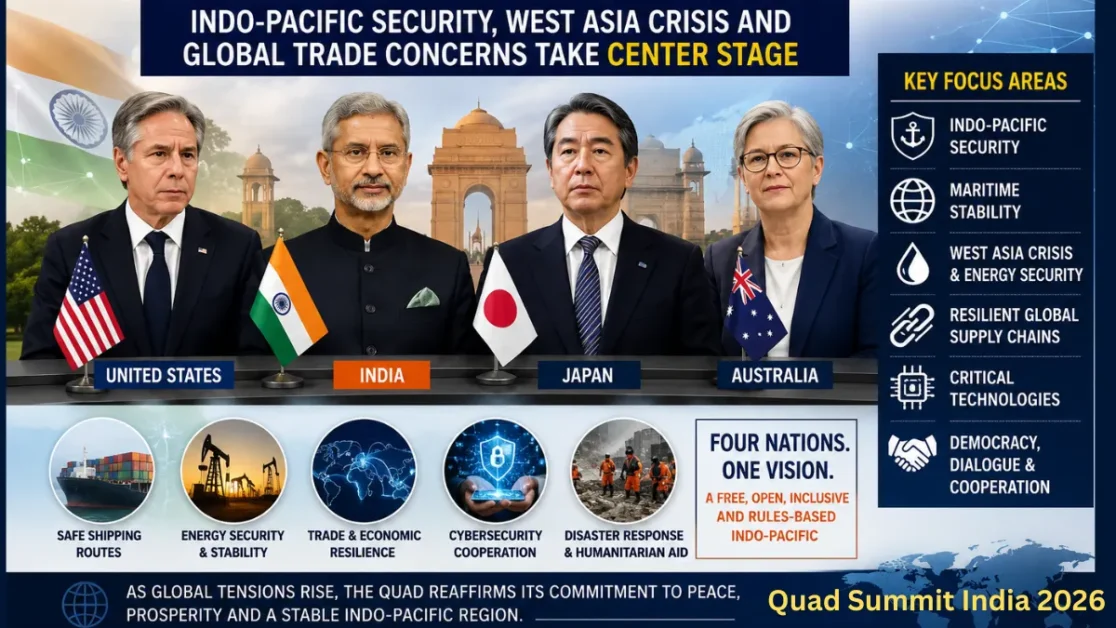
Recently, the foreign ministers of the QUAD (Quadrilateral Security Dialogue)—India, the United States, Japan, and Australia—held a meeting focusing on security in the Indo-Pacific region, critical minerals, maritime cooperation, and energy security. The meeting comes at a time when China’s aggressive activities in the South China Sea, global supply chain disruptions, energy insecurity, and technological competition are intensifying rapidly.
Key Outcomes of the Recent Meeting:
-
-
- Cooperation on Critical Minerals:
- The meeting emphasized advancing the Critical Minerals Initiative. Minerals such as lithium, cobalt, nickel, and rare earth elements are essential for electric vehicles, batteries, semiconductors, and defense industries.
- At present, China dominates the global supply of these minerals. Therefore, QUAD countries aim to develop alternative and reliable supply chains. For India, these minerals are particularly important as the country is actively promoting green energy and semiconductor manufacturing.
- The meeting emphasized advancing the Critical Minerals Initiative. Minerals such as lithium, cobalt, nickel, and rare earth elements are essential for electric vehicles, batteries, semiconductors, and defense industries.
- Indo-Pacific Energy Security Initiative:
- QUAD countries announced new initiatives to strengthen clean energy, green hydrogen, energy infrastructure, and energy supply security.
- Global energy markets have been affected by the Russia–Ukraine war and instability in West Asia. In this context, diversification of energy sources has become a major priority for the QUAD.
- QUAD countries announced new initiatives to strengthen clean energy, green hydrogen, energy infrastructure, and energy supply security.
- Focus on Maritime Security:
- The meeting stressed enhancing Maritime Domain Awareness and increasing cooperation in the Indian Ocean and the South China Sea.
- The QUAD also expressed concern over growing attacks on commercial ships and threats to maritime trade routes. This is especially important for India because nearly 95% of its trade is conducted through sea routes.
- The meeting stressed enhancing Maritime Domain Awareness and increasing cooperation in the Indian Ocean and the South China Sea.
- Fiji Port Project:
- The QUAD announced the development of a joint port infrastructure project in Fiji. This is being viewed as a strategic response to China’s growing influence in the Pacific region.
- The initiative also reflects QUAD’s “development partnership model,” which focuses not only on security cooperation but also on infrastructure development.
- The QUAD announced the development of a joint port infrastructure project in Fiji. This is being viewed as a strategic response to China’s growing influence in the Pacific region.
- Cooperation on Critical Minerals:
-
Significance for India:
-
-
- QUAD strengthens India’s “Act East Policy,” “SAGAR Vision,” and Indo-Pacific strategy.
- Through QUAD, India can benefit from technological cooperation, defense partnerships, maritime security, and supply chain diversification.
- Additionally, QUAD provides India with a collective diplomatic platform to counter China’s aggressive policies.
- QUAD is no longer just a strategic dialogue platform; it is gradually evolving into a broader framework for economic, technological, and geopolitical cooperation.
- QUAD strengthens India’s “Act East Policy,” “SAGAR Vision,” and Indo-Pacific strategy.
-
Challenges:
-
-
- QUAD is still not a formal military alliance like NATO, and differences remain among member countries regarding their approach toward China.
- ASEAN countries also fear that growing strategic competition in the Indo-Pacific may increase regional tensions.
- QUAD is still not a formal military alliance like NATO, and differences remain among member countries regarding their approach toward China.
-
What is QUAD?
-
-
- QUAD is an informal strategic grouping of four democratic countries—India, the United States, Japan, and Australia. It was first initiated in 2007, but became more active after 2017 due to China’s increasing influence in the Indo-Pacific region.
- Its primary objective is to ensure a “free, open, inclusive, and rules-based Indo-Pacific.”
- QUAD is an informal strategic grouping of four democratic countries—India, the United States, Japan, and Australia. It was first initiated in 2007, but became more active after 2017 due to China’s increasing influence in the Indo-Pacific region.
-
Conclusion:
In the current global scenario, QUAD is rapidly emerging as a multidimensional strategic platform. Its scope is no longer limited to security cooperation; it now extends to technology, energy, trade, supply chains, and maritime governance. For India, QUAD is not only a means of maintaining strategic balance but also an important opportunity to strengthen its role in the evolving global power structure.



