
Context:
The QS World University Rankings 2027 were released recently, assessing over 1,500 global institutions on parameters such as academic reputation, research impact, employer reputation, and internationalisation. The rankings reflect the growing global presence of Indian higher education institutions, particularly IITs.
Key Highlights of the Rankings:
-
-
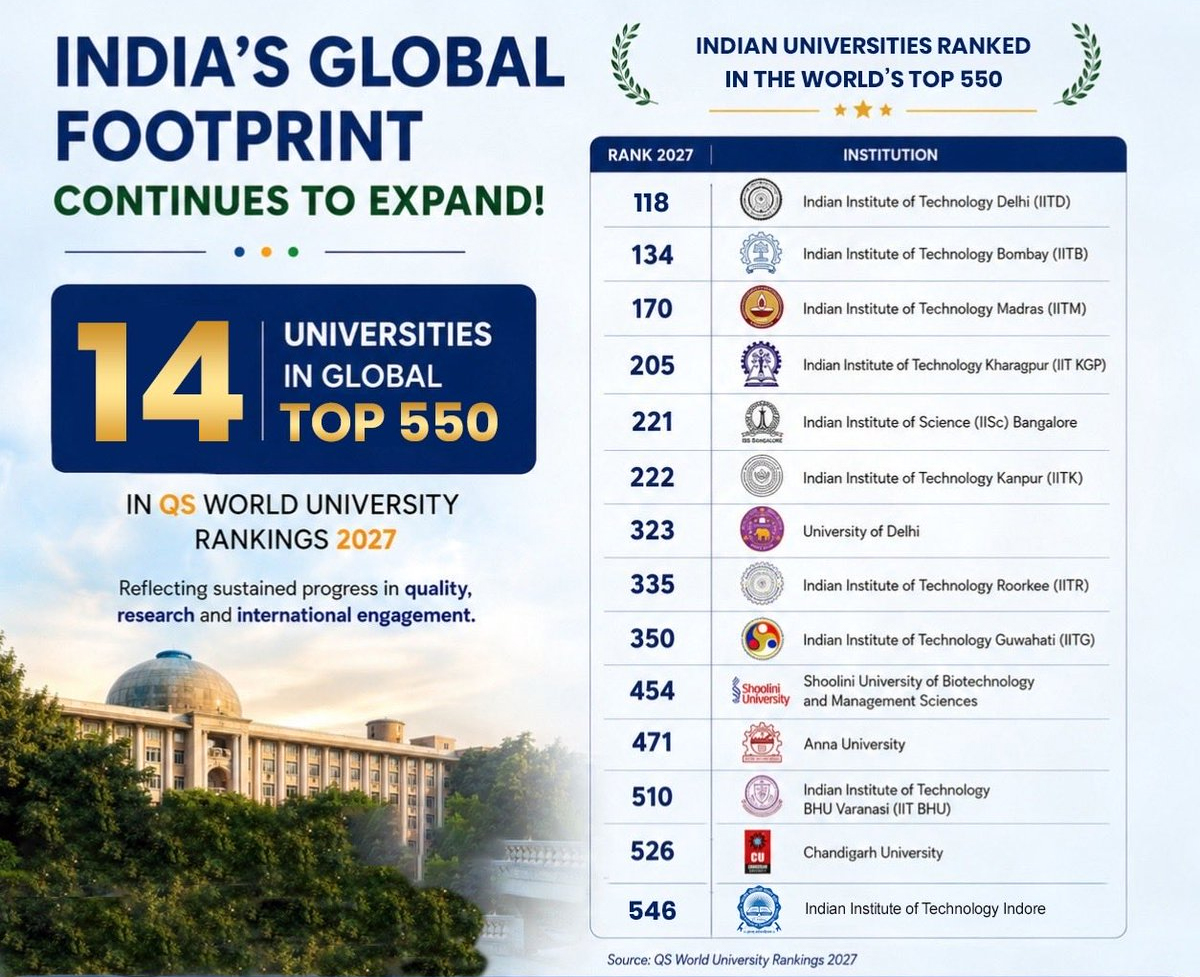
- IIT-Delhi ranked 118th globally, rising five places and becoming India’s top institution.
- IIT-Bombay slipped to 134th position from 129 last year.
- IIT-Madras ranked 170th (improved from 180) and remained the only other Indian institute in the global top 200.
- Globally, MIT (USA) retained the top position for the 15th consecutive year, followed by Stanford University, Imperial College London, University of Oxford, and Harvard University.
- Other top Indian institutions include IIT-Kharagpur (205), IIT-Kanpur (221), IISc Bengaluru (221), University of Delhi (322), IIT-Roorkee (335), and IIT-Guwahati (349).
- IIT-Delhi ranked 118th globally, rising five places and becoming India’s top institution.
-
Performance of Major Indian Institutions:
-
-
- The Indian Institutes of Technology (IITs) continue to dominate India’s higher education landscape. However, performance differences are visible across institutions.
- IIT-Delhi improved due to strong scores in employer reputation, citations per faculty, and employment outcomes.
- IIT-Bombay remained strong in employer reputation but declined in citations per faculty and international engagement indicators.
- IISc Bengaluru, despite high research citations, continued its downward trend in rankings due to weaker employer reputation and employment outcomes.
- IIT-Delhi improved due to strong scores in employer reputation, citations per faculty, and employment outcomes.
- Private institutions also showed progress. Shoolini University entered India’s top 10 list, reflecting improvements in research output and global engagement indicators.
- The Indian Institutes of Technology (IITs) continue to dominate India’s higher education landscape. However, performance differences are visible across institutions.
-
India’s Overall Position in QS Rankings:
-
-
- India has 52 universities ranked globally, slightly lower than 54 last year.
- India ranks 5th globally in number of institutions after the United States, United Kingdom, China, and Germany.
- Over the past decade, India’s presence has increased by 271%, rising from 11 institutions in 2015 to 52 in 2027.
- Despite this growth, no Indian institution has entered the global top 100 overall, mainly due to weaker performance in academic reputation and internationalisation metrics.
- India has 52 universities ranked globally, slightly lower than 54 last year.
-
Key Performance Indicators:
QS Rankings are based on nine indicators, including academic reputation, employer reputation, faculty-student ratio, citations per faculty, and internationalisation.
-
-
- Indian institutes perform strongly in citations per faculty (research output).
- They also perform well in employer reputation, especially IITs.
- However, weak performance in international faculty ratio, student diversity, and global research collaboration continues to limit global ranking gains.
- No Indian institute features in the global top 100 for academic reputation, the most heavily weighted parameter.
- Indian institutes perform strongly in citations per faculty (research output).
-
Challenges for Indian Institutions:
-
-
- Low international faculty and student participation.
- High student intake pressures under NEP expansion goals.
- Limited global research collaboration compared to leading universities.
- Need for stronger global visibility and academic branding.
- Low international faculty and student participation.
-
Global Context:
QS noted that higher education systems in the US and Europe are facing relative decline due to shifting research and talent flows towards Asia. However, internationalisation remains a key advantage for top global universities.
Conclusion:
The QS 2027 rankings highlight India’s improving global academic presence, led by IIT-Delhi. However, gaps in internationalisation and academic reputation continue to limit India’s entry into the global top 100. Strengthening global collaboration and research ecosystems will be a key for future progress.



