
Context:
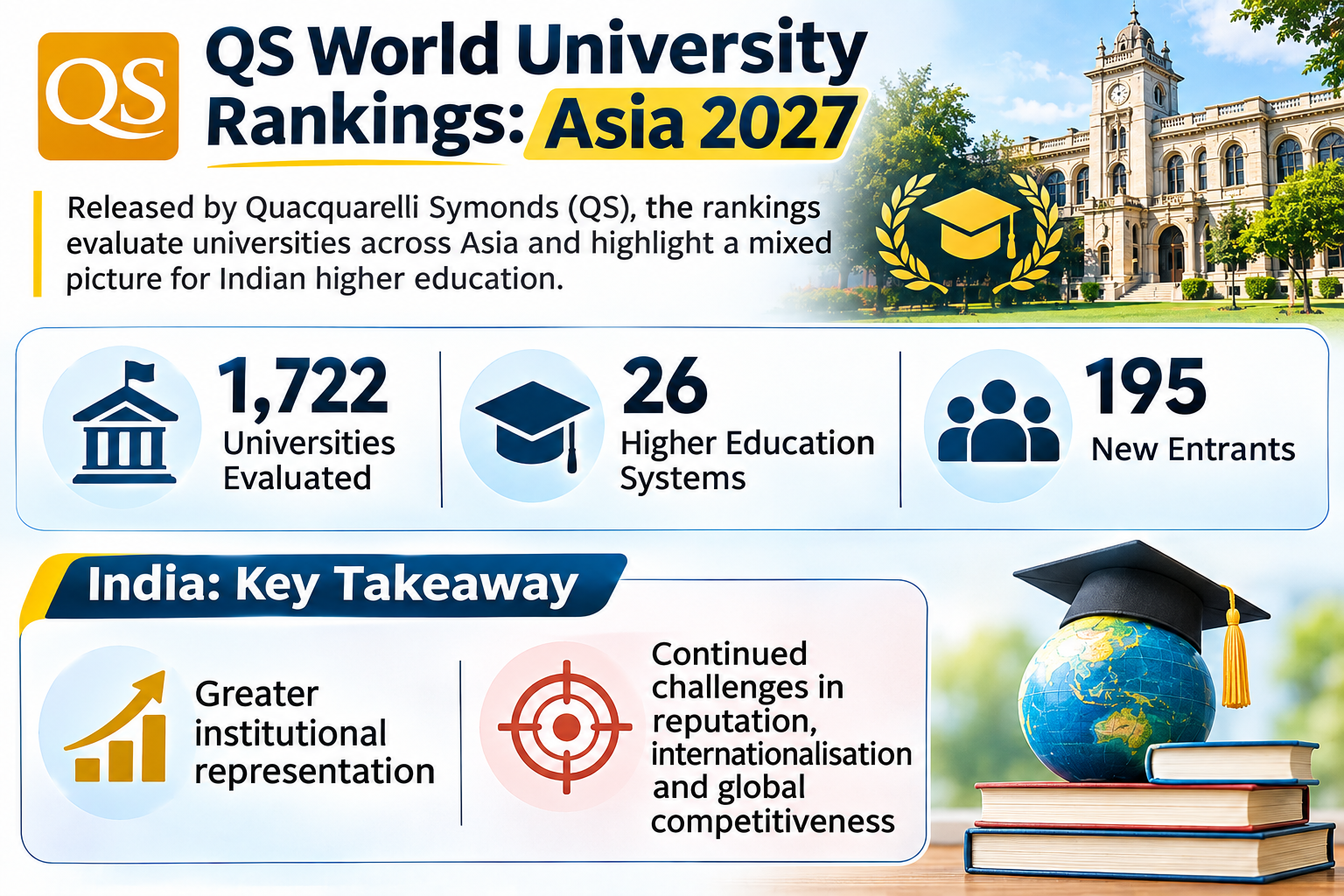
Recently, The QS World University Rankings: Asia 2027, released by Quacquarelli Symonds (QS), evaluates 1,722 universities across 26 higher education systems, with 195 new entrants. The rankings reveal a significant paradox in Indian higher education: while India's institutional representation has expanded considerably, its universities continue to face challenges in academic reputation, internationalisation and global competitiveness.
Key Highlights of QS Asia Rankings 2027:
-
-
- Regional Leadership: The University of Hong Kong retained the first position in Asia, followed by Peking University at second and Tsinghua University at third.
- Intensifying Competition: Mainland China leads with 448 universities, while 195 new institutions entered the rankings, increasing competition across the region.
- Indian Decline: Around 71% of Indian universities slipped in the rankings, 18% improved and 11% remained stable.
- Relative Performance: QS clarified that nearly two-thirds of Indian universities that declined in rank improved their overall scores, indicating that falling rankings do not necessarily mean declining institutional quality.
- Regional Leadership: The University of Hong Kong retained the first position in Asia, followed by Peking University at second and Tsinghua University at third.
-
About India’s Performance:
-
-
- India has emerged as Asia's second-largest higher education system, after Mainland China, with 325 universities in the 2027 rankings, including 34 new entrants.
- IIT Delhi Leads India: IIT Delhi remains India's highest-ranked institution at 66th, declining from 59th in 2026.
- Sliding Top Institutions: All six leading Indian institutions declined. IISc Bengaluru fell from 64th to 79th, IIT Bombay from 71st to 83rd and IIT Madras from 70th to 85th.
- University of Delhi: Delhi University slipped from 95th to 106th, moving outside Asia's top 100.
- Bright Spots: Chandigarh University improved to 104th, Lovely Professional University to 154th and Symbiosis International to 175th. IIT Hyderabad and IIT (BHU) Varanasi also recorded improvements.
- India has emerged as Asia's second-largest higher education system, after Mainland China, with 325 universities in the 2027 rankings, including 34 new entrants.
-
Major Reasons Behind the Decline:
-
-
- The decline is primarily associated with weak academic reputation, employer perception and internationalisation. Academic Reputation, carrying 30% weight, declined for 76% of Indian universities, while Employer Reputation, carrying 20% weight, declined for 83%.
- The international student indicator fell for 85% of institutions, while inbound and outbound student exchange indicators declined for 91% and 89%, respectively. Limited global collaborations, research visibility and industry-academia linkages remain important challenges.
- The decline is primarily associated with weak academic reputation, employer perception and internationalisation. Academic Reputation, carrying 30% weight, declined for 76% of Indian universities, while Employer Reputation, carrying 20% weight, declined for 83%.
-
The Research Paradox:
Despite overall ranking declines, India demonstrates strengths in research productivity:
-
-
- Papers per Faculty: India has 27 universities in Asia's top 50, including five in the top 10. It was the only indicator in which more Indian universities improved than declined.
- Staff with PhD: 15 Indian universities share first place in this indicator.
- Where India Lags: Only three Indian universities feature in Asia's top 50 for Citations per Paper, highlighting the gap between research output and international research impact.
- Employer Reputation: IIT Bombay and IIT Delhi rank seventh and tenth, respectively, in Asia for this indicator.
- Papers per Faculty: India has 27 universities in Asia's top 50, including five in the top 10. It was the only indicator in which more Indian universities improved than declined.
-
India's Growth in Higher Education:
India's representation increased from 24 universities in 2016 to 325 in 2027, a growth of more than 1,250%. It now accounts for nearly one-fifth of ranked Asian universities, while its presence in the regional top 200 has increased from 17 to 21 institutions. This reflects substantial quantitative expansion but also highlights the need to improve institutional quality and global recognition.
Government Initiatives:
The National Education Policy (NEP) 2020 promotes multidisciplinary education, research and internationalisation. The Institutions of Eminence Scheme supports world-class institutions, while NIRF encourages quality assessment. Study in India aims to attract international students. The Anusandhan National Research Foundation and PM-USHA seek to strengthen research and improve state higher education institutions.
Conclusion:
The QS Asia 2027 rankings highlight India's expanding higher education system but also expose weaknesses in reputation, internationalisation and research impact. Transforming institutional growth into academic excellence is essential to realise the vision of NEP 2020 and establish India as a global knowledge hub.



