
Context:
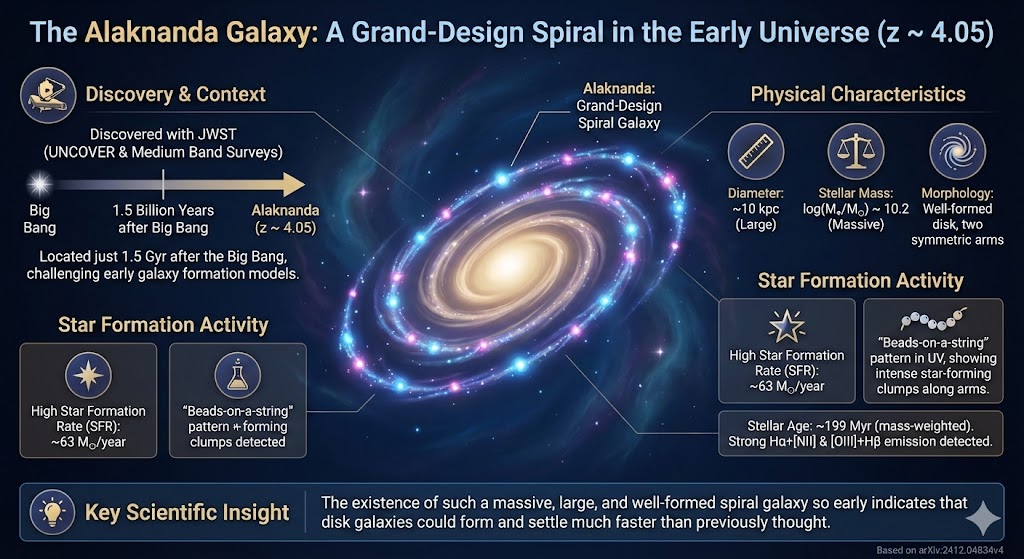
Indian researchers at National Centre for Radio Astrophysics (NCRA-TIFR), Pune have recently discovered a massive spiral galaxy named Alaknanda. The galaxy existed when the universe was just 1.5 billion years old (~10% of its current age). The findings are Published in Astronomy and Astrophysics, a leading European astronomy journal.
Significance of the Discovery:
-
- Challenges existing theories: Early galaxies were thought to be chaotic, clumpy, turbulent, and unstable.
- Alaknanda is well-structured, with a textbook spiral form resembling the Milky Way.
- Suggests that complex galactic structures were forming much earlier than previously believed.
- Challenges existing theories: Early galaxies were thought to be chaotic, clumpy, turbulent, and unstable.
Key Features of Alaknanda:
-
- Spiral structure: Two prominent spiral arms wrapping around a bright central bulge.
- Size: Diameter of approximately 30,000 light-years.
- Distance: Roughly 12 billion light-years away, representing the early universe.
- Named after the Himalayan river Alaknanda, as a “sister” to the Milky Way (Mandakini).
- Spiral structure: Two prominent spiral arms wrapping around a bright central bulge.
Observation Techniques:
-
- Discovered using NASA’s James Webb Space Telescope (JWST).
- JWST allows observation of early universe galaxies formed just a few hundred million years after the Big Bang.
- Future studies will involve JWST and ALMA telescope (Chile) to study kinematics of gas and stars, and understand formation mechanisms of spiral arms.
- Discovered using NASA’s James Webb Space Telescope (JWST).
Implications for Cosmology:
-
- Indicates the early universe was more mature than previously thought.
- Could point to alternative evolutionary pathways for galaxy formation in the first few billion years.
- Studying Alaknanda’s disk temperature (cold or hot) will help determine how spiral arms formed.
- Indicates the early universe was more mature than previously thought.



