
Context:
Recently, The Lok Sabha passed the Public Examinations (Prevention of Unfair Means) Amendment Bill, 2026 to strengthen India's legal framework against examination fraud, paper leaks, and organised cheating networks.
Background:
The Public Examinations (Prevention of Unfair Means) Act, 2024 was enacted to curb unfair practices in public examinations conducted by central authorities. However, recurring incidents of paper leaks and organised cheating exposed loopholes in enforcement and delayed judicial processes. The 2026 Amendment seeks to establish a stronger deterrent through stricter punishments, time-bound investigations, and speedy trials.
Key Provisions of the Bill:
-
-
- Stringent Penalties
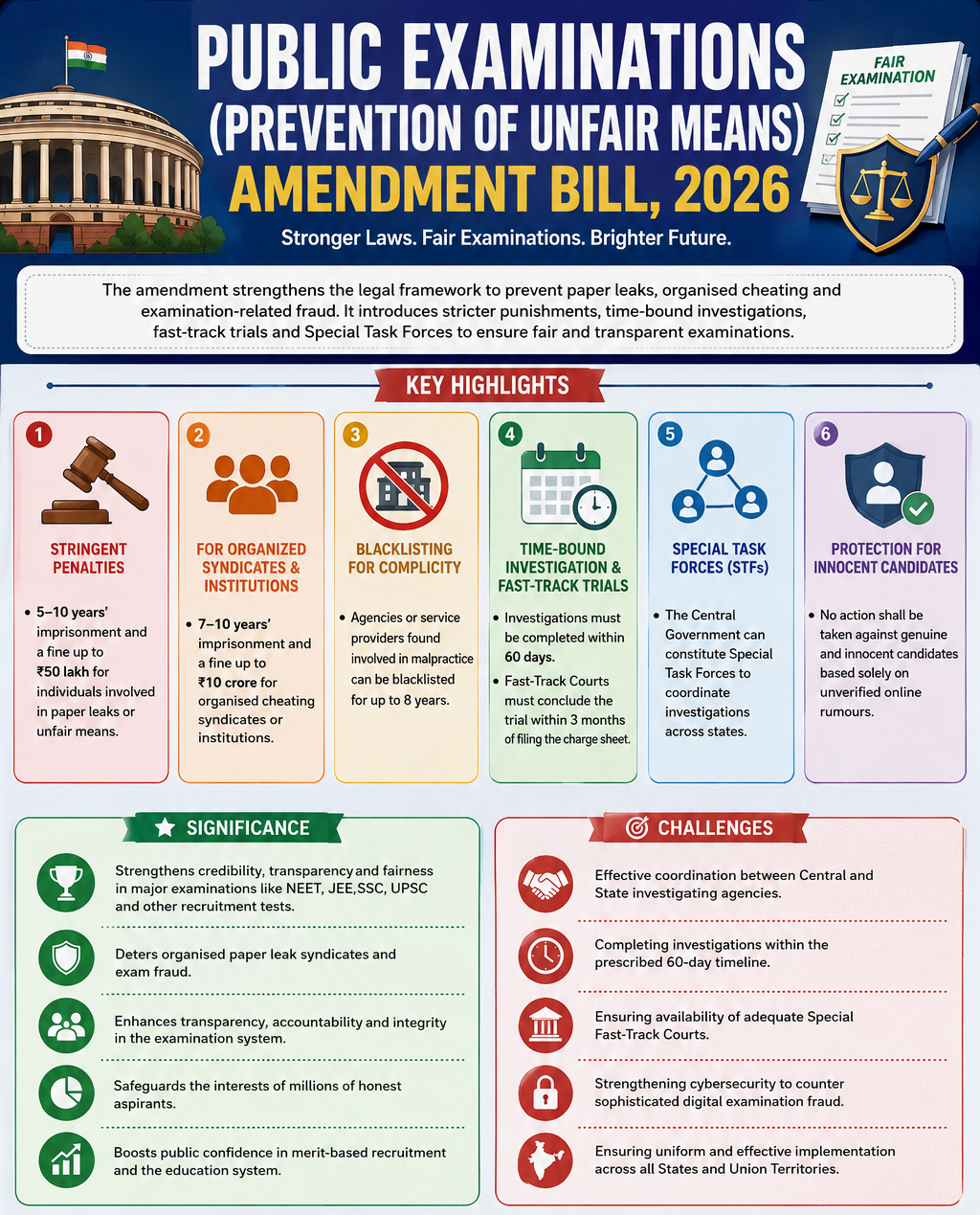
- Individuals found guilty of leaking question papers or using unfair means in examinations shall face imprisonment ranging from 5 to 10 years and a fine of up to ₹50 lakh.
- Organised criminal syndicates or institutions involved in offences such as paper leaks shall be liable to 7 to 10 years of imprisonment and a fine of up to ₹10 crore.
- Service providers or management agencies found complicit in examination malpractice may be blacklisted for up to eight years.
- Individuals found guilty of leaking question papers or using unfair means in examinations shall face imprisonment ranging from 5 to 10 years and a fine of up to ₹50 lakh.
- Time-bound Investigation and Speedy Justice
- Investigating agencies will be required to complete investigations within 60 days.
- Special Fast-Track Courts must conclude the trial within three months from the date the charge sheet is filed.
- Investigating agencies will be required to complete investigations within 60 days.
- Constitution of Special Task Forces
- The Central Government is empowered to constitute Special Task Forces (STFs) to coordinate investigations across states and tackle organised examination-related offences.
- The Central Government is empowered to constitute Special Task Forces (STFs) to coordinate investigations across states and tackle organised examination-related offences.
- Protection of Innocent Candidates
- The Bill primarily targets organised paper leaks, cyberattacks, and institutional corruption in public examinations.
- No action shall be taken against genuine and innocent candidates solely on the basis of unverified online rumours.
- The Bill primarily targets organised paper leaks, cyberattacks, and institutional corruption in public examinations.
- Stringent Penalties
-
Significance:
-
-
- It will strengthen the credibility, transparency and fairness of examinations such as NEET, JEE, SSC, UPSC, and other recruitment tests.
- It establishes a strong deterrent against organised paper leak syndicates.
- It enhances transparency, accountability and integrity in the examination system.
- It safeguards the interests of millions of honest aspirants.
- It reinforces public confidence in merit-based recruitment and the education system.
- It will strengthen the credibility, transparency and fairness of examinations such as NEET, JEE, SSC, UPSC, and other recruitment tests.
-
Challenges:
-
-
- Ensuring effective coordination between Central and State investigating agencies.
- Completing investigations within the prescribed 60-day timeline.
- Ensuring the availability of an adequate number of Special Fast-Track Courts.
- Strengthening cybersecurity to combat increasingly sophisticated digital examination fraud.
- Ensuring uniform and effective implementation of the law across all States and Union Territories.
- Ensuring effective coordination between Central and State investigating agencies.
-
Conclusion:
The Public Examinations (Prevention of Unfair Means) Amendment Bill, 2026 represents a significant step towards ensuring fairness, transparency, and integrity in India's examination system. While stringent legal provisions can effectively deter organised examination fraud, sustained institutional reforms, technological safeguards, and efficient implementation will be essential to restore public trust and uphold the principles of meritocracy in public recruitment and education.



