
Context:
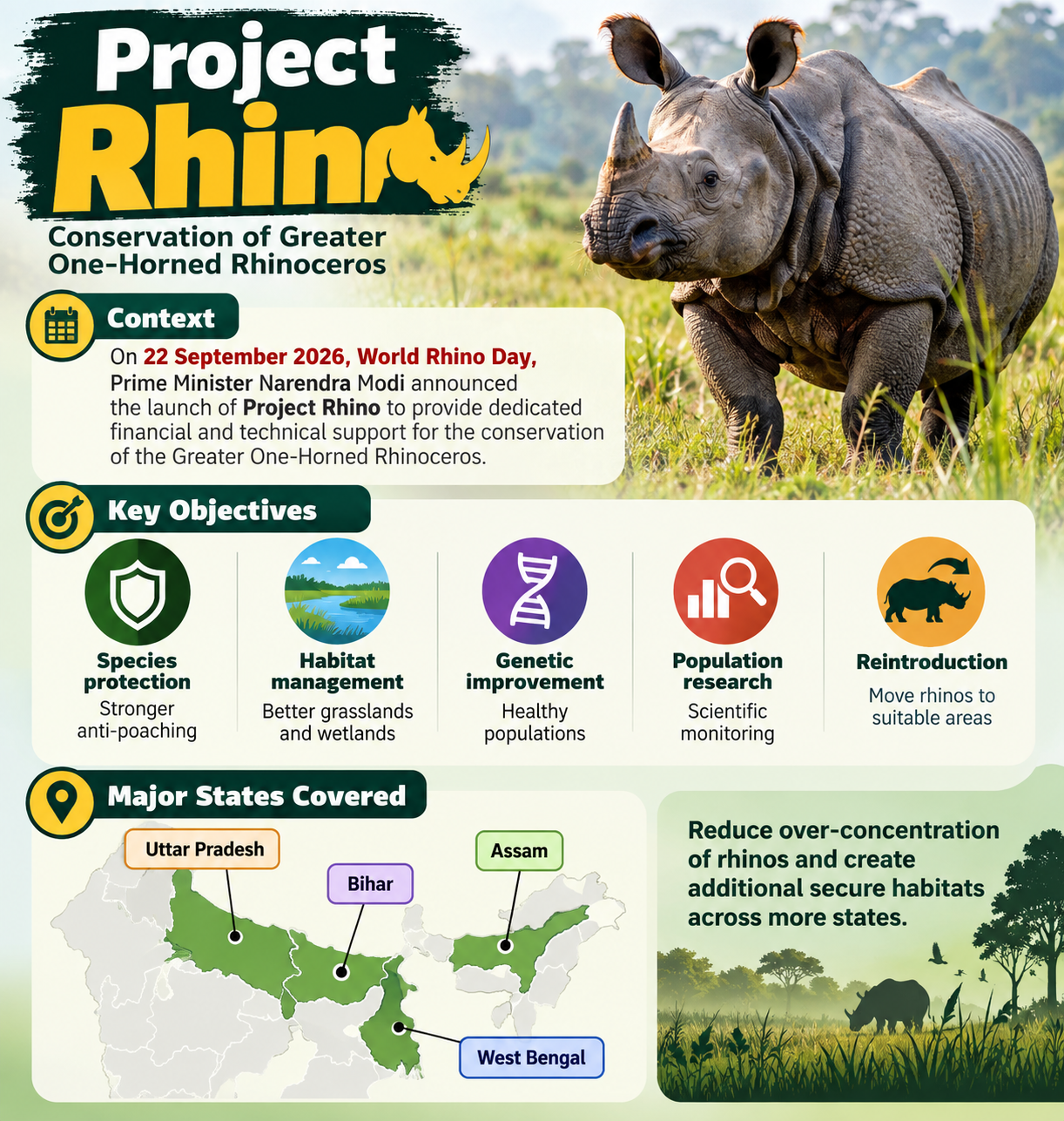
On 22 September 2026, World Rhino Day, Prime Minister Narendra Modi announced the launch of Project Rhino. The initiative aims to provide dedicated financial and technical support for the conservation of the Greater One-Horned Rhinoceros (Rhinoceros unicornis). It seeks to strengthen species protection, habitat management, genetic improvement, scientific research and population monitoring across India's rhino-bearing states.
Key Objectives of the project:
Project Rhino will focus on:
-
-
- Species protection: Strengthening anti-poaching and wildlife-crime prevention.
- Habitat management: Improving grasslands, wetlands and other rhino habitats.
- Genetic improvement: Supporting genetic studies and maintaining healthy populations.
- Population research: Scientific monitoring, population estimation and ecological studies.
- Reintroduction: Supporting the movement of rhinos to suitable protected areas to expand their range.
- Species protection: Strengthening anti-poaching and wildlife-crime prevention.
-
Major States Covered:
-
-
- The project will support conservation and reintroduction efforts in:
- Assam
- West Bengal
- Bihar
- Uttar Pradesh
- Assam
- This approach can help reduce excessive concentration of rhino populations in a few protected areas and create additional secure habitats.
- The project will support conservation and reintroduction efforts in:
-
India’s Rhino Conservation Success:
-
-
- India is home to the majority of the world's Greater One-Horned Rhinos, making it a crucial country for the species' global conservation.
- Assam is the principal stronghold, with Kaziranga National Park supporting the largest population.
- Strong anti-poaching measures have contributed to improved rhino protection in Assam.
- Dudhwa National Park/Tiger Reserve in Uttar Pradesh has witnessed successful rhino reintroduction and population recovery.
- Protected areas in West Bengal and Bihar also contribute to expanding the species' conservation landscape.
- India is home to the majority of the world's Greater One-Horned Rhinos, making it a crucial country for the species' global conservation.
-
Challenges:
Despite conservation gains, major challenges include:
-
-
- Poaching and illegal wildlife trade, particularly demand for rhino horn.
- Habitat loss and fragmentation due to agriculture, infrastructure and human settlements.
- Floods and other ecological disturbances affecting grassland habitats.
- Limited suitable habitat for expanding rhino populations.
- Maintaining genetic diversity in isolated populations.
- Human–wildlife conflict during population expansion and reintroduction.
- Poaching and illegal wildlife trade, particularly demand for rhino horn.
-
Significance of Project Rhino:
Provides a dedicated conservation framework for India's Greater One-Horned Rhino.
Promotes a shift from population protection alone towards landscape-level conservation.
Strengthens scientific and technology-based wildlife management.
Can facilitate reintroduction and range expansion into suitable historical habitats.
Supports India's broader commitments to biodiversity conservation and wildlife protection.
Conclusion:
Project Rhino seeks to consolidate India's achievements in Greater One-Horned Rhino conservation through financial support, habitat restoration, scientific research, genetic management and anti-poaching measures. Expanding secure habitats beyond traditional strongholds will be crucial for ensuring the species' long-term survival.
Prelims Facts
Scientific name: Rhinoceros unicornis Common name: Greater One-Horned Rhino / Indian Rhino IUCN Status: Vulnerable Horn: Made of keratin, the same protein found in human hair and nails. Major Indian habitats: Kaziranga, Manas, Orang and Pobitora in Assam; Jaldapara and Gorumara in West Bengal; Dudhwa in Uttar Pradesh. Protection in India: Schedule I under the Wildlife (Protection) Act, 1972. |



