
Context:
Defence Secretary Rajesh Kumar Singh recently stated that India is advancing towards a home-grown long-range air defence system under Project Kusha, aimed at matching the capabilities of Russia’s S-400 Triumf and the US’s MIM-104 Patriot.
About Project Kusha:
-
-
- Project Kusha is an indigenous long-range surface-to-air missile (SAM) system to protect strategic military and civilian assets. Developed by the Defence Research and Development Organisation, the ER-SAM system is designed to engage aerial threats up to 400 km.
- DRDO leads development with Bharat Electronics Limited responsible for radars and integration. It will integrate with the IAF’s Integrated Air Command and Control System (IACCS), enabling real-time tracking, threat assessment, and coordinated engagement.
- Project Kusha is an indigenous long-range surface-to-air missile (SAM) system to protect strategic military and civilian assets. Developed by the Defence Research and Development Organisation, the ER-SAM system is designed to engage aerial threats up to 400 km.
-
Key features:
-
-
- Three-Tier Architecture:
- The system uses three interceptor variants:
- M1: ~150 km range
- M2: ~250 km range
- M3: ~350–400 km range
- M1: ~150 km range
- This layered structure ensures redundancy. Interceptors target fighter jets, UAVs, cruise missiles, precision-guided munitions, and some ballistic threats, achieving speeds up to Mach 5.5 with advanced seekers for terminal guidance.
- The system uses three interceptor variants:
- Radars, Sensors and Network-Centric Warfare
- Project Kusha integrates long-range surveillance and fire-control radars with command nodes, synthesising data from ground, airborne, and potential space assets. This network-centric design allows simultaneous multi-target tracking, automated threat prioritisation, and coordinated engagements across the battlespace, fully integrated with IACCS.
- Project Kusha integrates long-range surveillance and fire-control radars with command nodes, synthesising data from ground, airborne, and potential space assets. This network-centric design allows simultaneous multi-target tracking, automated threat prioritisation, and coordinated engagements across the battlespace, fully integrated with IACCS.
- Part of Mission Sudarshan Chakra
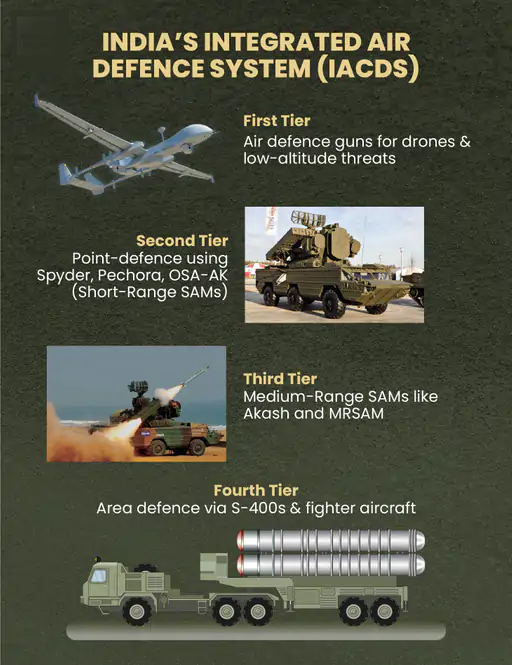
- Project Kusha forms the long-range backbone of Mission Sudarshan Chakra, India’s plan for a multi-layered air and missile defence shield by 2035. It complements QRSAM, VSHORADS, laser weapons, and ballistic missile defence systems.
- Project Kusha forms the long-range backbone of Mission Sudarshan Chakra, India’s plan for a multi-layered air and missile defence shield by 2035. It complements QRSAM, VSHORADS, laser weapons, and ballistic missile defence systems.
- Three-Tier Architecture:
-
Implications:
Currently, India relies on imported S-400 systems from Russia. Project Kusha reduces dependence by offering indigenous production, upgrade sovereignty, deployment flexibility, and potential export opportunities, mitigating geopolitical and logistical constraints.
Kusha vs S-400 vs Patriot:
|
Feature |
Project Kusha |
S-400 Triumf |
MIM-104 Patriot |
|
Origin |
India |
Russia |
United States |
|
Max Range |
~400 km (M3) |
Up to 400 km |
~160 km (varies by variant) |
|
Focus |
Multi-layered aerial defence |
Long-range multi-target |
Strong ballistic missile focus (PAC-3) |
|
Integration |
Native IACCS integration |
Imported system |
NATO-integrated |
|
Strategic Control |
Full domestic control |
Supplier-dependent |
Supplier-dependent |
While the S-400 is battle-proven and the Patriot has a strong combat record, Project Kusha offers India full software control, integration flexibility and upgrade sovereignty.
Conclusion:
Phased testing of M1, M2, and M3 interceptors continues, aiming for induction around 2030. Beyond missile performance, Project Kusha’s success depends on the robustness of India’s integrated air defence grid, marking a milestone in strategic self-reliance.



