
Context:
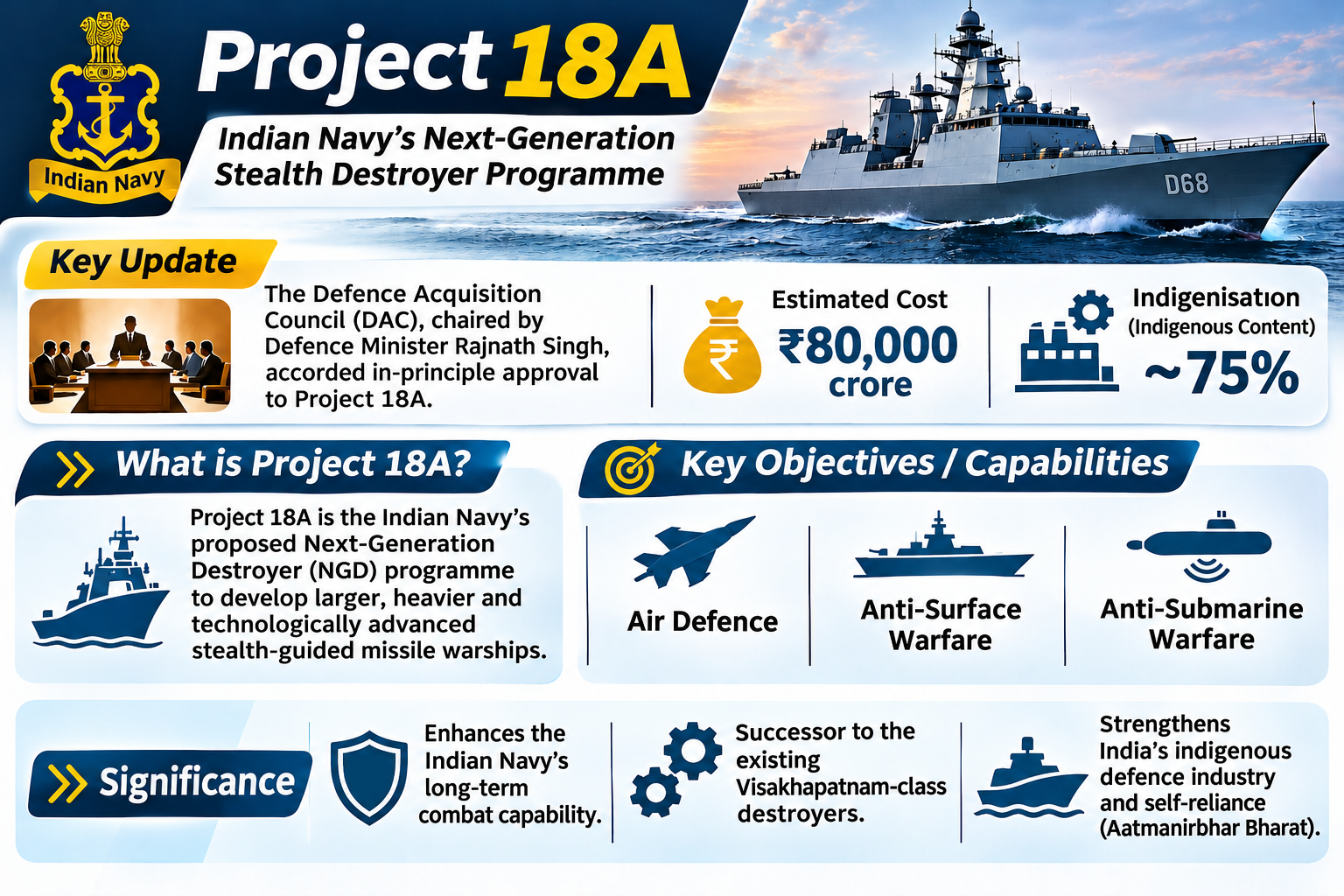
Recently, the Defence Acquisition Council (DAC), chaired by Defence Minister Rajnath Singh, accorded in-principle approval to the Indian Navy's next-generation stealth destroyer programme under Project 18A. The proposed programme is estimated to cost ₹80,000 crore, with approximately 75% indigenous content.
What are Stealth Destroyers?
Stealth destroyers are advanced guided-missile warships designed to reduce their detection by enemy radar and surveillance systems. They are equipped with advanced weapons, sensors, air defence systems, surveillance technologies and anti-submarine warfare (ASW) capabilities. These vessels can undertake air defence, anti-surface warfare and underwater threat detection.
What is Project 18A?
Project 18A is the Indian Navy's proposed Next-Generation Destroyer (NGD) programme. It aims to develop larger, heavier and technologically advanced stealth-guided missile warships that will succeed the existing Visakhapatnam-class destroyers. These warships will enhance India's air defence, anti-surface warfare and anti-submarine warfare capabilities.
Key Features of Project 18A:
The warships will be designed by the Indian Navy's Warship Design Bureau (WDB) and are expected to feature approximately 75% indigenous content. Their major features include advanced missile systems, sophisticated surveillance sensors, improved air defence, enhanced anti-submarine warfare systems and modern stealth technology. Both Defence Public Sector Undertakings (DPSUs) and private shipbuilding companies will be eligible to participate through competitive bidding.
Strategic Significance for India:
Project 18A will strengthen India's maritime deterrence against China's expanding naval presence and Pakistan's growing submarine capabilities. It will improve the protection of Sea Lines of Communication (SLOCs), enhance maritime domain awareness and safeguard India's strategic and economic interests in the Indian Ocean Region. It will also strengthen India's position in the Indo-Pacific.
Significance for Atmanirbhar Bharat:
The project will promote indigenous warship design, defence manufacturing and public-private partnerships. Around 75% indigenous content will encourage domestic production of advanced weapons, sensors and electronic systems, reduce import dependence and generate employment in the defence manufacturing ecosystem.
About Defence Acquisition Council (DAC):
-
-
- The DAC is the apex decision-making body in the Ministry of Defence for capital acquisitions. Established in 2001, following the recommendations of the Group of Ministers after the 1999 Kargil War, it is chaired by the Union Defence Minister. Its members include the Minister of State for Defence, Chief of Defence Staff, Service Chiefs and senior Defence Ministry officials.
- Its major functions include granting Acceptance of Necessity (AoN) for capital procurement, categorising acquisitions under Buy, Buy and Make, and Make, promoting indigenous defence production, and providing in-principle approval to long-term defence procurement plans. It also deals with procurement policy and technology transfer.
- The DAC is the apex decision-making body in the Ministry of Defence for capital acquisitions. Established in 2001, following the recommendations of the Group of Ministers after the 1999 Kargil War, it is chaired by the Union Defence Minister. Its members include the Minister of State for Defence, Chief of Defence Staff, Service Chiefs and senior Defence Ministry officials.
-
India's Existing Destroyer Fleet:
The Indian Navy operates three major guided-missile destroyer classes: Delhi-class (Project 15), Kolkata-class (Project 15A) and Visakhapatnam-class (Project 15B). These warships are equipped with BrahMos supersonic cruise missiles, surface-to-air missiles, naval guns and anti-submarine warfare systems. The induction of new destroyers will help replace ageing vessels and maintain operational strength.
Conclusion:
Project 18A represents an important step towards modernising the Indian Navy and strengthening India's maritime security. Its successful implementation will enhance indigenous defence capabilities, strategic autonomy and India's ability to safeguard its maritime interests in the Indo-Pacific region.