
Context:
Recently, Congress MP Manish Tewari has introduced a private member’s bill in Lok Sabha seeking a major reform of India’s Anti-Defection Law (Tenth Schedule). This is third attempt (after 2010 and 2021) to loosen party control over MPs’ votes.
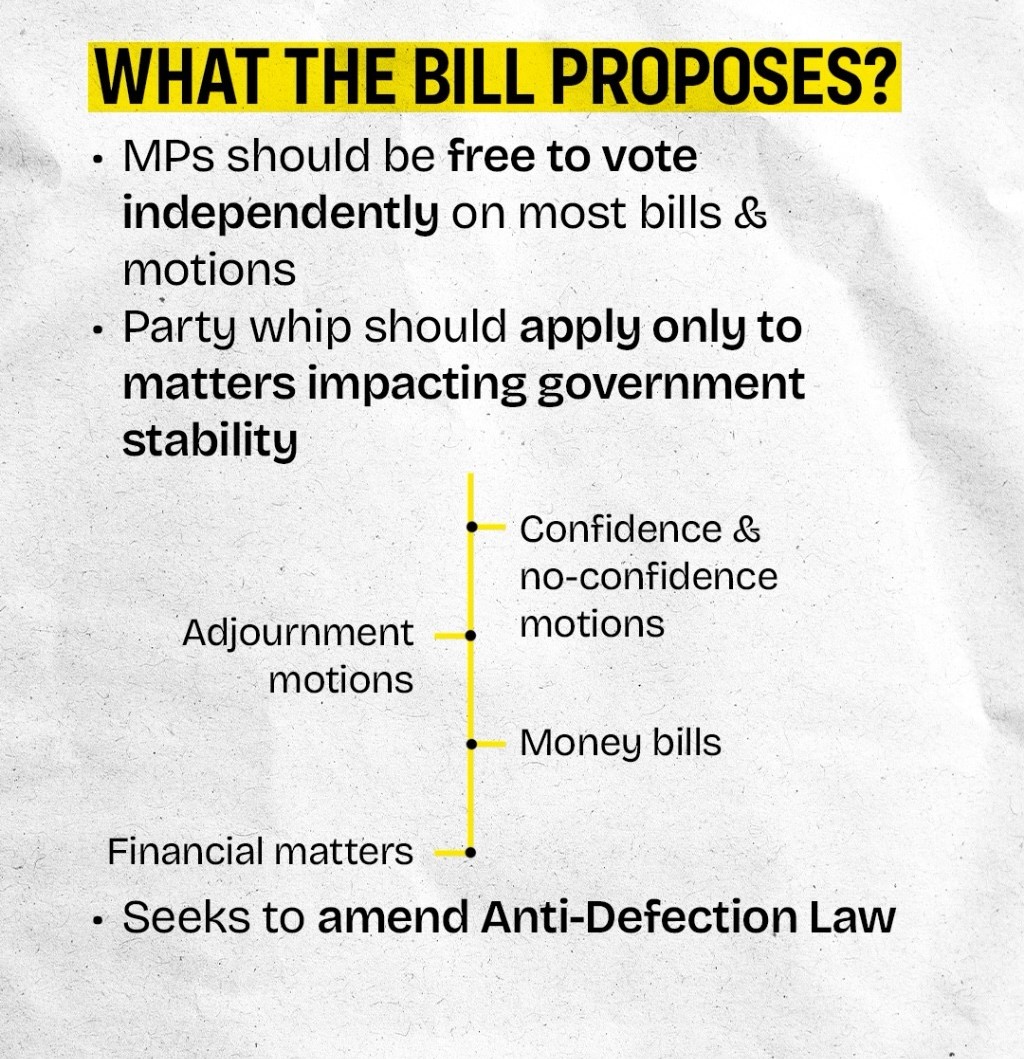
Key Provisions of the Proposed Bill:
-
- Whip applicability restricted to only the following:
- Confidence motion
- No-confidence motion
- Adjournment motion
- Money bills
- Other financial matters affecting government stability
- Confidence motion
- For all other bills and motions, MPs can vote freely based on:
- Personal judgement
- Constituency interests
- Policy reasoning
- Personal judgement
- Procedural reforms proposed:
- Party directions must be announced publicly by Speaker/Chairman.
- Defiance would cause automatic cessation of membership.
- MP can file an appeal within 15 days.
- Presiding officer must dispose of the appeal within 60 days.
- Party directions must be announced publicly by Speaker/Chairman.
- Whip applicability restricted to only the following:
About Anti-Defection Law (10th Schedule):
· Introduced by: 52nd Amendment Act, 1985
· Purpose:
o Curb “Aya Ram Gaya Ram” politics of frequent party-switching.
o Ensure government stability.
o Maintain party discipline and curb corruption.
· Applicability: MPs (Lok Sabha/Rajya Sabha) and MLAs/MLCs (State Assemblies).
Grounds for Disqualification:
1. Voluntary Resignation: Giving up party membership.
2. Defying Party Whip: Voting or abstaining against party directive without permission.
3. Independent Members: Joining a party after election.
4. Nominated Members: Joining a party after 6 months of taking seat.
Exceptions:
· Merger: If 2/3rds of members of a party merge with another party (91st Amendment, 2003).
· No-Confidence Vote: Party may permit members to vote against or abstain.
Deciding Authority & Judicial Review:
· Presiding Officer: Speaker/Chairman decides disqualification.
· Judicial Review: Decisions are reviewable in courts (Supreme Court, Kihoto Hollohan vs Zachilhu, 1992).
Criticism of Current Anti-Defection Regime:
-
- Excessive use of the whip has:
- Reduced Parliament’s capacity to function as a deliberative and quasi-judicial body.
- Undermined oversight, especially in financial accountability.
- Reduced Parliament’s capacity to function as a deliberative and quasi-judicial body.
- Excessive use of the whip has:
Private Member’s Bills (PMBs):
1. Definition:
· A Private Member is any MP (elected or nominated) other than a Minister.
· A bill introduced by such an MP is called a Private Member’s Bill.
· Drafting responsibility lies with the MP introducing it.
2. Mechanism:
· Notice: One-month notice before introduction, with Speaker/Chairman’s permission.
· Time Allocation:
o Lok Sabha: Last 2.5 hours of business every Friday.
o Rajya Sabha: 2.5 hours (2:30–5:00 p.m.) on alternate Fridays.
· First PMB Passed: Muslim Wakfs Bill, 1952 (Syed Mohammed Ahmad Kasmi).
Conclusion:
Manish Tewari’s bill highlights the tension between party control and legislative freedom in India. While the Anti-Defection Law was designed to ensure stability, it has often curtailed MPs’ independence. Reforming the law to allow conscience-based voting, except on matters affecting government survival, could strengthen democracy by making lawmakers more accountable to their constituents rather than just to party whips.



