
Prison Statistics India (PSI) 2024 Report
Context:
Recently, the National Crime Records Bureau released the Prison Statistics India (PSI) 2024 Report, which provides a comprehensive assessment of India’s prison system. The report examines prison population, overcrowding, infrastructure, staffing, rehabilitation programmes, and the socio-economic profile of prisoners.
About Prison Statistics India (PSI) Report:
The Prison Statistics India (PSI) Report is an annual publication prepared by the NCRB. It compiles prison-related data from all States and Union Territories and highlights key issues concerning prison administration, inmate welfare, and correctional reforms. The report helps policymakers and judicial authorities assess challenges in India’s prison system and design appropriate reforms.
Key Findings of PSI 2024 Report:
-
-
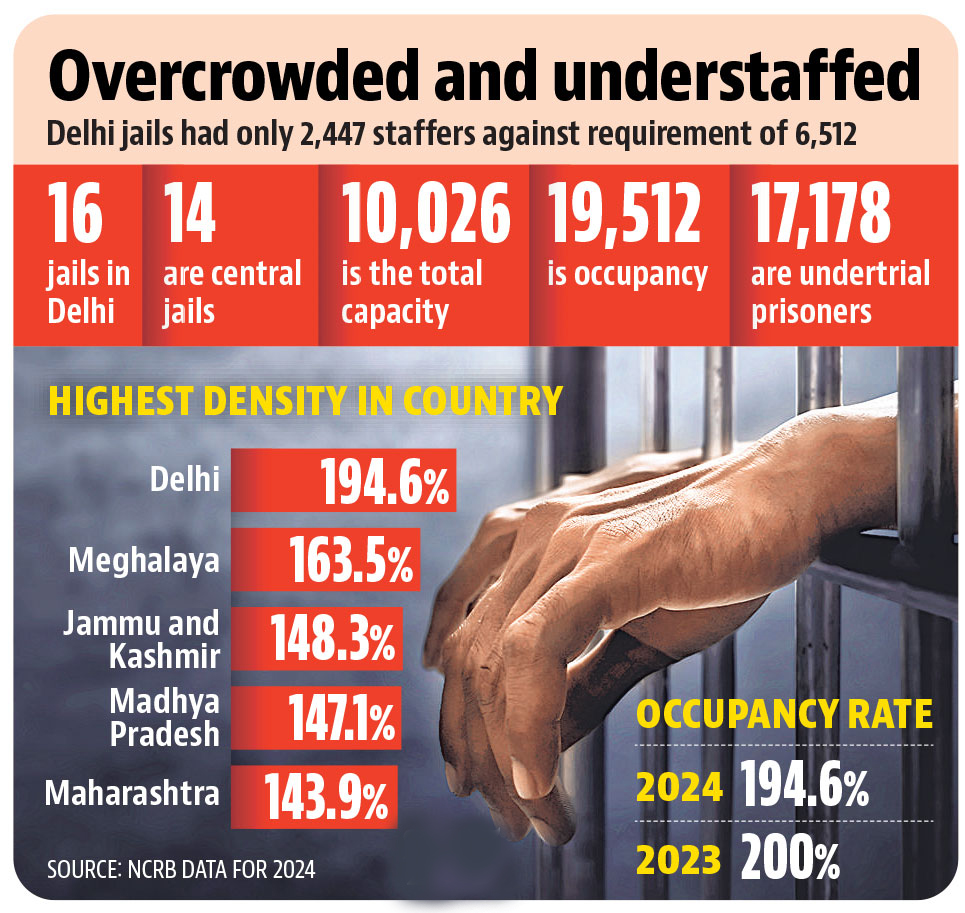
- One of the most serious concerns highlighted in the PSI 2024 Report is severe prison overcrowding. Delhi recorded the highest occupancy rate at 194.6%, with 19,512 inmates against a sanctioned capacity of 10,026. Similar overcrowding was observed in Meghalaya, Jammu & Kashmir, and Madhya Pradesh. Overcrowding negatively affects sanitation, healthcare, living conditions, prison discipline, and rehabilitation efforts.
- The report also revealed India’s heavy dependence on undertrial detention. Delhi prisons housed 17,178 undertrial prisoners compared to only 2,232 convicted prisoners. This reflects judicial delays, lengthy trial procedures, and limited access to bail and legal aid.
- Another major issue identified was the shortage of prison staff. Against a sanctioned strength of 6,516 personnel, only 2,447 staff members were available, leaving 4,069 vacancies. Such shortages weaken prison security, inmate supervision, counselling, and rehabilitation services.
- The report further highlighted the socio-economic vulnerability of prisoners. A majority of inmates had education below Class 10 and belonged to economically weaker sections, showing the strong link between poverty, low education, and criminal justice vulnerability.
- One of the most serious concerns highlighted in the PSI 2024 Report is severe prison overcrowding. Delhi recorded the highest occupancy rate at 194.6%, with 19,512 inmates against a sanctioned capacity of 10,026. Similar overcrowding was observed in Meghalaya, Jammu & Kashmir, and Madhya Pradesh. Overcrowding negatively affects sanitation, healthcare, living conditions, prison discipline, and rehabilitation efforts.
-
Structural Causes behind Prison Crisis:
-
-
- Several structural factors contribute to the prison crisis in India:
- Judicial delays leading to prolonged undertrial detention
- Excessive use of custodial detention and restrictive bail practices
- Poor prison infrastructure and inadequate expansion of facilities
- Weak legal aid mechanisms for economically weaker prisoners
- Large-scale vacancies in prison administration and staff
- Several structural factors contribute to the prison crisis in India:
-
Government Initiatives and Reforms:
The government has introduced several reforms to improve prison administration:
-
-
- Model Prisons and Correctional Services Act, 2023 to modernise prisons and promote rehabilitation
- Model Prison Manual, 2016 for uniform prison management, legal aid, and vocational training
- E-Prisons Project for digitisation of prison records
- Integrated Criminal Justice System (ICJS) linking courts, police, prisons, and prosecution
- FASTER System for rapid electronic transmission of bail orders
- Under-Trial Review Committees (UTRCs) to review prolonged detention cases
- NALSA legal aid programmes for legal literacy and free legal services inside prisons
- Model Prisons and Correctional Services Act, 2023 to modernise prisons and promote rehabilitation
-
Way Forward:
India must reduce undertrial detention through faster trials and liberal bail policies. Increasing judicial strength and establishing fast-track courts can help reduce case pendency. Prison infrastructure, sanitation, and healthcare facilities should be modernised, while staff vacancies must be filled urgently. Greater emphasis should be placed on rehabilitation, education, vocational training, counselling, and legal aid. Promotion of open and semi-open prisons and the use of digital technology can improve transparency and efficiency in prison governance.
Conclusion:
The PSI 2024 Report exposes deep structural weaknesses in India’s prison system, particularly overcrowding, excessive undertrial detention, and inadequate infrastructure. Although recent reforms aim to transform prisons into correctional and rehabilitative institutions, effective implementation, judicial efficiency, and a human rights-based approach remain essential for meaningful prison reforms in India.



