
Prime Minister Narendra Modi’s UAE Visit
Context:
Recently, Prime Minister Narendra Modi visited the United Arab Emirates, strengthening India’s “Look West” policy amid West Asia tensions. The visit reinforced the Comprehensive Strategic Partnership focusing on energy, investment, technology, and regional stability.
Major Outcomes and Bilateral Agreements:
-
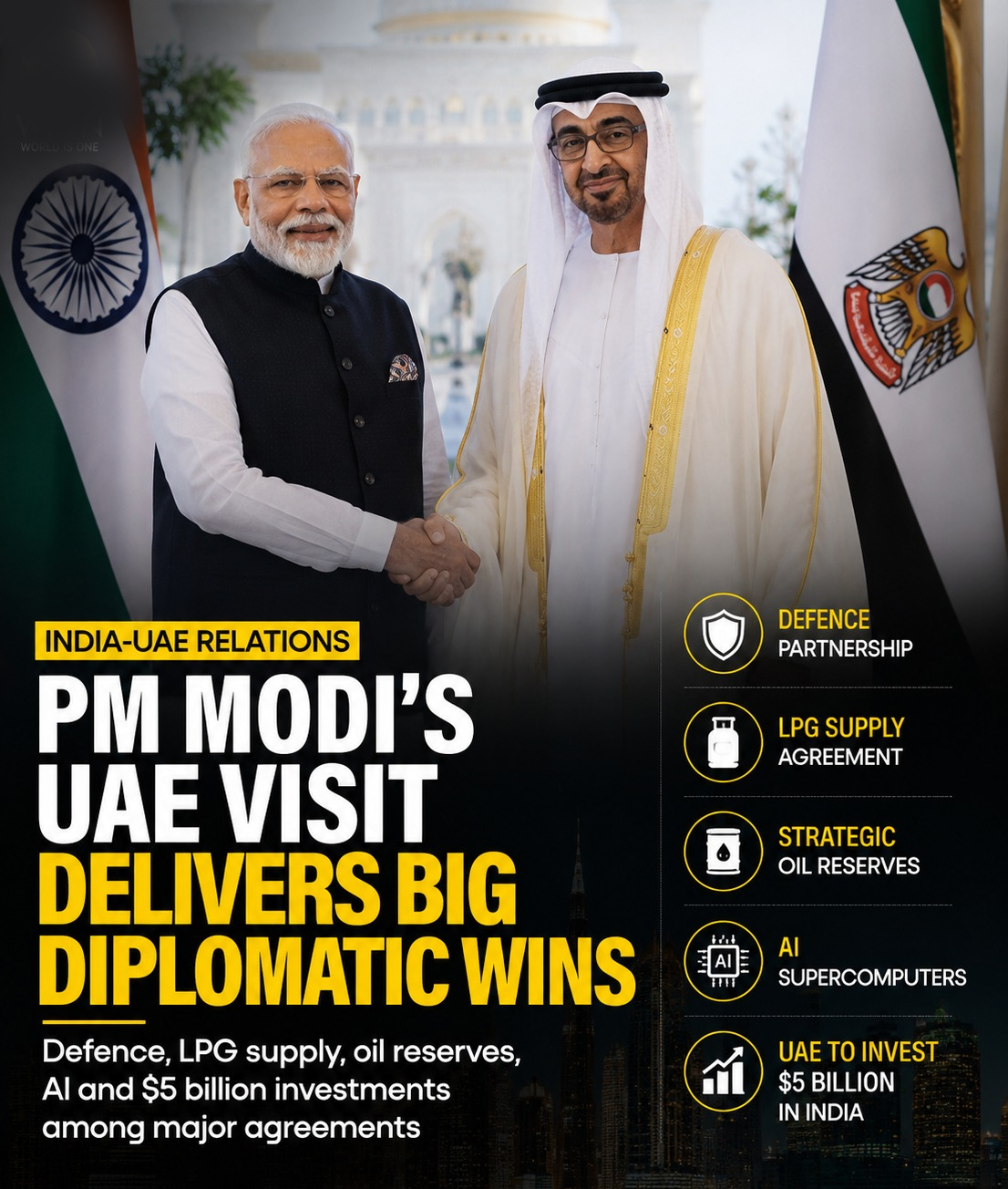
- Investment and Economic Cooperation: The UAE announced USD 5 billion investments in India. Key commitments include USD 3 billion by Emirates NBD in RBL Bank and USD 1 billion each by ADIA–NIIF (infrastructure) and IHC (Sammaan Capital). These will boost infrastructure, banking, and capital markets.
- Energy Security and Strategic Cooperation: Energy ties remain central, with the UAE being India’s 4th largest crude oil supplier, 3rd largest LNG supplier, and largest LPG supplier (FY 2024–25). Agreements on long-term LPG supply and Strategic Petroleum Reserves (SPR) were signed. The Strait of Hormuz remains critical for global energy security.
- Defence and Security Framework: A new defence framework was agreed, focusing on joint exercises, defence industry cooperation, and maritime security. It strengthens coordination in the Indian Ocean Region and enhances strategic trust.
- Technology and Maritime Infrastructure: Cooperation expanded in AI, supercomputing, and fintech, including an 8 Exaflop CDAC–G42 supercomputing cluster. Maritime agreements between Cochin Shipyard Limited and Drydocks World at Vadinar will boost ship repair capacity, logistics, and skill development under Make in India.
- Investment and Economic Cooperation: The UAE announced USD 5 billion investments in India. Key commitments include USD 3 billion by Emirates NBD in RBL Bank and USD 1 billion each by ADIA–NIIF (infrastructure) and IHC (Sammaan Capital). These will boost infrastructure, banking, and capital markets.
Significance of the Visit:
-
- Reliable Energy Partner: The UAE ensures stable energy supplies for India. Long-term LPG and SPR cooperation enhances energy security and resilience.
- Geopolitical Balancing: The visit reflects India’s balanced diplomacy in West Asia, maintaining ties across competing regional actors while promoting stability.
- Strengthening CEPA Framework: The outcomes build on the India–UAE Comprehensive Economic Partnership Agreement, which pushed bilateral trade beyond USD 100 billion (FY 2025–26), with a target of USD 200 billion by 2032.
- Reliable Energy Partner: The UAE ensures stable energy supplies for India. Long-term LPG and SPR cooperation enhances energy security and resilience.
About India–UAE Relations:
India and the UAE share centuries-old maritime trade links in spices, pearls, textiles, and dates. Diplomatic relations were established in 1972. The partnership accelerated after PM Modi’s 2015 visit, expanding across trade, energy, defence, infrastructure, technology, and renewable energy.
Trade and Investment Relations:
The UAE is among India’s largest trading partners, with bilateral trade crossing USD 101.25 billion (FY 2025–26). Investment flows include USD 25.19 billion FDI (2000–2025), supported by sovereign wealth funds and a Local Currency Settlement system reducing dollar dependence.
Energy Partnership:
The UAE is India’s key energy supplier and the only partner in India’s Strategic Petroleum Reserve programme, strengthening long-term energy security.
Conclusion:
The visit marks a shift toward a future-oriented partnership. With USD 5 billion investments, strong energy cooperation, defence collaboration, and advanced technology partnerships, India–UAE relations are emerging as a key pillar of India’s economic growth and West Asian diplomacy.



