
Context:
The National Skill Development Corporation (NSDC), the implementing agency of the Pradhan Mantri Kaushal Vikas Yojana (PMKVY), has come under scrutiny following the sudden exit of its CEO, a police complaint alleging misappropriation of funds, and a critical audit report by the Comptroller and Auditor General (CAG). The audit highlighted multiple irregularities affecting scheme delivery and beneficiary outcomes.
About PMKVY:
-
-
-
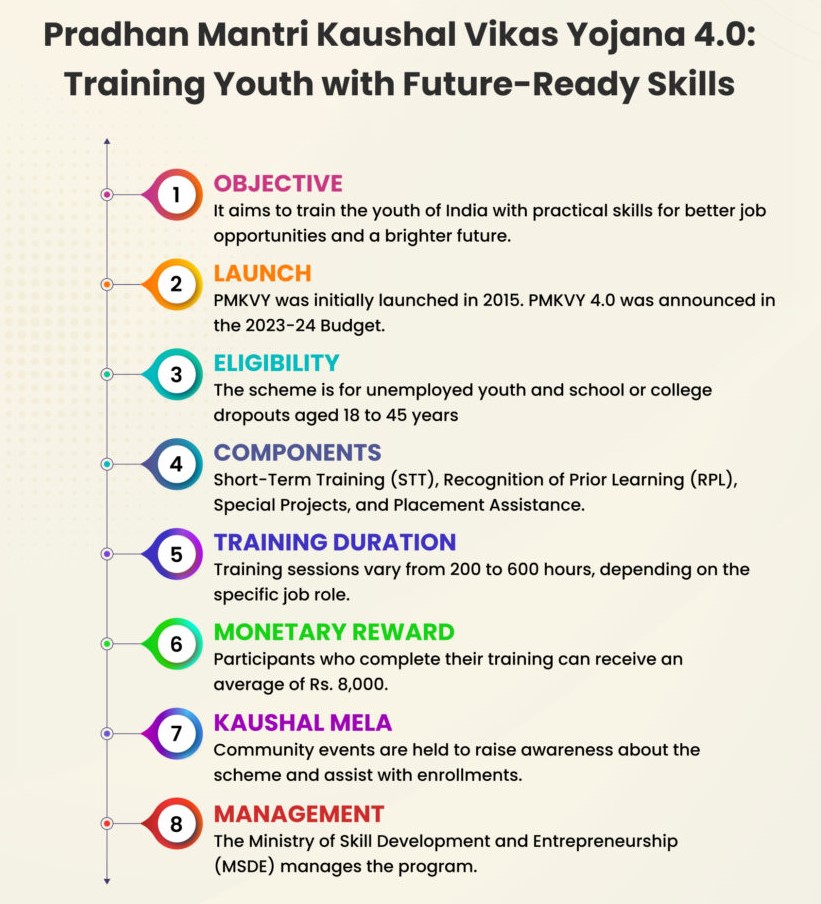
- The Pradhan Mantri Kaushal Vikas Yojana (PMKVY), launched on 15 July 2015 under the Ministry of Skill Development and Entrepreneurship (MSDE), is India’s flagship skill development initiative. The scheme aims to empower youth by providing industry-relevant skill training to enhance employability.
- Eligibility is for individuals aged 15–45 years. The scheme is fully government-funded and provides industry-recognised certification, along with benefits such as accidental insurance coverage of ₹2 lakh for three years and placement support.
- The Pradhan Mantri Kaushal Vikas Yojana (PMKVY), launched on 15 July 2015 under the Ministry of Skill Development and Entrepreneurship (MSDE), is India’s flagship skill development initiative. The scheme aims to empower youth by providing industry-relevant skill training to enhance employability.
-
-
Key Phases:
-
-
-
- PMKVY 1.0 (2015–16): Pilot phase aimed at establishing a skill certification and reward ecosystem.
- PMKVY 2.0 (2016–20): Expanded across sectors and states, with a target of training 10 million youth and an outlay of ₹12,000 crore.
- PMKVY 3.0 (2020–22): Introduced a decentralised, demand-driven model implemented through District Skill Committees.
- PMKVY 4.0 (2022–26): The current phase focuses on “New Age” skills such as Artificial Intelligence, Robotics, the Internet of Things (IoT), and Drones. Over 25 lakh candidates had been trained as of July 2025.
- PMKVY 1.0 (2015–16): Pilot phase aimed at establishing a skill certification and reward ecosystem.
-
-
Core Components:
-
-
-
- Short Term Training (STT): Targets school and college dropouts or unemployed youth, covering technical skills, soft skills, and digital literacy.
- Recognition of Prior Learning (RPL): Certifies existing informal skills in line with the National Skills Qualification Framework (NSQF).
- Special Projects: Customised programmes for marginalised groups, remote areas, or niche job roles.
- Kaushal & Rozgar Mela: Placement fairs conducted biannually to facilitate employment opportunities.
- Short Term Training (STT): Targets school and college dropouts or unemployed youth, covering technical skills, soft skills, and digital literacy.
-
-
CAG Audit Findings:
Auditing PMKVY Phases 1 to 3 (2015–2022), covering an expenditure of ₹14,450 crore and 1.32 crore beneficiaries, the CAG reported the following issues:
-
-
-
- Existence of fake or invalid bank accounts and duplicate identification details among beneficiaries.
- Non-payment of training incentives to 34 lakh certified candidates.
- Weak monitoring mechanisms, including non-functional biometric devices and poor coordination between central and state authorities.
- Blacklisting of 178 training centres, mainly located in Uttar Pradesh, Delhi, Madhya Pradesh, and Rajasthan.
- Existence of fake or invalid bank accounts and duplicate identification details among beneficiaries.
-
-
Conclusion:
These developments highlight significant challenges related to governance, accountability, and monitoring in India’s flagship skill development mission. While PMKVY aims to enhance employability and workforce readiness, ensuring data integrity, robust oversight, and transparent execution is essential to achieving its objectives and restoring public trust.



