
Context:
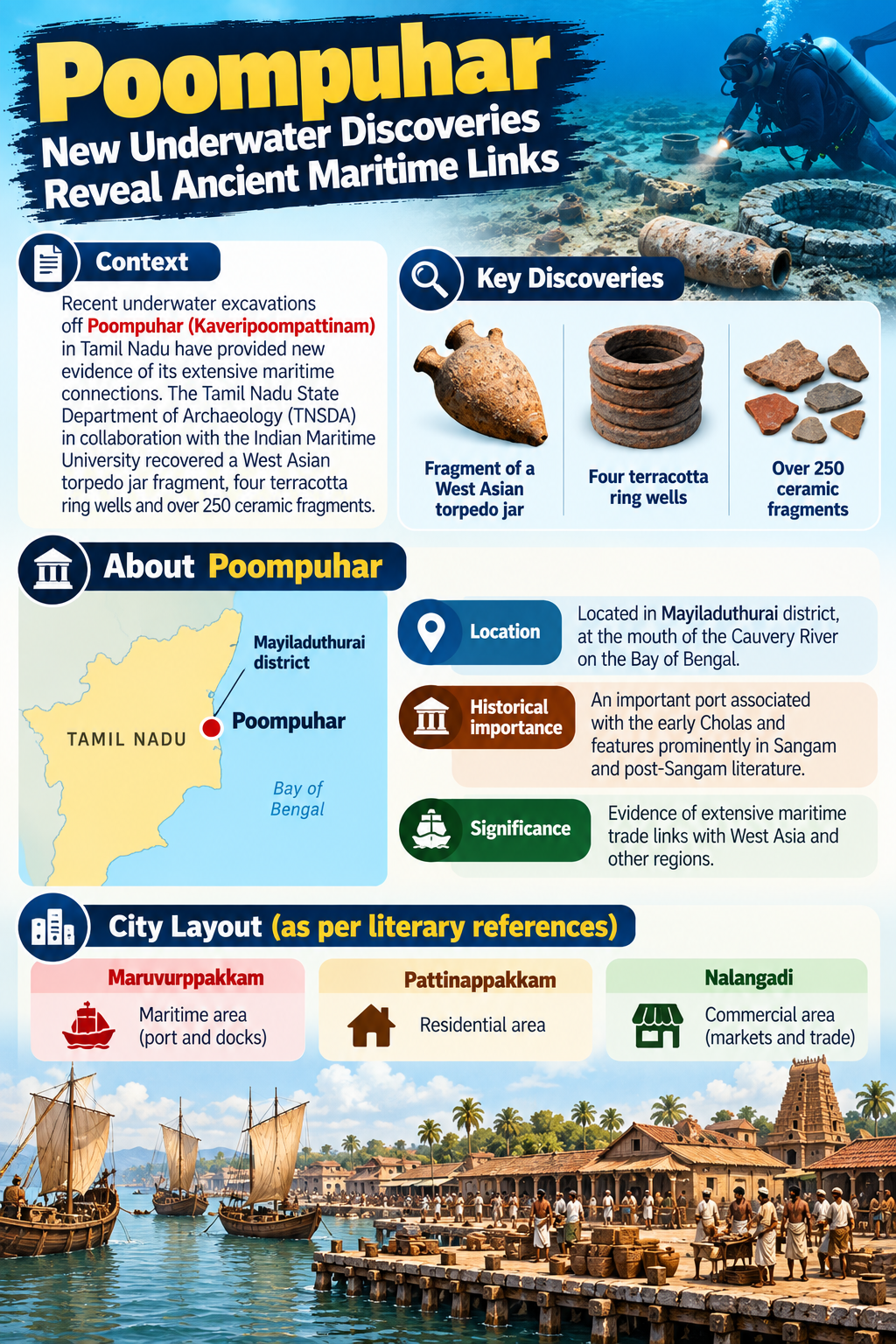
Recent Fresh underwater archaeological excavations off Poompuhar (Kaveripoompattinam) in Tamil Nadu have provided new evidence of its extensive maritime connections. Tamil Nadu State Department of Archaeology (TNSDA) in collaboration with the Indian Maritime University recovered a fragment of a West Asian torpedo jar, four terracotta ring wells and over 250 ceramic fragments.
About Poompuhar:
-
-
- Poompuhar is located in Mayiladuthurai district, at the mouth of the Cauvery River on the Bay of Bengal. It was an important port associated with the early Cholas and features prominently in Sangam and post-Sangam literature.
- The city was traditionally divided into Maruvurppakkam, Pattinappakkam and Nalangadi, reflecting its maritime, residential and commercial character.
- Poompuhar is located in Mayiladuthurai district, at the mouth of the Cauvery River on the Bay of Bengal. It was an important port associated with the early Cholas and features prominently in Sangam and post-Sangam literature.
-
Major Archaeological Findings:
-
-
- The discovery of a West Asian torpedo jar fragment is particularly significant. Such vessels were used to transport liquid commodities such as wine and oil through maritime trade routes. Its presence indicates Poompuhar's connections with West Asia and the wider Indian Ocean–Mediterranean trading network.
- The four ring wells, found on the seabed, may indicate the existence of a palaeochannel, or an ancient river channel, which was subsequently submerged due to coastal changes. More than 250 ceramic fragments, including glazed ware, further strengthen evidence of commercial activity.
- The discovery of a West Asian torpedo jar fragment is particularly significant. Such vessels were used to transport liquid commodities such as wine and oil through maritime trade routes. Its presence indicates Poompuhar's connections with West Asia and the wider Indian Ocean–Mediterranean trading network.
-
About Chola Empire:
-
-
- The Imperial Cholas (9th–13th centuries CE) emerged under Vijayalaya Chola, who captured Thanjavur around 850 CE. Rajaraja I expanded Chola power and constructed the Brihadeeswarar Temple at Thanjavur. Rajendra I further expanded the empire through campaigns in Sri Lanka and a celebrated naval expedition towards Srivijaya in Southeast Asia.
- The Cholas developed a powerful maritime capability, facilitating trade and cultural interactions across the Bay of Bengal and Southeast Asia.
- The Imperial Cholas (9th–13th centuries CE) emerged under Vijayalaya Chola, who captured Thanjavur around 850 CE. Rajaraja I expanded Chola power and constructed the Brihadeeswarar Temple at Thanjavur. Rajendra I further expanded the empire through campaigns in Sri Lanka and a celebrated naval expedition towards Srivijaya in Southeast Asia.
-
Administration and Economy:
-
-
- Chola administration is noted for its sophisticated local institutions. The empire was organised into Mandalam, Valanadu, Nadu, villages.
- The Uttiramerur inscriptions provide important evidence of village assemblies and the Kudavolai system of selecting representatives.
- Agriculture was supported by an extensive irrigation network in the Cauvery delta, while land revenue formed a major source of state income.
- Chola administration is noted for its sophisticated local institutions. The empire was organised into Mandalam, Valanadu, Nadu, villages.
-
Art and Architecture:
The Cholas made outstanding contributions to Dravidian temple architecture, bronze sculpture and religious art. The Brihadeeswarar Temple, along with other Great Living Chola Temples, represents the architectural and cultural achievements of the period.
Significance for India:
The excavation helps reconstruct:
-
-
- Ancient Indian Ocean trade networks
- Early Tamil maritime history
- Chola commercial and naval activities
- Ancient urbanisation
- Coastal and sea-level changes
- India's cultural links with Southeast Asia and West Asia
- Ancient Indian Ocean trade networks
-
Conclusion:
The underwater discoveries at Poompuhar demonstrate the importance of marine archaeology in reconstructing India's maritime past. From the early Chola port of Kaveripoompattinam to the later Imperial Cholas' naval expansion, the Tamil region played an important role in India's commercial and cultural engagement with the wider Indian Ocean. Continued scientific exploration and conservation of submerged heritage can deepen our understanding of India's maritime civilisation, trade networks and coastal history.



