
Context:
A recent World Resources Institute (WRI) India working paper has found that open waste burning in Indian cities rises sharply during winter, with the incidence, quantity of waste burned and associated emissions being up to three times higher than in summer. The study is based on field surveys conducted between 2019 and 2026 across 11 polluted Indian cities.
Key Findings:
-
- Tier-2 cities recorded the highest quantities of waste burned. Their waste burning increased from around 21 tonnes/day in summer to 41 tonnes/day in winter.
- Tier-3 cities recorded the highest incidence of burning, at around 49.6 incidents per sq. km. per day during winter.
- Poorer neighbourhoods witnessed substantially more burning, with nearly 84 incidents per sq. km. per day recorded in poorer areas of Tier-2 cities.
- Paper and plastics were among the major materials burned.
- Open waste burning contributed less than 1% of total citywide PM2.5 and PM10 emissions in the cities assessed, but created significant localised exposure because burning often occurs near homes, roads and waste dumps.
- Tier-2 cities recorded the highest quantities of waste burned. Their waste burning increased from around 21 tonnes/day in summer to 41 tonnes/day in winter.
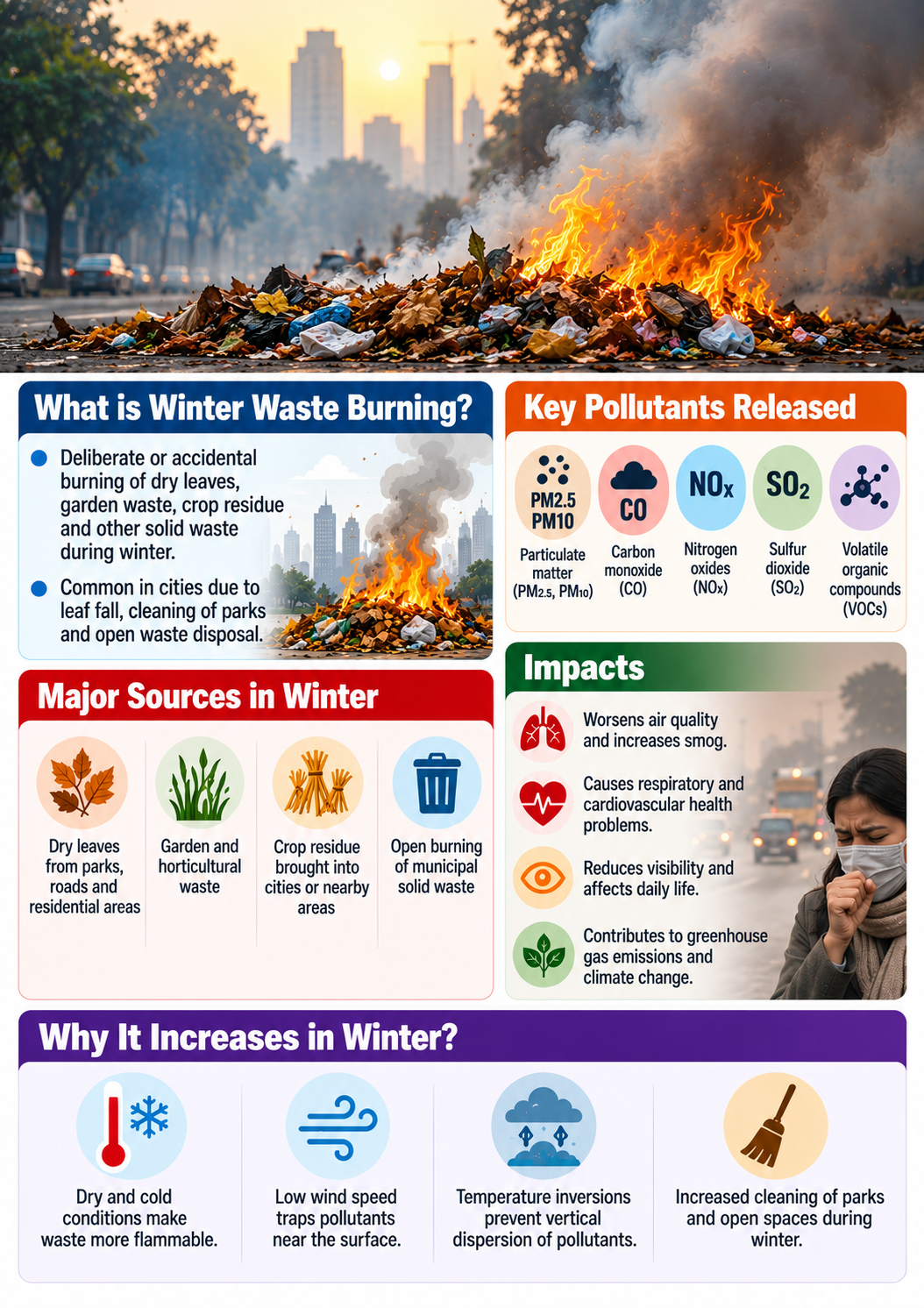
Why Does Waste Burning Increase in winter?
-
-
- Winter is associated with weaker winds, stable atmospheric conditions and temperature inversions, which restrict the dispersion of pollutants and allow them to accumulate near the ground.
- Waste burning also increases because some vulnerable populations use waste as a source of warmth, while seasonal waste-disposal practices and inadequate municipal collection further encourage open burning.
- Air Pollution and Health Impacts:
- Open burning releases PM2.5, PM10, carbon monoxide, nitrogen dioxide and other toxic pollutants. Burning plastics and mixed waste can be particularly hazardous.
- Air pollution can contribute to respiratory diseases, asthma exacerbation, cardiovascular disease, stroke and lung cancer. Although open burning may have a small share in total citywide emissions, its proximity to human settlements can result in intense short-term exposure.
- Winter is associated with weaker winds, stable atmospheric conditions and temperature inversions, which restrict the dispersion of pollutants and allow them to accumulate near the ground.
-
Socio-Economic Dimension:
-
-
- The study highlights that pollution is also an issue of environmental inequality. Poorer communities often have inadequate waste-collection services and greater proximity to dumpsites and burning locations. Therefore, enforcement alone cannot solve the problem.
- The study highlights that pollution is also an issue of environmental inequality. Poorer communities often have inadequate waste-collection services and greater proximity to dumpsites and burning locations. Therefore, enforcement alone cannot solve the problem.
-
Government Measures:
-
-
- The Commission for Air Quality Management (CAQM) has initiated measures in the NCR, including identifying “waste-sensitive” sites, strengthening inspections, training waste-management workers and conducting awareness campaigns.
- The Union Environment Ministry has also stressed increasing waste-processing capacity and providing heating facilities for workers as an alternative to burning waste for warmth.
- The Commission for Air Quality Management (CAQM) has initiated measures in the NCR, including identifying “waste-sensitive” sites, strengthening inspections, training waste-management workers and conducting awareness campaigns.
-
Way Forward:
-
- Strengthen door-to-door collection and source segregation.
- Expand scientific and decentralised waste processing.
- Map and monitor recurring waste-burning hotspots.
- Provide safe heating alternatives to vulnerable workers.
- Combine strict enforcement with improved municipal services.
- Use technology such as GIS and satellite monitoring for better surveillance.
- Strengthen door-to-door collection and source segregation.
Conclusion:
The WRI study shows that winter waste burning is a localised but significant public-health concern. Tackling it requires moving beyond seasonal enforcement towards year-round scientific waste management, stronger urban local bodies, social protection and sustainable urban planning.



