
Context:
With the rapid expansion of social media usage in India, digital platforms have increasingly become vectors for both conventional and cyber-enabled crimes. In response, police forces across States and Union Territories have expanded dedicated social media monitoring cells, reflecting the growing importance of proactive policing in the digital age.
Expansion of Social Media Monitoring Cells:
-
-
- The number of dedicated social media monitoring cells increased from 262 in 2020 to 365 in 2024 across 28 States and 8 Union Territories.
- States with the highest number of cells include:
- Bihar – 52
- Maharashtra – 50
- Punjab – 48
- West Bengal – 38
- Assam – 37
- Bihar – 52
- Manipur, following ethnic violence in May 2023, expanded its monitoring cells from 3 (2020) to 16 (2024), despite experiencing nearly 140 days of Internet suspension.
- Other notable expansions include:
- Assam: 1 → 37
- West Bengal: 2 → 38
- Punjab: 24 → 48
- Assam: 1 → 37
- The number of dedicated social media monitoring cells increased from 262 in 2020 to 365 in 2024 across 28 States and 8 Union Territories.
-
Background and Data Sources:
-
-
- Initially operating under cybercrime police stations, social media monitoring units emerged as distinct operational entities from 2021 onwards, according to the Data on Police Organisations (DoPO) reports prepared by the Bureau of Police Research and Development (BPR&D).
- The number of cybercrime police stations also rose significantly, from 376 in 2020 to 624 in 2024.
- The use of drones for surveillance increased from 1,010 in 2023 to 1,147 in 2024.
- Initially operating under cybercrime police stations, social media monitoring units emerged as distinct operational entities from 2021 onwards, according to the Data on Police Organisations (DoPO) reports prepared by the Bureau of Police Research and Development (BPR&D).
-
Significance:
-
-
- The expansion of social media monitoring cells highlights a technology-driven approach to policing, enabling real-time intelligence gathering and faster response.
- These units play a key role in preventing cybercrime, controlling communal tensions, addressing online harassment, and countering radicalisation.
- Integration with drone surveillance and cybercrime units strengthens India’s internal security architecture.
- The expansion of social media monitoring cells highlights a technology-driven approach to policing, enabling real-time intelligence gathering and faster response.
-
Rising Social Media–Related Crimes:
-
-
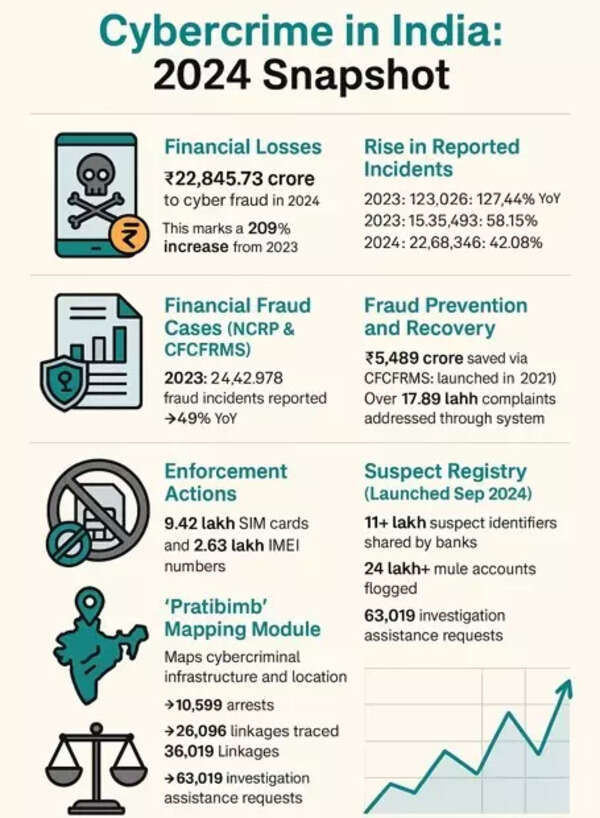
- Cybersecurity incidents rose sharply from 10.29 lakh in 2022 to 22.68 lakh in 2024.
- Common criminal activities on social media include:
- Financial Scams and “Digital Arrests” – Fraudsters impersonate officials through video calls to extort money.
- Identity Theft and Impersonation – Fake profiles used for romance scams or to defame victims.
- Cyberstalking and Harassment – Persistent online abuse and deepfake threats, particularly targeting women and children.
- Incitement to Violence – Dissemination of fake news to trigger communal tension or mob violence.
- Recruitment and Radicalisation – Extremist groups exploiting encrypted platforms to target vulnerable individuals.
- Financial Scams and “Digital Arrests” – Fraudsters impersonate officials through video calls to extort money.
- Cybersecurity incidents rose sharply from 10.29 lakh in 2022 to 22.68 lakh in 2024.
-
Legal Framework:
-
-
- The Bharatiya Nyaya Sanhita (BNS), 2023 penalises misinformation, cyberstalking, and defamation.
- The Information Technology Act, 2000 and allied rules mandate action against identity theft, impersonation, and unlawful online content, with compliance obligations on digital platforms.
- The Digital Personal Data Protection Act, 2023 safeguards personal data and enhances protections for children against harmful online targeting and tracking.
- The Bharatiya Nyaya Sanhita (BNS), 2023 penalises misinformation, cyberstalking, and defamation.
-
Conclusion:
The expansion of social media monitoring units reflects India’s evolving response to digital-age crime. As cyber offences and online criminal techniques grow in scale and sophistication, a combination of strengthened legal frameworks and specialised policing infrastructure is essential to ensure public security while maintaining a balance with civil liberties.



