
Context:
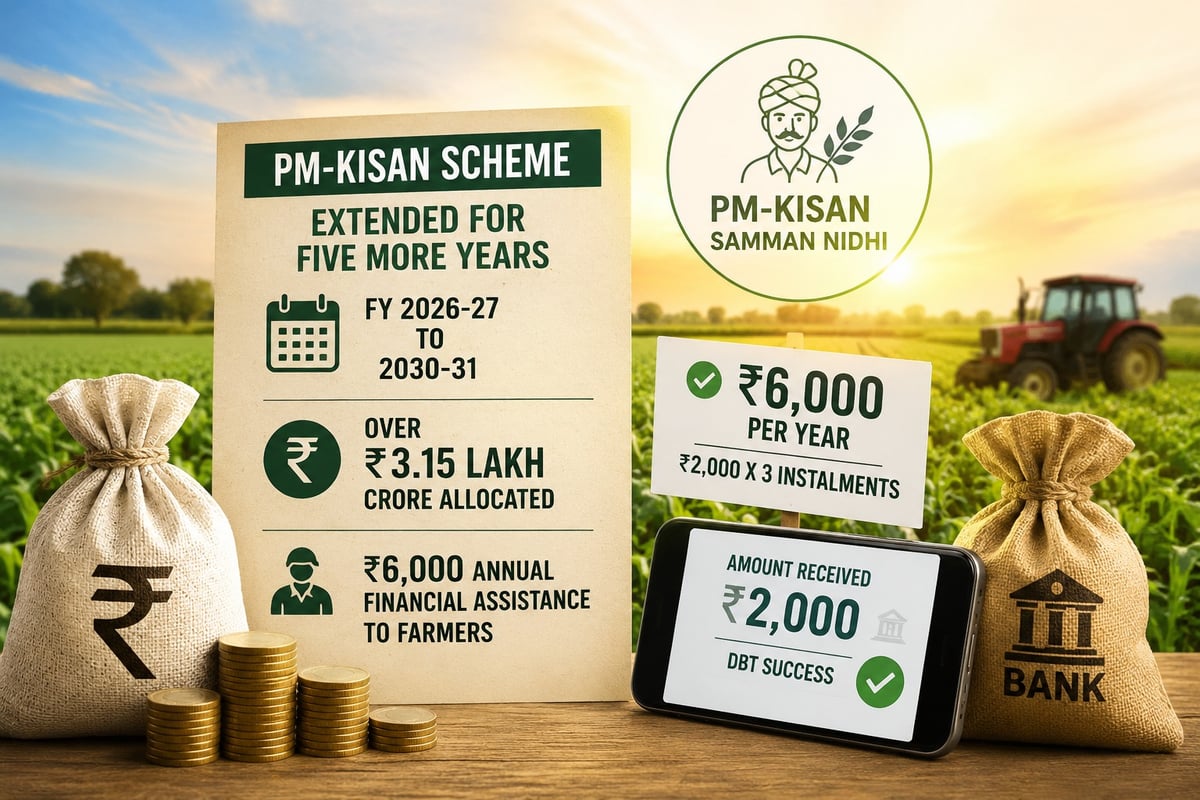
Recently, the Union Cabinet approved the continuation of the Pradhan Mantri Kisan Samman Nidhi (PM-KISAN) Scheme for another five years, from 2026–27 to 2030–31. A financial outlay of ₹3.15 lakh crore has been allocated for this extension. The decision aims to provide continued income support to eligible farmer families through the Direct Benefit Transfer (DBT) mechanism.
About the PM-KISAN Scheme:
The PM-KISAN Scheme was launched on 24 February 2019. It is a Central Sector Scheme implemented by the Ministry of Agriculture and Farmers’ Welfare. Under the scheme, eligible landholding farmer families receive ₹6,000 per year in three equal installments of ₹2,000 each, which are directly transferred to their bank accounts through an Aadhaar-enabled Direct Benefit Transfer (DBT) system. The scheme is fully funded by the Government of India and aims to supplement farmers' income while encouraging agricultural investment.
Recent Developments:
-
-
- The Union Cabinet has extended the PM-KISAN Scheme for the period 2026–27 to 2030–31.
- Since its launch, more than ₹4.47 lakh crore has been transferred to farmers through 23 installments.
- Under the 23rd installment, ₹18,984 crore was credited to the bank accounts of more than 9.49 crore farmers.
- During the COVID-19 pandemic, more than ₹1.71 lakh crore was disbursed under the scheme.
- Women farmers have received over ₹1.06 lakh crore, and nearly one-fourth of the total beneficiaries are women.
- The Union Cabinet has extended the PM-KISAN Scheme for the period 2026–27 to 2030–31.
-
Key Features:
-
-
- Provides ₹6,000 per year as financial assistance to eligible farmer families.
- The amount is paid in three equal installments through the Direct Benefit Transfer (DBT) mechanism.
- It is a 100% Centrally funded scheme.
- Supports expenditure on seeds, fertilizers, agricultural equipment, and other farming requirements.
- Aadhaar-based e-KYC is mandatory for receiving benefits.
- Provides ₹6,000 per year as financial assistance to eligible farmer families.
-
Impact:
-
-
- According to the Development Monitoring and Evaluation Office (DMEO), NITI Aayog:
- More than 92% of beneficiaries used the financial assistance for agricultural activities and farm investments.
- Nearly 85% of farmers reported an increase in agricultural income and reduced dependence on informal sources of credit.
- The scheme has also strengthened financial inclusion by ensuring transparent and timely DBT transfers without the involvement of intermediaries.
- According to the Development Monitoring and Evaluation Office (DMEO), NITI Aayog:
-
Challenges:
The scheme does not cover tenant farmers, sharecroppers, and landless agricultural labourers.
Inaccurate land records, delays in e-KYC, and the declining real value of the ₹6,000 assistance due to rising agricultural input costs limit the effectiveness of the scheme.
Conclusion:
The extension of the PM-KISAN Scheme until 2030–31 reflects the Government’s commitment to strengthening farmers’ livelihoods through direct income support. However, to make the scheme more inclusive and effective, it is essential to improve land records, include genuine cultivators, ensure seamless DBT delivery, and integrate the scheme with broader agricultural reforms such as irrigation, market access, and climate-resilient farming. These measures will enable PM-KISAN to become a more sustainable and inclusive instrument for rural development and agricultural prosperity.



