
Context:
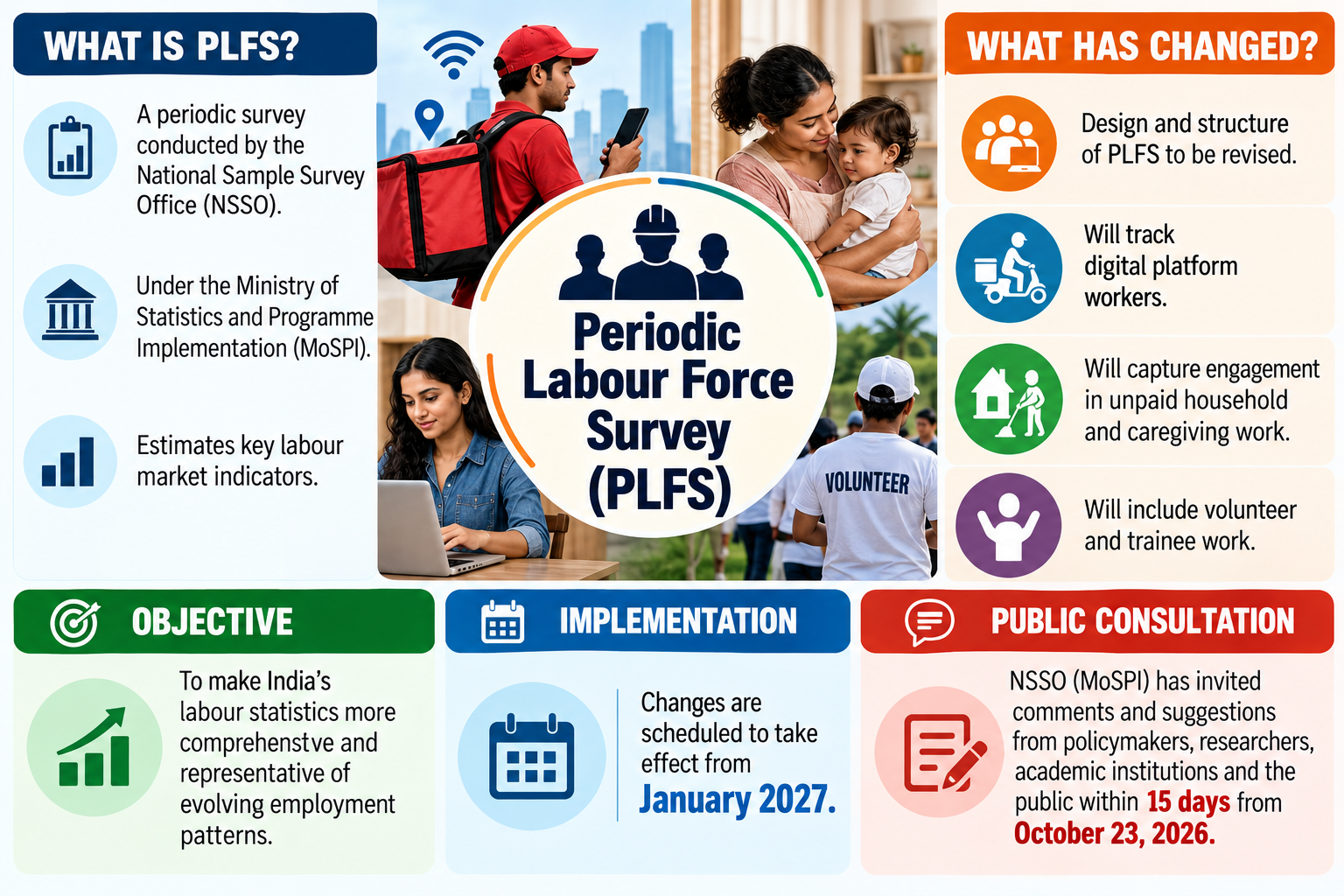
Recently, The Union government has decided to change the design and structure of the Periodic Labour Force Survey (PLFS) to track digital platform workers and capture engagement in unpaid household, caregiving, volunteer and trainee work. The changes are scheduled to take effect from January 2027 and aim to make India’s labour statistics more comprehensive and representative of evolving employment patterns.
-
-
- The National Sample Survey Office (NSSO), under the Ministry of Statistics and Programme Implementation (MoSPI), has invited comments and suggestions from policymakers, researchers, academic institutions and the public within 15 days from October 23, 2026.
- The National Sample Survey Office (NSSO), under the Ministry of Statistics and Programme Implementation (MoSPI), has invited comments and suggestions from policymakers, researchers, academic institutions and the public within 15 days from October 23, 2026.
-
Background:
-
-
-
- Traditional employment statistics have limitations in capturing the contribution of gig and platform workers, who are often classified under broader categories such as self-employed or casual workers. Similarly, unpaid domestic activities, including cooking, cleaning, childcare and elderly care, remain inadequately represented in conventional employment indicators.
- This statistical invisibility creates difficulties in accurately estimating labour force participation, understanding gender inequalities and designing targeted welfare policies.
- The Code on Social Security, 2020, recognises gig workers and platform workers and provides a framework for extending social security to them. The e-Shram portal supports the registration of unorganised workers and facilitates access to welfare initiatives. Improved PLFS data can help policymakers assess the reach and effectiveness of these frameworks.
- Traditional employment statistics have limitations in capturing the contribution of gig and platform workers, who are often classified under broader categories such as self-employed or casual workers. Similarly, unpaid domestic activities, including cooking, cleaning, childcare and elderly care, remain inadequately represented in conventional employment indicators.
-
-
Key Proposed Changes from January 2027:
-
-
-
- The proposed reforms include introducing a dedicated Second Stage Stratum (SSS) in the sampling framework to identify households containing digital platform workers, with four strata in rural areas and five in urban areas, as described in the supplied concept note.
- Revised questionnaires will directly identify household members engaged in app-based work. The survey will also pay greater attention to unpaid domestic services, caregiving and own-use production of goods. Additional indicators will help assess underemployment and labour underutilisation, providing a more comprehensive picture of employment conditions.
- The proposed reforms include introducing a dedicated Second Stage Stratum (SSS) in the sampling framework to identify households containing digital platform workers, with four strata in rural areas and five in urban areas, as described in the supplied concept note.
-
-
Significance for India:
-
-
-
- The reform can improve understanding of women’s economic contribution by documenting unpaid care work, which often limits their participation in paid employment.
- Better identification of gig and platform workers can support evidence-based policies on fair earnings, social security, occupational safety and working conditions.
- More reliable data can also improve the targeting of health insurance, pensions and portable welfare benefits for workers who frequently change jobs or platforms. Overall, the changes can strengthen evidence-based governance and help identify gaps in employment and social protection.
- The reform can improve understanding of women’s economic contribution by documenting unpaid care work, which often limits their participation in paid employment.
-
-
Challenges:
-
-
-
- Implementation may face difficulties in defining gig, platform and informal employment consistently, capturing irregular working hours and multiple income sources, and preventing double counting between paid employment and unpaid household activities.
- Protecting respondents’ privacy, ensuring survey reliability and converting improved statistics into actual welfare coverage will also be essential.
- Implementation may face difficulties in defining gig, platform and informal employment consistently, capturing irregular working hours and multiple income sources, and preventing double counting between paid employment and unpaid household activities.
-
-
Conclusion:
The proposed PLFS overhaul represents an important step towards making India’s labour market more visible in official statistics. By recognising digital platform employment and unpaid care work, it can support gender-responsive policymaking, inclusive growth and targeted social protection. Better measurement must be accompanied by effective implementation of labour rights and welfare policies to produce meaningful outcomes.



