
Context:
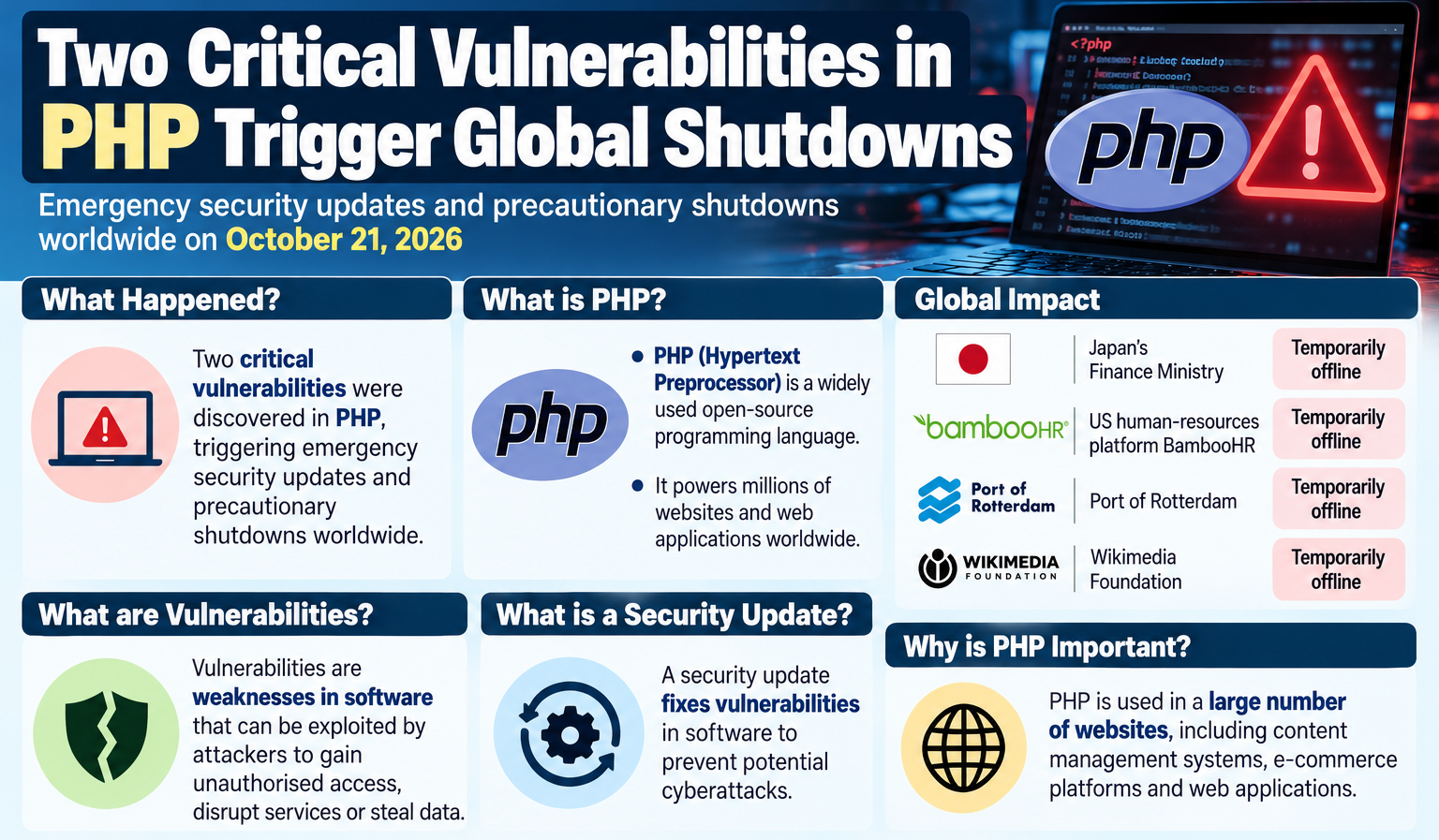
Recently, Two critical vulnerabilities in PHP, a programming language used by millions of websites, triggered emergency security updates and precautionary shutdowns worldwide on October 21, 2026. Several services, including Japan’s Finance Ministry, US human-resources platform BambooHR, the Port of Rotterdam and the Wikimedia Foundation, temporarily went offline as organisations worked to secure their systems.
About PHP and why is it so widely used?
-
-
- PHP (Hypertext Preprocessor) is a free, open-source programming language that operates behind the scenes on roughly 70% of websites whose server-side language is identifiable. It processes tasks such as logins, applications and online purchases.
- WordPress, which powers more than 40% of websites worldwide, also uses PHP. Its widespread use means vulnerabilities can affect websites across governments, businesses and media organisations.
- PHP (Hypertext Preprocessor) is a free, open-source programming language that operates behind the scenes on roughly 70% of websites whose server-side language is identifiable. It processes tasks such as logins, applications and online purchases.
-
What is PHP2Shell, and why is it dangerous?
-
-
- PHP2Shell refers to two critical vulnerabilities in PHP that could allow attackers to execute malicious code remotely without logging in or access sensitive information in server memory.
- According to cybersecurity experts, the flaws occur within PHP itself, before individual websites’ login checks or security systems can operate.
- PHP2Shell refers to two critical vulnerabilities in PHP that could allow attackers to execute malicious code remotely without logging in or access sensitive information in server memory.
-
Researchers identified two problems:
-
-
- A problem when PHP runs out of memory: When a request causes a memory error, PHP may incorrectly treat incomplete or invalid information as legitimate, creating an opportunity for exploitation.
- A problem with leftover information: PHP may mistakenly reuse outdated references to internal information from earlier requests, potentially causing subsequent requests to be processed incorrectly.
- Attackers could exploit these weaknesses to steal customer data, database passwords and login credentials, modify websites, install backdoors or gain access to internal networks. AI tools could also help attackers develop exploits more quickly.
- A problem when PHP runs out of memory: When a request causes a memory error, PHP may incorrectly treat incomplete or invalid information as legitimate, creating an opportunity for exploitation.
-
Why did websites go offline?
-
-
- Cybersecurity agencies advised organisations to install security updates immediately. Websites that could not be patched promptly were advised to go offline temporarily to reduce the risk of compromise.
- Updating PHP can be complicated because it operates across hosting platforms, content-management systems and third-party products. Older devices may also depend on vendors for updates.
- CERT-EU and India’s CERT-In issued warnings urging affected organisations to apply the fixes.
- Cybersecurity agencies advised organisations to install security updates immediately. Websites that could not be patched promptly were advised to go offline temporarily to reduce the risk of compromise.
-
Implications for India:
The incident highlights risks to Digital India services, e-governance platforms, financial systems and critical information infrastructure. It reinforces the importance of CERT-In advisories, coordinated vulnerability disclosure and robust cyber incident-response mechanisms.
Legal and Institutional Framework in India:
-
-
- IT Act, 2000: Section 70 addresses protected systems, Section 70A provides for protection of critical information infrastructure, and Section 70B establishes CERT-In’s incident-response role.
- CERT-In: Issues cybersecurity advisories and coordinates responses to cyber incidents. Its 2022 directions require specified incidents to be reported within six hours of being noticed or brought to an organisation’s attention.
- DPDP Act, 2023: Section 8(5) requires data fiduciaries to implement reasonable security safeguards to prevent personal data breaches.
- IT Act, 2000: Section 70 addresses protected systems, Section 70A provides for protection of critical information infrastructure, and Section 70B establishes CERT-In’s incident-response role.
-
Conclusion:
PHP2Shell demonstrates how vulnerabilities in widely used open-source infrastructure can create systemic cyber risks. Strengthening software security, responsible AI governance and institutional preparedness is essential to building a resilient digital ecosystem.



