
Patent Growth in India 2026
Context:
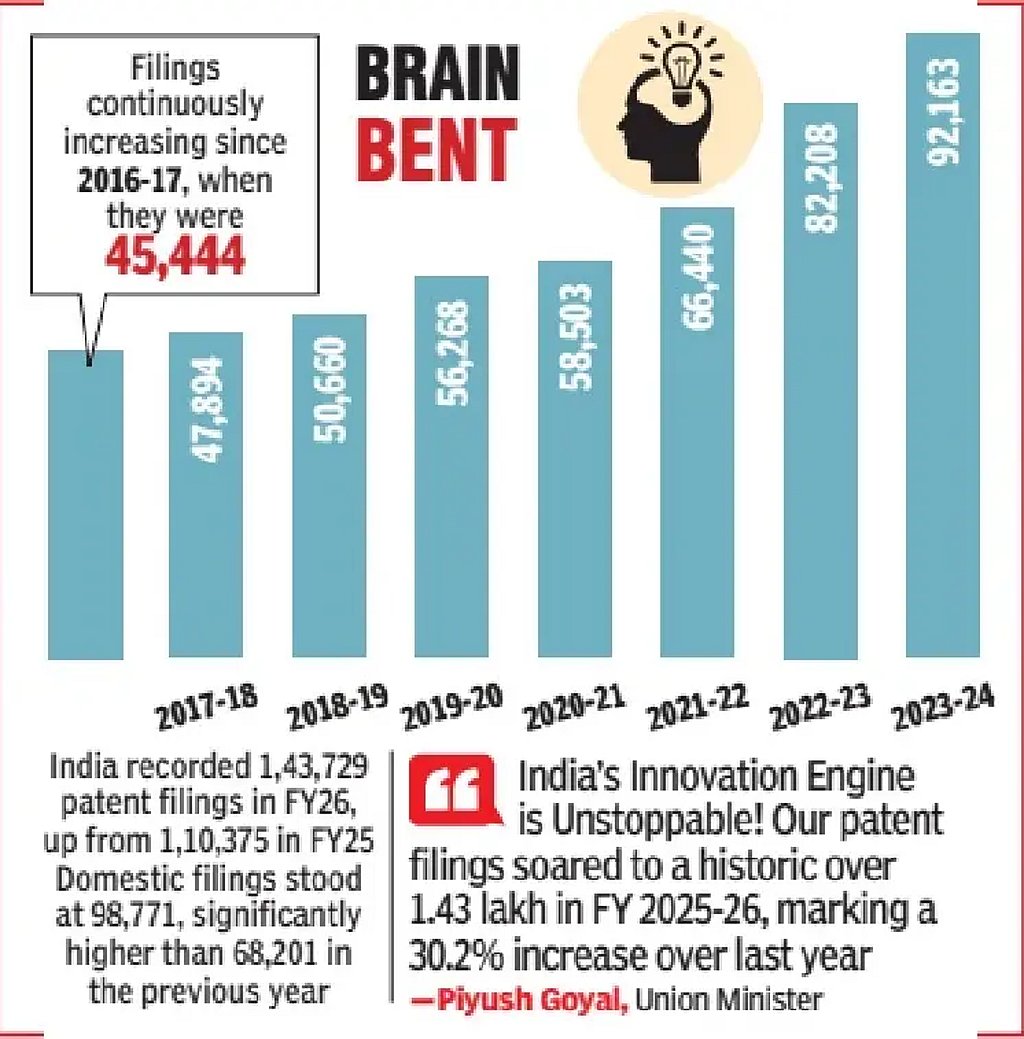
Recently, India has witnessed a record surge in patent filings in FY 2025–26, with applications rising to 1,43,729, marking a 30.2% increase over the previous year. This is the highest ever patent filing in India’s history. With this growth, India has also emerged as the 6th largest patent filer globally.
Domestic Innovation:
Out of the total applications, about 69% patents were filed by domestic applicants, which indicates an increase in indigenous innovation capability.
State-wise Performance:
-
-
- Tamil Nadu at the top
- Karnataka at second position
- Maharashtra at third position
- Tamil Nadu at the top
-
This shows that innovation in India is mainly concentrated in industrial, technological, and startup-centric states.
In the last five years, patent filing has recorded an increase of about 146%, which confirms a structural shift from “Made in India” to “Invented in India.”
About Patents:
A patent is an exclusive legal right granted to an inventor for a new invention, allowing them to prevent others from making, using, or selling the invention without permission for a limited period (usually 20 years).
Purpose of Patents:
-
-
- Encourage innovation and creativity
- Protect intellectual property rights (IPR)
- Promote technological advancement
- Provide commercial benefits to inventors
- Encourage innovation and creativity
-
Legal Framework for Patents in India:
The patent system in India is governed by the Patents Act, 1970, which was amended in 2005 in accordance with the TRIPS Agreement. This reflects India’s international trade and IPR commitments.
Institutional Structure:
-
-
- Controller General of Patents, Designs and Trademarks (CGPDTM): A key institution under the Ministry of Commerce and Industry.
- National IPR Policy, 2016: With the objective of “Creative India, Innovative India,” promoting innovation.
- Controller General of Patents, Designs and Trademarks (CGPDTM): A key institution under the Ministry of Commerce and Industry.
-
Government Incentives and Reforms:
-
-
- Up to 80% fee exemption for startups, MSMEs, and women entrepreneurs
- Faster patent examination process through Expedited Examination
- About 95% patent applications filed digitally
- Legal support under SIPP (Start-up Intellectual Property Protection) scheme
- Up to 80% fee exemption for startups, MSMEs, and women entrepreneurs
-
Economic Importance:
-
-
- India’s global ranking: sixth largest patent filer
- Strong IPR system increases attraction of FDI (Foreign Direct Investment)
- Transformation of India from a service-based economy to a knowledge-based economy
- Promotion of innovation-based industries and startups
- India’s global ranking: sixth largest patent filer
-
Major Challenges:
-
-
- Low R&D expenditure: about 0.7% of GDP (USA ~3.5%, China ~2.4%)
- Lack of commercialization: only 10–15% of patents are converted into products
- Shortage of human resources: insufficient number of patent examiners, leading to increased backlog cases
- Low R&D expenditure: about 0.7% of GDP (USA ~3.5%, China ~2.4%)
-
Way Forward:
India needs to focus on increasing its Research and Development (R&D) investment to 2% of GDP in order to promote high-quality innovation. At the same time, it is essential to strengthen collaboration between universities and industry so that research can be effectively translated into practical products and technologies. Developing a robust ecosystem for the commercialization of patents is also crucial, enabling inventions to generate economic value. Additionally, the use of digital technologies and Artificial Intelligence (AI) in IPR administration should be expanded to make processes more transparent, faster, and efficient.
Conclusion:
The patent data of FY 2025–26 is not just statistical growth, but a reflection of India’s changing scientific and innovation mindset. If India increases R&D investment, improves patent quality, and strengthens commercialization, then it can play a decisive role in achieving the goal of “Developed India 2047.”



