
Context:
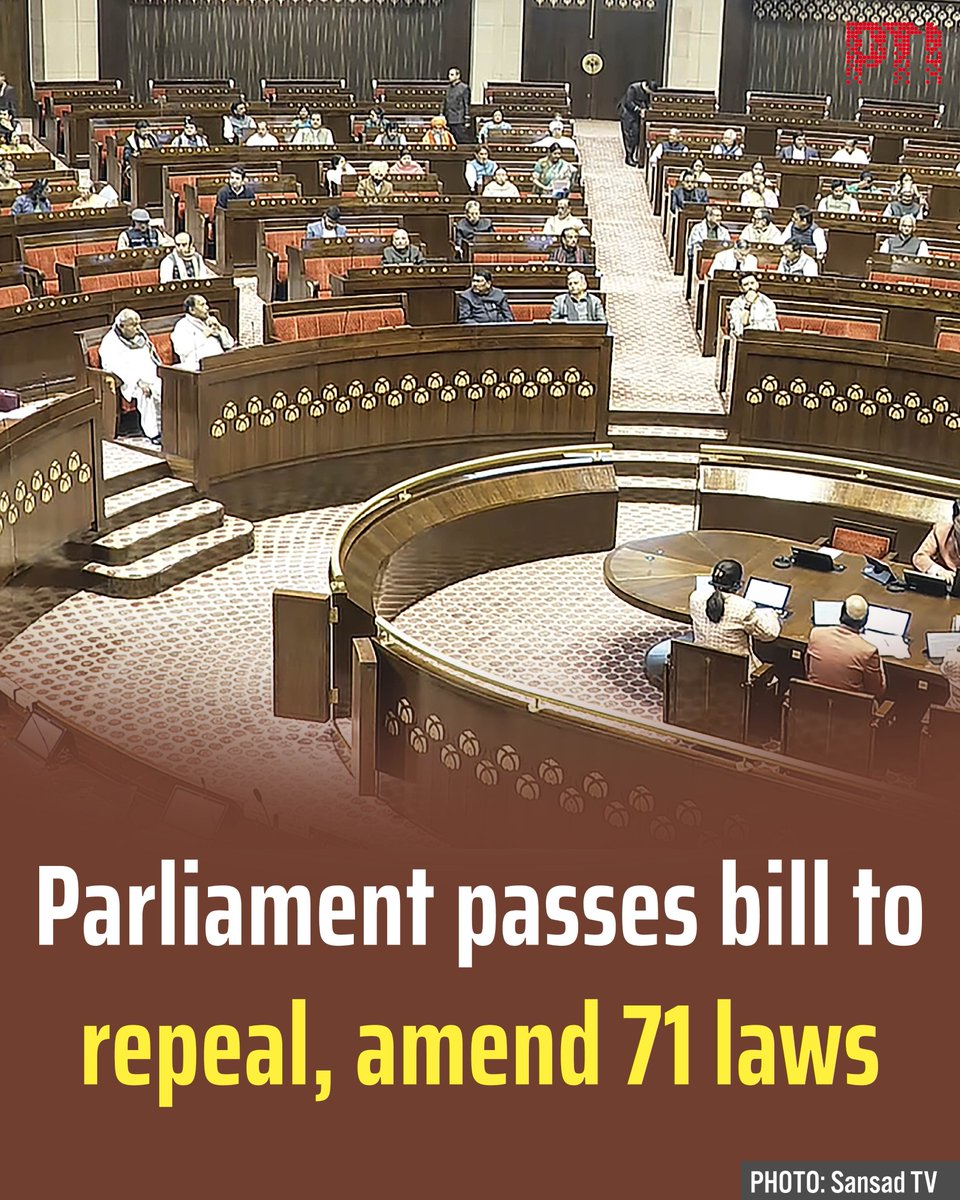
Recently, Parliament passed the Repealing and Amending Bill, 2025, aimed at pruning the statute book by repealing or amending laws that have become obsolete, redundant, or outdated. This move forms part of the government’s ongoing legislative reform and statute-simplification drive.
Key Provisions of the Bill:
-
-
- The Bill proposes to repeal 71 Acts that are considered obsolete or no longer relevant.
- It also seeks to amend four existing laws to correct drafting errors, update terminology, and remove discriminatory provisions.
- Examples of laws proposed for repeal include the Indian Tramways Act, 1886, the Levy Sugar Price Equalisation Fund Act, 1976, and the Bharat Petroleum Corporation Limited (Determination of Conditions of Service of Employees) Act, 1988.
- The Bill proposes to repeal 71 Acts that are considered obsolete or no longer relevant.
-
Key Amendments:
-
-
- Indian Succession Act, 1925: Section 213, which required certain religious groups to obtain court probate for wills in specific metropolitan areas, is removed.
- Disaster Management Act, 2005: A drafting error in Section 30 is corrected by replacing the word “prevention” with “preparation”.
- General Clauses Act, 1897 and Code of Civil Procedure, 1908: The term “registered post” is updated to “speed post with registration” to align with contemporary postal services.
- Indian Succession Act, 1925: Section 213, which required certain religious groups to obtain court probate for wills in specific metropolitan areas, is removed.
-
Objectives and Rationale:
-
-
- The principal objective is to remove archaic and irrelevant laws, thereby streamlining the legal framework to reflect current socio-economic realities.
- The government argues that such repeal enhances ease of living for citizens and supports ease of doing business by reducing regulatory clutter.
- The reforms are also intended to reverse the legacy of colonial-era legislation and make the legal framework more citizen-centric.
- The principal objective is to remove archaic and irrelevant laws, thereby streamlining the legal framework to reflect current socio-economic realities.
-
Broader Legislative Trend:
-
-
- The present Bill forms part of a larger pattern of statute rationalisation, with over 1,560 Central laws repealed since 2014 under the current government’s reform efforts.
- Historically, Parliament has periodically enacted Repealing and Amending Acts to prune the statute book; similar exercises were undertaken in earlier years, sometimes repealing dozens or even hundreds of obsolete laws.
- The present Bill forms part of a larger pattern of statute rationalisation, with over 1,560 Central laws repealed since 2014 under the current government’s reform efforts.
-
Significance:
-
-
- Legal clarity and accessibility: Removing unnecessary laws reduces confusion and legal uncertainty for citizens, businesses, and enforcement agencies.
- Governance efficiency: A leaner statute book improves legislative coherence and enhances administrative efficiency.
- Symbolic reform: The exercise underscores the state’s intent to align the legal framework with contemporary needs and constitutional values.
- Legal clarity and accessibility: Removing unnecessary laws reduces confusion and legal uncertainty for citizens, businesses, and enforcement agencies.
-
Conclusion:
The passage of the Repealing and Amending Bill, 2025 represents a focused parliamentary initiative to modernise India’s legal framework by excising obsolete legislation and fine-tuning existing statutes. While such legal housekeeping supports broader goals of governance reform, it also requires careful scrutiny to ensure legislative balance and the protection of rights.



