
Panchayat Advancement Index (PAI) 2.0
Context:
The Panchayat Advancement Index (PAI) 2.0 was recently released by the Ministry of Panchayati Raj. It evaluates the performance of 2,59,867 Gram Panchayats (excluding West Bengal) based on their progress in implementing Sustainable Development Goals (SDGs) at the grassroots level.
About Panchayat Advancement Index (PAI) 2.0:
-
-
- The PAI 2.0 is a multi-dimensional framework designed to assess the Localization of Sustainable Development Goals (LSDGs) at the Gram Panchayat level.
- Developed by: Ministry of Panchayati Raj
- Coverage: 2.59 lakh+ Gram Panchayats (all states except West Bengal)
- Assessment year: FY 2023–24
- Indicators: 150 indicators
- Themes: 9 SDG-aligned local themes
- Developed by: Ministry of Panchayati Raj
- The index measures how effectively Panchayats contribute to inclusive and sustainable rural development.
- The PAI 2.0 is a multi-dimensional framework designed to assess the Localization of Sustainable Development Goals (LSDGs) at the Gram Panchayat level.
-
Key Features and Classification:
-
-
- PAI 2.0 ranks Gram Panchayats on a 0–100 scale and categorises them into five groups:
- Achiever (90–100): 0 Panchayats
- Front Runner (75–90): 3,635 Panchayats
- Performer (60–75): 1,18,824 Panchayats
- Aspirant (40–60): 1,23,719 Panchayats
- Beginner (below 40): 13,689 Panchayats
- Achiever (90–100): 0 Panchayats
- The distribution shows that most Panchayats fall in the middle categories, indicating moderate and uneven rural development progress.
- PAI 2.0 ranks Gram Panchayats on a 0–100 scale and categorises them into five groups:
-
Key Outcomes:
-
-
- The Panchayat Advancement Index (PAI) 2.0 recorded a 97.30% participation rate of Gram Panchayats, making it one of the highest levels of data coverage in rural governance assessments in India. Among states, Tripura performed the best with around 80% of its Panchayats in the Front Runner category, followed by Kerala and Odisha, which also showed strong governance outcomes and steady improvement. In contrast, larger states such as Uttar Pradesh, Bihar, and Rajasthan lagged behind in terms of performance rankings, reflecting regional disparities in grassroots development.
- PAI 2.0 evaluates Panchayats across nine SDG-linked themes such as poverty alleviation, health, education, sanitation, and gender equality. Under thematic performance, Theme 1 (Poverty-free and Livelihoods) saw 3,313 Gram Panchayats achieving A+ grades, while Theme 2 (Healthy Panchayat) recorded 1,015 A+ graded Panchayats, indicating strong outcomes in key social sectors.
- The Panchayat Advancement Index (PAI) 2.0 recorded a 97.30% participation rate of Gram Panchayats, making it one of the highest levels of data coverage in rural governance assessments in India. Among states, Tripura performed the best with around 80% of its Panchayats in the Front Runner category, followed by Kerala and Odisha, which also showed strong governance outcomes and steady improvement. In contrast, larger states such as Uttar Pradesh, Bihar, and Rajasthan lagged behind in terms of performance rankings, reflecting regional disparities in grassroots development.
-
Objectives of the Index:
-
-
- PAI 2.0 aligns with the UN Sustainable Development Goals (SDGs) and complements India’s SDG India Index (NITI Aayog).
- Key objectives:
- Strengthen grassroots governance
- Promote data-driven planning
- Support “Viksit Gram Panchayat” vision
- Ensure inclusive rural development
- Strengthen grassroots governance
- It consolidates 17 SDGs into 9 local themes such as poverty reduction, health, education, water, sanitation, and women empowerment.
- PAI 2.0 aligns with the UN Sustainable Development Goals (SDGs) and complements India’s SDG India Index (NITI Aayog).
-
Significance for Panchayati Raj System:
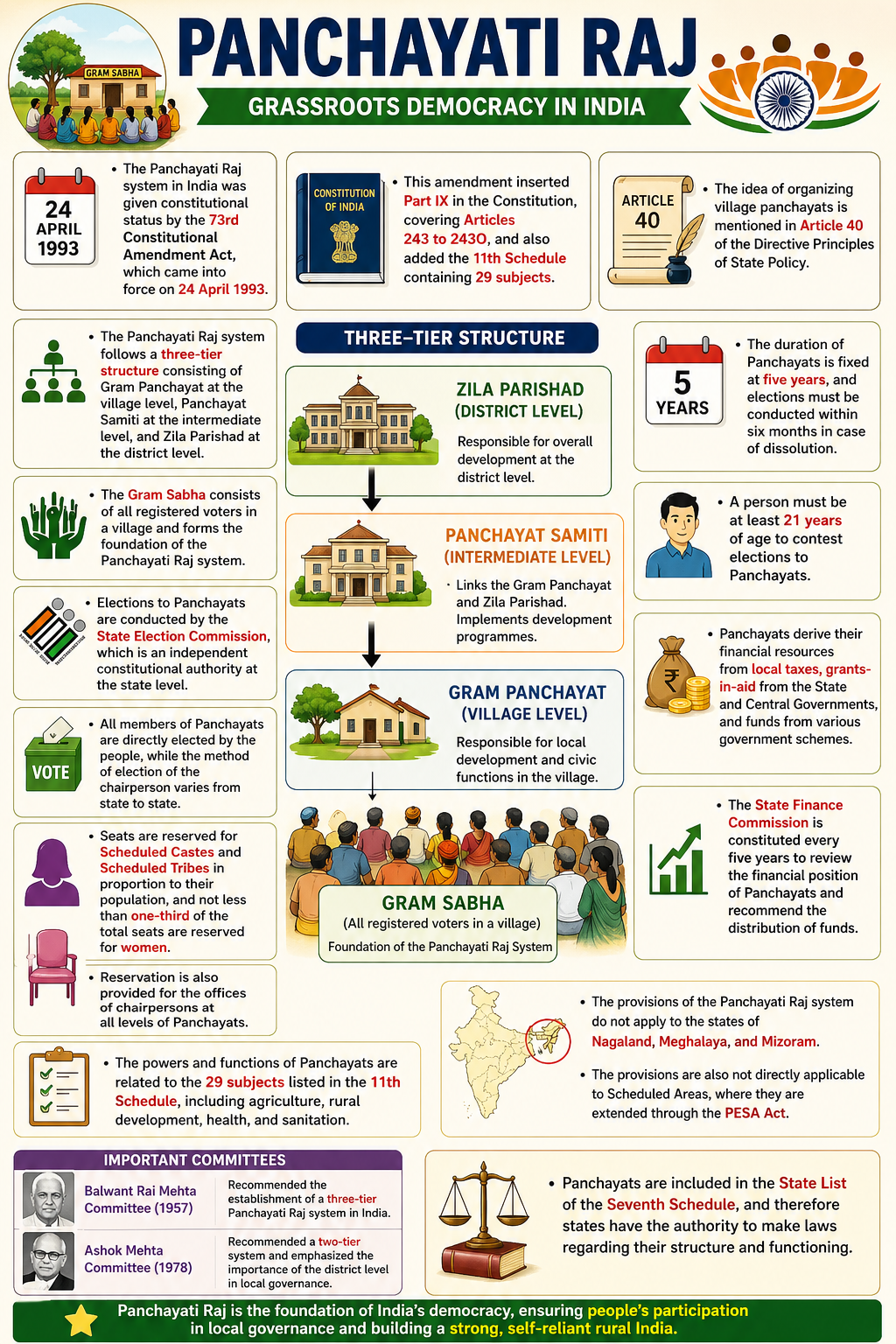
PAI 2.0 strengthens India’s three-tier Panchayati Raj system under the 73rd Constitutional Amendment Act, 1992.
Significance:
-
-
- Encourages competitive governance among Panchayats
- Identifies regional disparities in development
- Promotes transparency and accountability
- Supports better resource allocation
- Strengthens participatory democracy at the grassroots
- India has over 2.63 lakh Panchayats and 32 lakh elected representatives, making such indices crucial for governance monitoring.
- Encourages competitive governance among Panchayats
-
Conclusion:
The Panchayat Advancement Index (PAI) 2.0 is a significant reform tool for assessing and improving grassroots governance in India. By linking local development with global SDGs, it strengthens the vision of Viksit Gram Panchayats and promotes inclusive, transparent, and data-driven rural transformation.



