
Context:
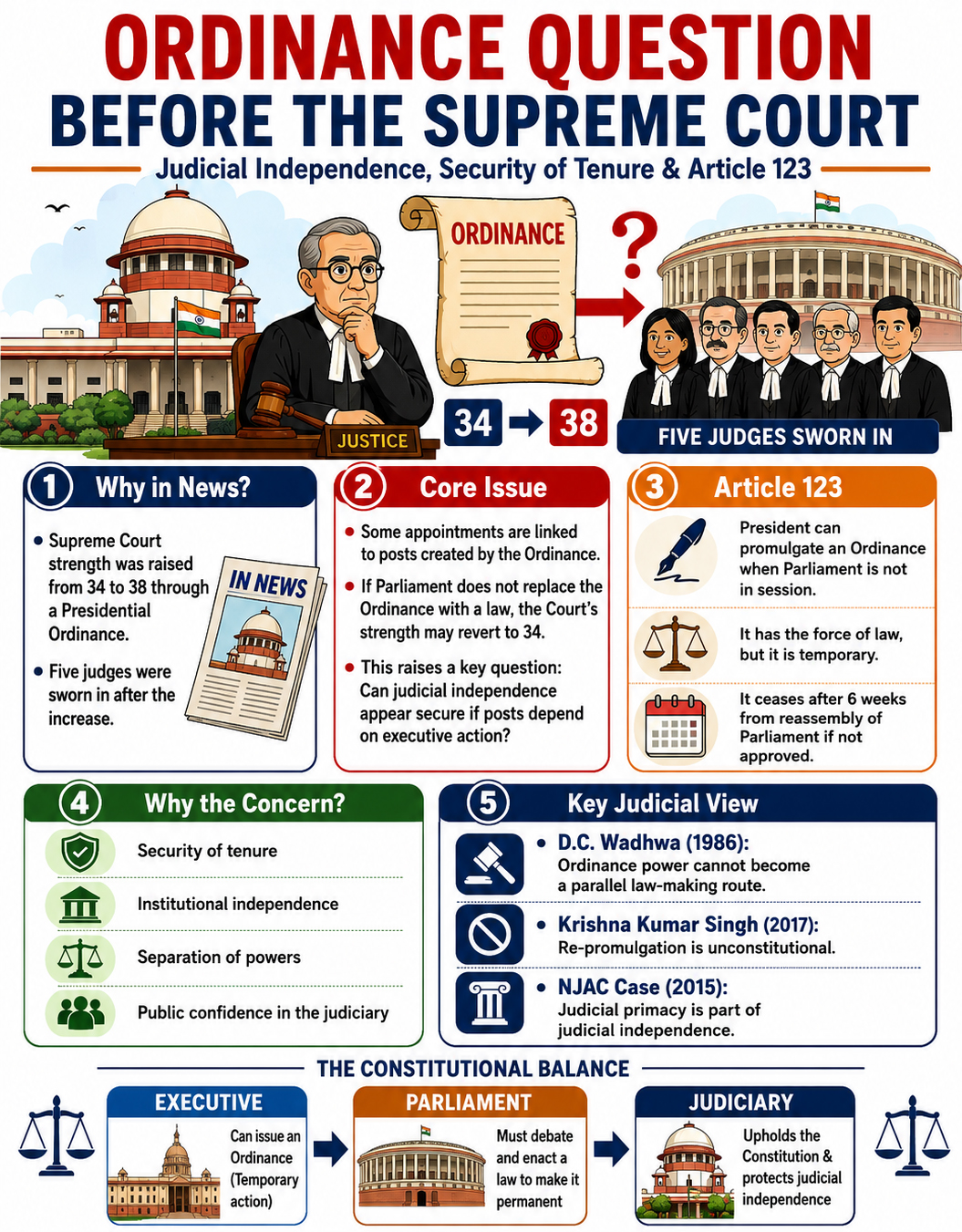
Recently, through the “The Supreme Court (Number of Judges) Amendment Ordinance, 2026”, the sanctioned strength of judges in the Supreme Court has been increased from 34 to 38 (including the Chief Justice of India). Following this ordinance, the appointment of five new judges has triggered a renewed debate on judicial independence and the relationship between the judiciary and the executive.
Key Constitutional Provisions Related to the Ordinance:
-
-
- Article 124(1): This provision states that there shall be a Supreme Court of India and gives Parliament full authority to determine the number of judges by law.
- Article 123: It empowers the President to promulgate ordinances during the recess of Parliament. Such ordinances have the same force and effect as a law passed by Parliament, but are temporary in nature.
- Article 124(1): This provision states that there shall be a Supreme Court of India and gives Parliament full authority to determine the number of judges by law.
-
Appointment Process and Its Implications:
-
-
- Existing Vacancies vs Ordinance-Created Posts: At the time the ordinance was issued, the Supreme Court had 32 serving judges against a sanctioned strength of 34, meaning two posts were already vacant. The ordinance increased the sanctioned strength, thereby creating additional judicial posts.
- Temporary Nature of Appointments: Out of the five new appointments:
- Two judges were appointed against existing vacancies, and
- Three judges were appointed against posts created by the ordinance.
- These three ordinance-created positions will continue to exist only as long as the ordinance remains in force or until it is replaced by a permanent Act of Parliament.
- Two judges were appointed against existing vacancies, and
- Existing Vacancies vs Ordinance-Created Posts: At the time the ordinance was issued, the Supreme Court had 32 serving judges against a sanctioned strength of 34, meaning two posts were already vacant. The ordinance increased the sanctioned strength, thereby creating additional judicial posts.
-
Key Concerns arise:
-
-
- Judicial Independence: The Supreme Court in Supreme Court Advocates-on-Record Association v. Union of India (2015) struck down the National Judicial Appointments Commission (NJAC), emphasizing judicial primacy in appointments as part of the Constitution’s basic structure. Critics argue that accepting posts created through an Ordinance places judges in a position where their seats ultimately depend upon Parliament approving the Ordinance, creating at least a perception of dependence on the executive.
- Security of Tenure: If Parliament fails to replace the Ordinance with legislation, the sanctioned strength would revert to 34. This raises an unprecedented constitutional question regarding the status of judges appointed to Ordinance-created posts.
- Appearance of Institutional Neutrality: Judicial independence is not only about actual independence but also public confidence in impartiality. The possibility that judges may occupy positions awaiting legislative approval could create concerns regarding institutional detachment from the executive.
- Judicial Independence: The Supreme Court in Supreme Court Advocates-on-Record Association v. Union of India (2015) struck down the National Judicial Appointments Commission (NJAC), emphasizing judicial primacy in appointments as part of the Constitution’s basic structure. Critics argue that accepting posts created through an Ordinance places judges in a position where their seats ultimately depend upon Parliament approving the Ordinance, creating at least a perception of dependence on the executive.
-
Background:
The President promulgated an Ordinance on 16 May 2026 amending the Supreme Court (Number of Judges) Act, 1956, increasing the sanctioned strength of the Supreme Court from 34 judges to 38 judges (including the Chief Justice of India).
Why Was the Increase Necessary?
-
-
- Rising Pendency: As of April 2026, pending cases in the Supreme Court exceeded 92,000, highlighting the need for additional judicial capacity.
- Constitutional Benches: Under Article 145(3), constitutional matters require benches of at least five judges. Increasing judicial strength facilitates the formation of more Constitution Benches.
- Improving Judicial Efficiency: Supreme Court judges often hear dozens of matters daily. Additional judges can reduce workload pressures and improve the quality and speed of adjudication.
- Rising Pendency: As of April 2026, pending cases in the Supreme Court exceeded 92,000, highlighting the need for additional judicial capacity.
-
Conclusion:
The increase in the Supreme Court’s strength aims to reduce pendency and improve efficiency. However, creating additional judicial posts through an Ordinance has raised concerns about judicial independence and tenure security. While Parliament may replace it with legislation, the episode highlights the need to preserve judicial credibility by maintaining clear separation from executive influence.



